



European countries are growing concerned that Russia may decide to strike beyond the borders of Ukraine, leading governments across the continent to warn that any attempt by Moscow to destabilize the region will backfire.
Earlier this week, Denmark accused a Russian warship of firing two emergency flares at a Danish military helicopter over the Baltic Sea. Moscow claimed the flares were fired to prevent a “provocation.” Russia is also believed to have been responsible for launching a drone that was shot down by NATO fighter jets over Lithuanian airspace this week. Moscow has not taken responsibility for the drone or otherwise commented on the incident.
The incidents are believed to be part of a larger spate of “hybrid threats” that European leaders say are designed to weaken the resolve of countries supporting Ukraine, which has been fending off a full-scale invasion by Russia for more than four years.
Last month, Germany blamed Russia for an attempted drone attack at Leipzig/Halle Airport. The explosives-carrying drone did not detonate. It was found near a Ukrainian cargo plane on airport grounds, where German police safely defused the device. Moscow denied its suspected involvement in the attempted drone attack.
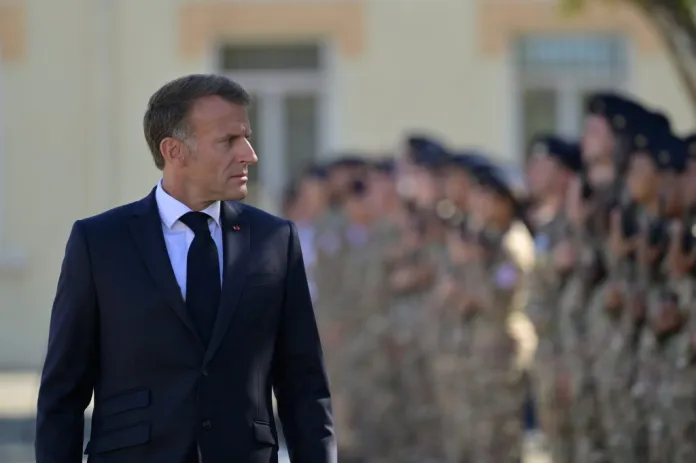
On Friday, France warned that the threat posed by Russia “has intensified” in recent weeks, prompting French President Emmanuel Macron to order his government to formulate a plan that protects critical infrastructure, including sensitive defense and technology sites.
“The intent is to intimidate us and break our effort to support Ukraine,” he said. “The result will be the exact opposite. We are not intimidated because we know that our security today and tomorrow is at stake in Ukraine.”
Macron called for an emergency G7 meeting in the coming weeks to focus on the Russia-Ukraine war and rising energy prices. The G7 member countries are Canada, France, Germany, Italy, Japan, the United Kingdom, and the United States.
“We must remain united in the face of crises,” Macron said.
Switzerland, which has long remained neutral in international military conflicts, also moved to adopt a security policy on Friday that would protect itself from a future Russian attack.
“Russia’s war of aggression against Ukraine, hybrid threats and critical dependencies pose challenges for the state, the economy and society,” the Swiss government said. “With the 2026 Security Policy Strategy, the Federal Council is positioning Switzerland to navigate this environment. The strategic priorities for the coming years are to strengthen resilience, improve capabilities for resistance and protection, and strengthen defence capabilities.”
NATO said there is “no imminent threat” of an attack from Russia at this time, but the intergovernmental military alliance noted it will not “be naive or complacent” and will remain strong in the coming years.
Additionally, Sweden joined Germany in carrying out military exercises near the strategic Swedish island of Gotland in the Baltic Sea. Weeks earlier, NATO allies conducted military exercises near the Russian exclave of Kaliningrad.
Poland also sounded the alarm about Russia, with Polish Prime Minister Donald Tusk warning on Thursday that Moscow could send drones or missiles into NATO countries allied with Ukraine in the coming months. Tusk said Russia wants to use the future attacks to “weaken NATO’s integrity” and convince the group’s members that “Article 5 is more theoretical than practical.”
NATO’s Article 5 states that any armed attack on one member is considered an attack on all 32 member states. Russian hybrid attacks are different from a traditional armed attack, but the alliance could theoretically trigger the collective defense clause in those cases.
“If anyone dares to attack us, they will face a resolute response,” Tusk said on Thursday. “Ours and that of our allies.”
MACRON ORDERS INCREASED DEFENSES AGAINST RUSSIAN SABOTAGE AFTER DRONE AND CYBERATTACKS
Sometime after Tusk’s warning, President Donald Trump announced the United States is moving forward with establishing a U.S. Army base in Poland. The base’s location is expected to be revealed soon, he said.
Trump also announced the U.S. will be establishing a permanent military presence in Greenland, which he has long sought to acquire for what he’s said are national security reasons. While the president didn’t mention Russia, the U.S. agreement with Denmark and Greenland is set to freeze out Russian forces from building a base in Greenland or deploying troops to the Arctic island.