


What does it look like when an ideology that has long insulated itself from criticism suddenly has to defend its premises in public? We may be watching that happen in the WNBA.
For years, critics of transgender ideology have often been dismissed as hateful rather than answered. But slogans become harder to maintain when they collide with an institution whose very existence depends on distinguishing women from men.
The deeper problem is the familiar one: Believing something does not make it so. Reality pushes back.
Enter Enes Kanter Freedom.
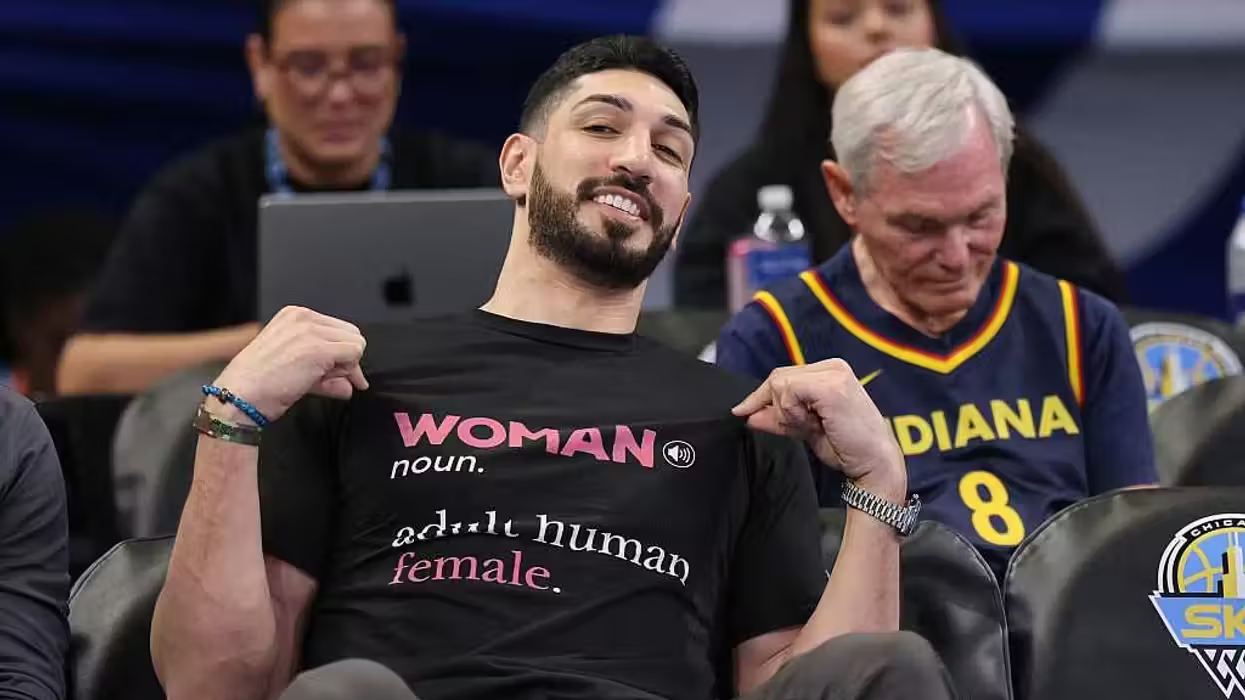
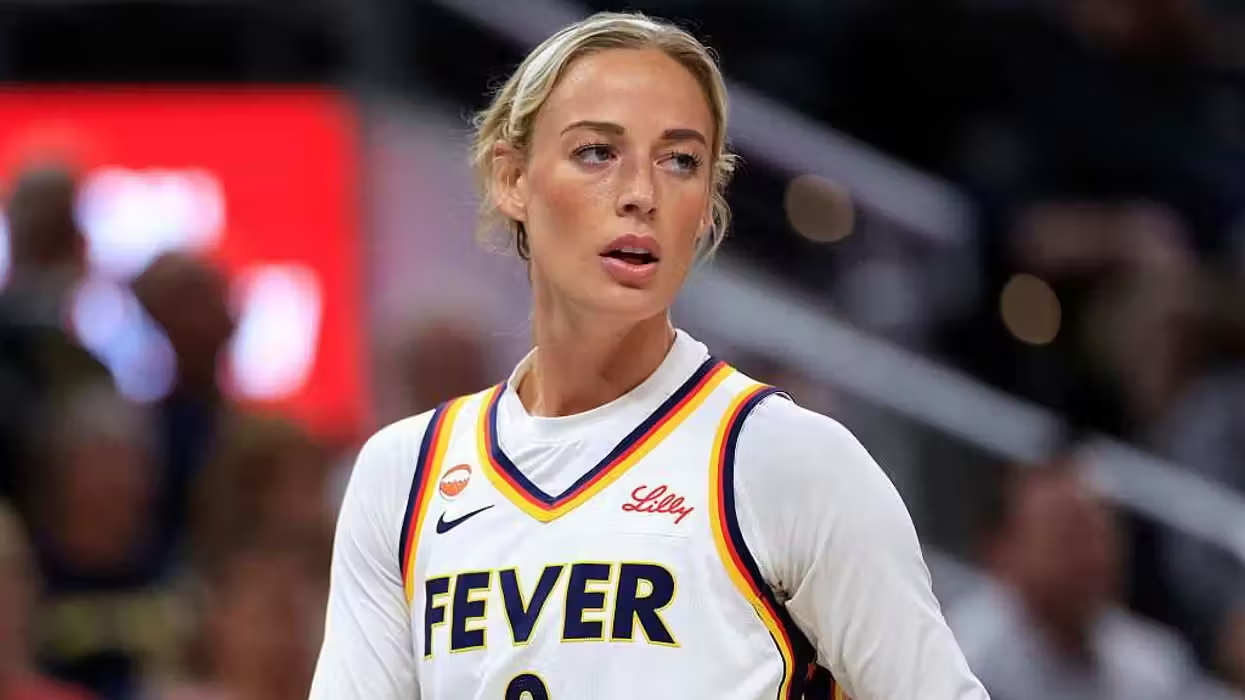
At Sunday’s Chicago Sky-Indiana Fever game, Freedom cheered after Fever guard Sophie Cunningham hit a three-pointer. A couple of possessions later, Sky guard Natasha Cloud yelled toward him, “She’s not going to sleep with you.” According to Freedom, Cloud then cursed at him. Video showed the two exchanging words before Freedom stepped toward the floor and security escorted him from the arena.
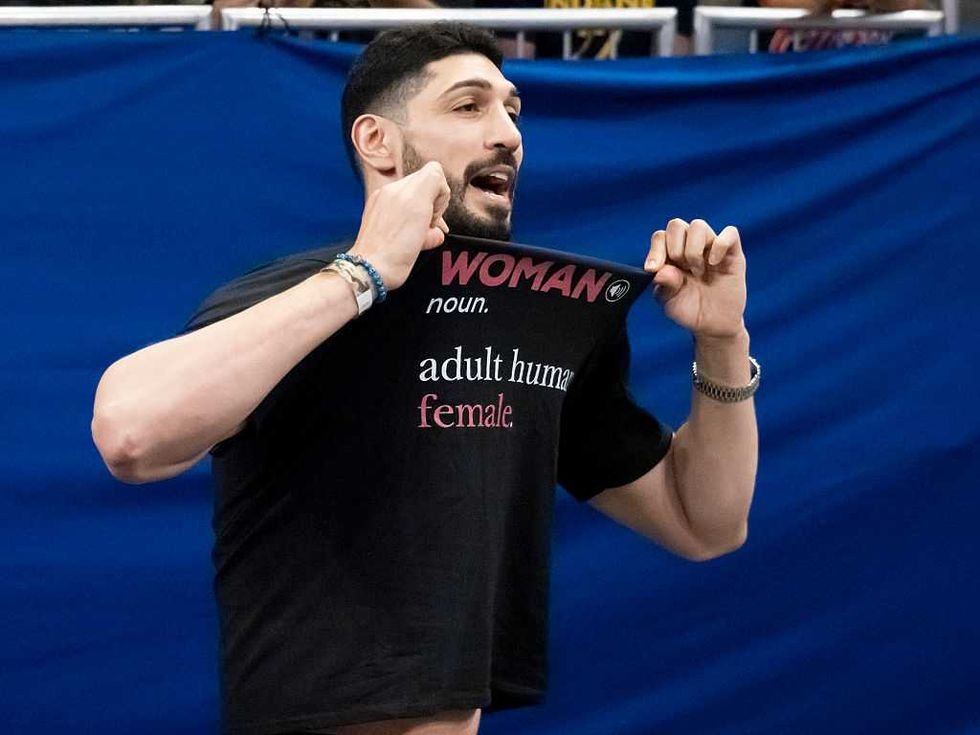
Freedom was wearing a shirt that defined “woman” as “adult human female.” He believes the shirt helped provoke the confrontation. In any case, the incident exposed the contradiction at the center of the debate.
After the game, Cloud posted: “To every trans kid/person, You are apart of MY community & tribe. You belong. You’re loved. You’re seen. You’re perfect as you are. & you will always be protected by me.”
That is a humane sentiment. But protection is not the same thing as agreement, and compassion does not settle the underlying question: What is a woman?
Freedom’s shirt gives the correct biological answer. That answer is not incidental to the WNBA. The “W” exists because female athletes are physically distinct enough from male athletes that women have their own competitive league. Saying so 20 years ago would have been unremarkable.
The modern dispute is not merely about how people dress, live, or describe themselves. It is about whether a person’s stated gender identity can override biological sex in language, law, medicine, and athletics. Critics are frequently told that refusing to affirm such claims causes grave harm. Some activists go further and describe restrictions on transgender policies as “genocidal.”
That rhetorical trick does real work. If disagreement is violence, then argument itself becomes suspect. The critic no longer has to be answered; he can simply be condemned.
But the WNBA makes that escape difficult. A women’s basketball league cannot avoid asking what qualifies someone to play in the women’s league.
RELATED: Former congressman sends warning to WNBA over blocking male player: Get ready for court
That’s why Freedom and former NBA player Royce White have been able to make their point through satire. If self-identification alone determines sex for purposes of women’s athletics, why could a male player not simply declare himself a woman and demand eligibility? The predictable answer is that he would not be sincere. But sincerity is not a biological category, and the objection quietly concedes that some external standard remains essential.
The deeper problem is the familiar one: Believing something does not make it so. Reality pushes back.
If I walk into a bank and announce that I identify as a billionaire, the teller will still check my account balance. My conviction may be sincere. It does not create a billion dollars.
Of course, sex and wealth are not identical categories. The analogy has a narrower purpose: Subjective conviction cannot, by itself, determine every fact about the world.
The cultural argument over sex became combustible because it moved beyond the old libertarian bargain — adults may live as they choose — and began demanding public affirmation, institutional accommodation, and changes to categories built around biological sex.
RELATED: Sophie Cunningham supporters speak out: WNBA is just passing the blame
For Christians, there is an even deeper dispute about what a human being is and whether the body is something received or something the will may redefine. I have argued elsewhere that the conflict ultimately reaches Christian anthropology.
But one need not settle that theological question to see the WNBA’s problem. A league created for women must know what a woman is.
The controversy surrounding Freedom is no mere spectacle. The issue is no longer confined to university seminars or activist language. It has arrived courtside, where a definition printed on a T-shirt can become more controversial than a player shouting at a fan.
Ideologies protected from criticism often appear strongest just before ordinary people begin noticing the absurdities and contradictions. Once the questions can be asked publicly, slogans are no longer enough.
The WNBA is discovering that in real time.