










Seeing Cthulhu in the title of a game will, fairly or not, stack a pile of expectations on top of it as tall as the walls of R’lyeh. The Cosmic Abyss does meet some of them, focusing heavily on not just the physical danger involved in immersing oneself in the mysteries of lost and cursed history, but the mental toll as well. It exceeds some too, placing the well worn fictional mythos in a setting it doesn’t often get fit into. But the limited time I had with the first couple of chapters was soaked with the sinking fear that even though its puzzles and atmosphere were brain tickling, there weren’t enough moments where the consequences of playing with this eldritch fire felt real or dangerous.
Cthul-clue
In the Lord’s Year of 2026, you’re going to have a hard time adapting HP Lovecraft’s cosmic horror mythopoeia in a way that feels fresh, but developers Big Bad Wolf make a good effort. It follows well worn tropes, like putting players in the shoes of a detective chasing more and more bizarre clues down an inter-dimensional rabbit hole. But the near-future setting, in a world that clearly benefits from advanced technology but still remains recognizable to denizens of our real world, spices things up in curious ways. My favorite is its optimistic take on an AI companion named Key that can actually be a general benefit to society, or at the very least towards your investigative efforts to know the unknowable.
Cthulhu: The Cosmic Abyss gives you a million chances to use it in crime scenes, which are dense with dark nooks to shed light on and stones to be turned over. Its key feature, the Vault, takes every clue you find that could be consequential to solving the mystery and puts it in a big board, where you can move them around and draw connections between them, Charlie Day-style. Some of these clues may become a deduction, which asks a question that can be answered by another clue in order to unlock some key breakthrough to help solve your case. These weren’t common, but were always impactful.
The handiest tool in Key’s arsenal is the sonar. After spending energy to scan the chemical makeup of an item or material, you can send a sonar ping out into the wild to find more objects that match that chemical. Pick up a weird rock and think it might have friends? Send a ping! Bloodstained drag marks suddenly and suspiciously end? Send a ping! You can even combine different materials, up to four, to further narrow down a thing you might be looking for, like if you wanted to find a specific sort of metal that is also covered in eldritch mold for some reason. It’s a clever way to help nudge players along who might be stuck, but without completely blowing the answers to some of the more important puzzles along the way.
Key can also be upgraded to give itself bonus abilities, like one where discovering clues has a slim chance to earn back some energy. I wasn’t really moved either way about the offerings available in the two chapters of the demo. When I did take the time to apply these, it never required me to change the way I play, and I spent no time weighing the value between potential opportunity costs of any of my available options. These might be more consequential in the full release, but I found them to be completely ignorable here.
A Policy of Non-Confrontation
Another way The Cosmic Abyss stands out among its peers is that it’s entirely free of combat, relying completely on the investigative and exploration aspects to provide tension and conflict. That’s a pretty bold choice, and puts a lot of faith in the team’s ability to create bad enough vibes that walking into dark rooms can feel like their own sort of boss fight. I’m not sure The Cosmic Abyss crushes this every time, though.
Many of the spaces make great first impressions. In chapter one, you and your partner, Elsa, arrive at the flooded and dilapidated home of a missing agent of your mysterious organization, Ancile. This house is a mess, floor littered with ancient artifacts, archeological relics, notes scribbled with nonsense, and just straight up trash. The rundown walls cast just the right kinds of shadows that make it feel like touching anything might wake the monstrous building itself.
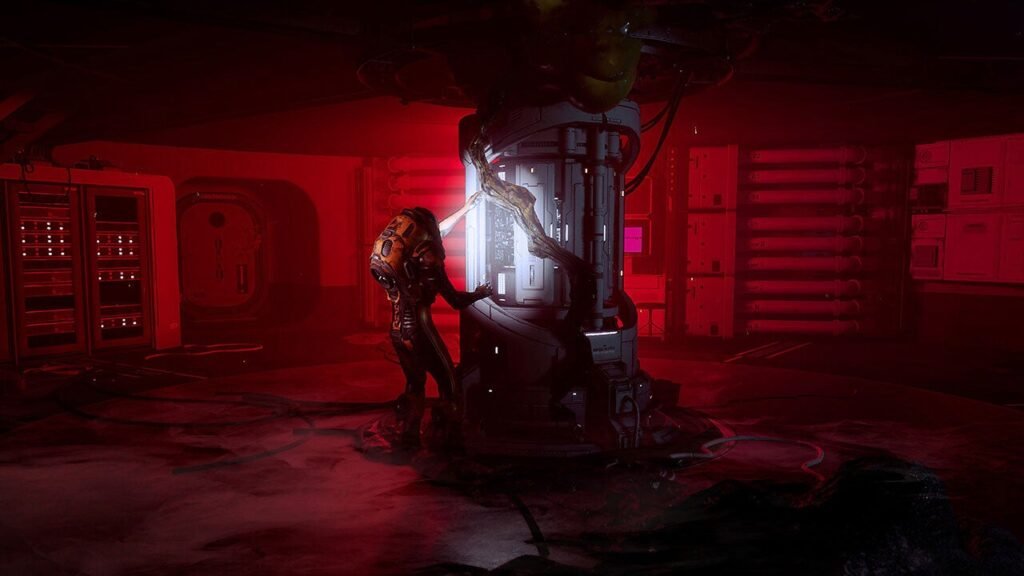
This goes doubly so for chapter two’s undersea mining facility that sprawls like a metal maze of corridors covered in blood and some sort of goop that is somehow more upsetting than blood. Every wing is a new set of uncomfortably disheveled but relatively routine looking things that lead you through a door and into a room where something obviously blasphemous went down.
But it’s really all sizzle that is hot when you’re in the moment but cools quickly. Besides some things falling off of shelves without warning, you’re never actually in danger in the haunted-feeling house of the first chapter. Though the second chapter’s complex heavily implies that there might be a sort of eldritch minotaur trapped in its watery labyrinth, you never get the displeasure of having to directly encounter one. I did a lot of running around and backtracking through the expansive sea base, and besides unlocking doors to get to new rooms, the building itself remained static, not really changing based on my actions or the progression of the plot, which definitely made it feel like I was treading water when trying to solve my way to the next big moment.
The other side of that coin, though, is that a lot of the solutions to the puzzles are hiding in plain sight, with the clever assessment of the clues you encounter and proper use of your tools being all you really need to find answers. It made me feel like a genius when I skipped from point A to point C in a logic path because I came to my own conclusions that let me skip B entirely (or simply got lucky and found a vital piece of a puzzle early). It also made me feel like a real dunce when I would continually miss the solution despite very clear clues that might as well have been neon signs pointing to it. The puzzles themselves aren’t tough, nothing more than just pattern recognition or just good old fashioned problem solving. The Witness, this is not.
Path of Least Resistance
The Cosmic Abyss does create a bit of friction by tempting the players themselves to take shortcuts at the risk of their sanity. Corruption is introduced in chapter two, and wracks your brain anytime you come into contact with some real evil juju, limiting Key’s abilities and possibly having more adverse effects that are unclear in the scope of this demo. The miners under the sea found a mysterious altar, and now they’re all missing. You can follow their footsteps to see how they activated this demonic device, but participating in the same ritual that vanished the people you were down here to find seems like a terrible idea, doesn’t it? Trying to find a relatively safe alternative to that requires taking the deductive reasoning version of the long way seemed the more sensible alternative, which meant me frustratingly spending a lot of time poking every object I could to figure out what I was missing, the lure of just trading my sanity for the quick and easy solution always hanging above me. In this limited demo, taking corruption seemed largely harmless, but as you move from chapter to chapter, carrying the mental scars of your past mistakes with you, I can see how this could hang over you like a long, Cthulhu face tentacle of Damocles.
My biggest fear for Cthulhu: The Cosmic Abyss was assuaged pretty early – this game does a great job setting Lovecraft’s well-worn mythos in a time and place that feels unique among its many, many contemporaries. It also leans into problem solving in a way maybe other games like it don’t, focusing more on the finding out parts of diligent detective work than the effing around parts of attempting to gun fight a bog monster. And though the puzzles you’ll encounter throughout tend to balance feeling rewarding to solve while being approachable, the tense and slow-burning pace is great for the process of discovery but doesn’t pay off the patience with many scares or really any pushback at all from anything that isn’t a puzzle. That said, I’ve only seen the tip of what it has to offer, so it’s hard to speak to how these elements evolve as you get closer to the real deal monsters, and how systems like Key’s upgrades and clever Sonar expand without playing more, which we will all have the chance to do when Cthulhu: The Cosmic Abyss releases on April 16th.