



Arizona’s rarest orchid, when not in bloom, resembles a blade of grass. It vanishes easily in the lush greenery of the Canelo Hills Cienega Preserve — even to the eyes of the botanists who plant it.
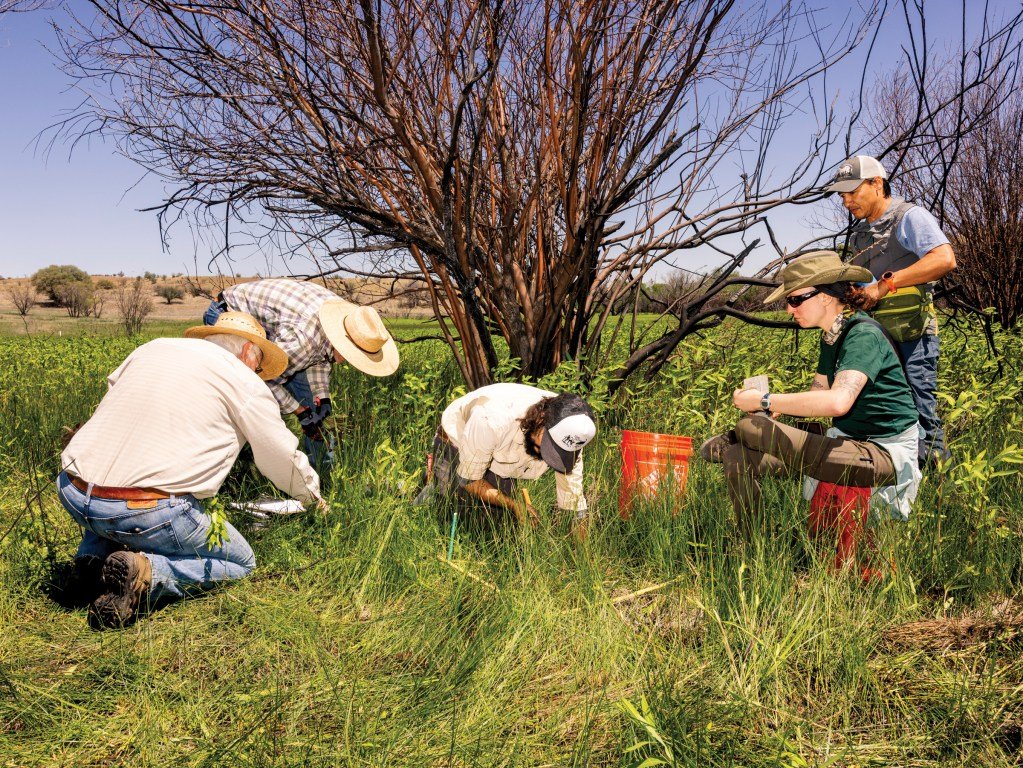
On a mild April morning, after a decade of preparation, a group of scientists gathered at a desert wetland cradled in southern Arizona’s hills to reintroduce a federally endangered orchid. Aside from the researchers’ chatter, the only sounds were water trickling from a spring and boots squelching through mud.
Steve Blackwell, conservation biologist at the Desert Botanical Garden (DBG), ventured into the wetland, using tussocks of grass as stepping-stones. He wanted to see if a small test plot of orchids planted months before had survived. He returned at a run, fists pumping the air. “I found one!”
The rest of the team, made up of orchid experts from DBG and the North American Orchid Conservation Center (NAOCC), followed him to a soil moisture sensor stuck into the boggy ground. He pulled aside sedges and grasses to reveal a thin, grass-like leaf.
“We did it, guys,” NAOCC technician Hope Brooks said.
“Now we just gotta do 360 more,” Blackwell replied.

“DESERT WETLAND” sounds like a contradiction. Known regionally as ciénegas, they’re pockets of green in an arid landscape, fed by freshwater springs. They’re among the rarest habitats in the Southwestern United States, making up just a tiny fraction of the landscape but home to a vast array of species.
The Canelo Hills ladies’-tresses, one of the most endangered orchids in the United States, contributes to that diversity. But only a few hundred remain in the wild, and none had been seen at the Canelo Hills Cienega Preserve, where the species was first documented in a scientific publication, since the early 2000s.
In 2020, the U.S. Fish and Wildlife Service asked DBG botanists whether they could grow the orchid from seed. “I’m like, ‘Yeah, sure I can,’” Blackwell said, chuckling at his own confidence. “I love getting these problems that are difficult and then trying to work through them.”
Ciénegas are among the rarest habitats in the Southwestern U.S., making up just a tiny fraction of the landscape but home to a vast array of species.
The first challenge was locating the remaining wild orchids; there were only two known populations, both in southern Arizona. Canelo Hills ladies’-tresses bloom in late summer, sending up a stalk spiraled with white flowers. The rest of the year, they’re essentially invisible. The team had to recruit two specially trained “ecology detection” dogs to sniff them out.
The seeds are minuscule, optimized for wind dispersal. “They’re like dust,” said ecologist Melissa McCormick, who directs NAOCC. “They don’t have nutrients in them to support the developing seeds.” Instead, baby orchids draw their nourishment from a particular type of mycorrhizal fungus.
Enter the second challenge: cultivating the right fungus in a laboratory. Researchers at NAOCC, a program of the Smithsonian Environmental Research Center in Maryland, led this task. They scrubbed orchid roots with toothbrushes and shaved off tiny pieces under a microscope. “All the little balls of fungus pop out,” McCormick said, enabling researchers to cultivate them in petri dishes. The ladies’-tresses, grown in glass flasks, can germinate with a substitute supply of nutrients, but they sprout much faster with a dab of lab-grown fungus.
The scientists also checked for the presence of Sonoran bumblebees at the Canelo Hills to ensure the orchids would have a pollinator, and they conducted a prescribed burn to push back trees encroaching on the wetland. All these pieces had to come together to give the reintroduction a chance. But McCormick rejected orchids’ fragile reputation: “They can grow in really tough conditions.”


INCLUDING, apparently, underwater. The team was surprised to find one of the test orchids fully submerged and still green. Fine silt clouded the water as the researchers rooted around, feeling for the metal tags that marked the planting locations.
Ultimately, the scientists located seven of the 20 orchids in the test plot; the others may have died, gone dormant or simply remained hidden. Reassured, the team set to work planting hundreds more, enough to test different restoration techniques. The first question: Can orchids thrive if they go straight from flask to ground, or do they need to spend some time potted in soil first?
Another variable is the fungus, which occurs naturally in some parts of the ciénega. This first batch of orchids was grown without the aid of the laboratory-cultivated fungus, which the plants need in the soil. The researchers placed fungus-inoculated cotton balls in the planting holes with some of the orchids. Others got cotton balls without fungus or nothing at all, to see whether the orchids grow better with a fungal boost. And they planted some orchids in a part of the wetland where tests didn’t turn up the right fungus in the ground. Would the fungus-spiked cotton balls open up new habitat for ladies’-tresses?
DBG conservation researcher Luis Romero lifted the first orchid out of its pot, brushed dirt from its roots, and put it on a scale. It was too light to register, so he counted the plant’s leaves and roots instead as a baseline to measure its growth later on. Brooks recorded the data while Romero improvised a pair of forceps out of charcuterie skewers and poked a cotton ball into the mud. The orchid sprout followed, and a peaty, plant-rot smell rose from the disturbed earth. It was the first of 15 orchids planted in a half-meter-by-half-meter square, all part of one experimental treatment.
In July, the team will return to check the results. Blackwell, half-jokingly, said he dreamed of returning to “a field of just white flowers.” But Romero said he will consider the project a success even if only a few orchids survive. At this early stage, both failures and successes provide lessons for future attempts. He aims to develop a blueprint for orchid reintroduction: a protocol that can be adopted by other institutions.
Julie Stromberg, an Arizona plant ecologist who wasn’t involved with the reintroduction project, echoed Romero’s emphasis on good experimental design. That way, even if a project’s orchids don’t survive, she said, “at least you’re going to learn something about what’s driving the system and why it’s failing.”
Ciénegas face many threats, including climate change, drought, groundwater pumping, diversions of spring water, overgrazing and fire suppression. Trees have overtaken many places, consuming water that used to sustain wetland flora. Human developments, such as roads and culverts, also take a toll. “A lot of these ciénegas, as a whole, have blinked out,” Stromberg said.
Because ciénegas are so isolated, they’re all different. Each holds a unique mix of rare species. “When you lose one ciénega, you’re losing something that really can’t be replaced,” she said.

TRACING THE causes of a ciénega’s decline is part science, part detective work. Upstream from the orchid-planting site, DBG botanist Andrew Salywon pointed out a roughly 10-foot-deep drop in a creek bed. It was a headcut, a site of dramatic erosion that would continue to carve its way upstream, deepening the creek as it goes. In a healthy wetland, water slows down and spreads out. A deep channel has the opposite effect.
“Historically, this probably was all wetland vegetation,” Salywon said, gesturing at the tree stumps on the streambanks. Now, it’s an example of a dying ciénega.
Headcutting happens in natural cycles but is worsened by extreme rainfall, which is becoming more frequent in a climate-changed world. It may also be a sign of the preserve’s ranchland history: Long-abandoned culverts and berms still capture and channelize water, which can cause headcuts and other erosion.
“When you lose one ciénega, you’re losing something that really can’t be replaced.”
Years ago, while surveying for orchids, Salywon noticed the 10-foot headcut and decided to try to save this ciénega. Restoring fire, removing trees and remediating earthworks are all part of that rescue effort. But Salywon acknowledged this damaged area may never recover enough to support ladies’-tresses — at least, not in his lifetime. Restoration, he said, “can take a long time, but you just need to start the healing.”
The new orchids, if they survive, will help cushion shocks to existing populations. They are currently the only ones known to be living on protected land; the Canelo Hills preserve was purchased by The Nature Conservancy in 1969 and is now closed to the public.
The researchers hope one day to expand the project to surrounding ranchland. Light grazing, like fire, may benefit these orchids by knocking back competing vegetation.
Curt Bernal, owner of the neighboring Z Triangle Ranch, said he welcomes opportunities to aid the restoration effort. For any rare plant, he said, “it’s incumbent upon us humans to do what it takes to make sure they continue to exist long after we’re gone.”

We welcome reader letters. Email High Country News at editor@hcn.org or submit a letter to the editor. See our letters to the editor policy.
This article appeared in the July 2026 print edition of the magazine with the headline “An endangered desert orchid comes home.”