



This story was produced in collaboration with Bay Nature, a nonprofit news organization that connects the people of the San Francisco Bay Area more deeply with the natural world. Visit Bay Nature to read “Price-Tagging Nature,” Mark Schapiro’s in-depth look at the compensatory mitigation industry.
Lookout Slough, a 3,400-acre wetland on the edge of the Sacramento-San Joaquin Delta in central California, is ringed with aquatic plants, pulsing with tides from San Francisco Bay, and home to dozens of species of fish, amphibians, reptiles and birds. Until two years ago, it was parched former farmland, cut off from the Sacramento River’s floodplain by a 26-foot-tall levee.
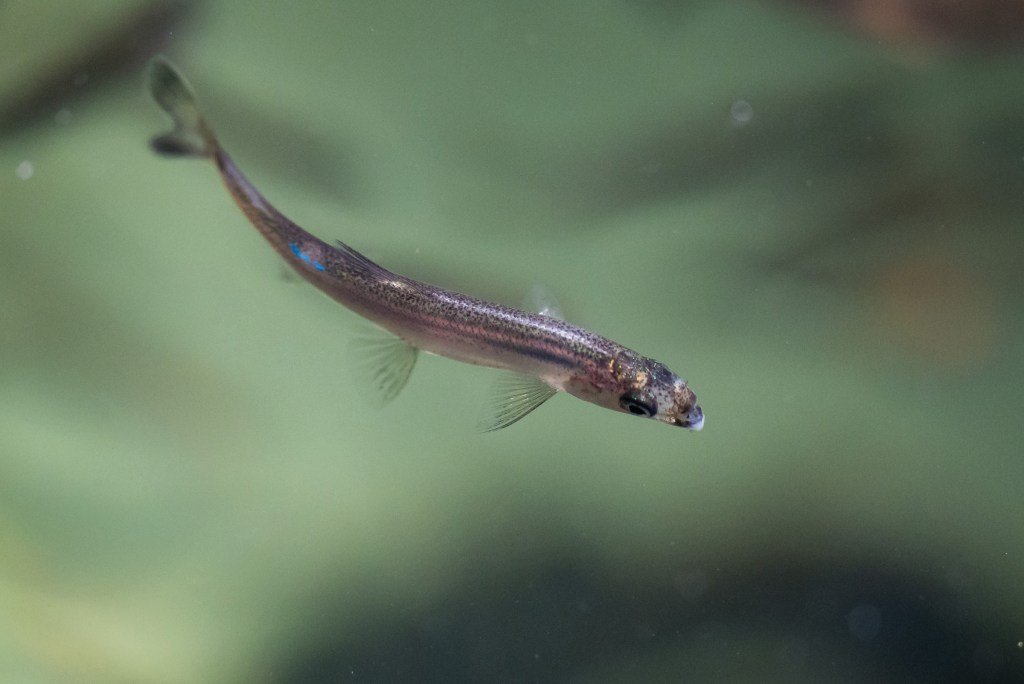
This transformation, the delta’s largest tidal restoration project, was prompted by the decline of the Delta smelt, a fish barely as long as an index finger. Adapted to the delta’s brackish tides over thousands of years, the smelt is considered a strong indicator of ecological health. No smelt means there’s not enough phytoplankton or zooplankton in the water to sustain the species, and therefore less food for birds and larger fish.
Charlotte Biggs, program manager for the California Department of Water Resources (DWR), compared the smelt’s role in the delta’s wetlands to the blood tests that tell humans about “bigger things that may be going on in your body.” The question now is whether restoring wetlands like Lookout Slough can revive the Delta smelt.
THE SACRAMENTO DELTA was — and remains — one of the most fertile places in California, thanks to the mix of saltwater from the San Francisco Bay and freshwater pouring in from the Sacramento and San Joaquin rivers to the north and east. Thousands of years before European settlement, numerous Indigenous groups — including Miwok, Maidu and Yokut communities — fished and cultivated food along the region’s riverbanks and waterways.
In the 20th century, the state and federal governments saw the delta’s water as key to the growth of California’s cities and large-scale agriculture. Levees were installed across it to tame the rivers, reduce flooding, and make orchards and tomato fields possible. By 1969, seven massive impeller pumps from the California State Water Project had begun diverting the water, sending it up a 244-foot hill outside the city of Tracy and through aqueducts to the farms of the Central Valley and cities farther south.
The pumping dried up the smelt’s spawning grounds, weakening the tidal flows that provided it with nourishing microorganisms and parching the aquatic plants that sheltered smelt from predators. In the early 2000s, the population plunged, along with the delta’s populations of longfin smelt, striped bass and threadfin shad.

In 2008, some four decades after the Tracy pumps started pumping, the U.S. Fish and Wildlife Service ruled that the diversion of freshwater from the delta posed enough of a threat to fish habitat to require the restoration of 8,000 acres of wetland and stream ecosystems. Thus began the state’s 18-year quest to mitigate the impacts of its own water diversions.
Over the following decade, DWR identified and began working on 10 restoration sites in the delta that covered a total of about 5,000 acres. Each involved dismantling one or more of the levees that had long separated the land from the water. But with another 3,000 acres still to go, the state realized it could not complete the project on its own. It was time to bring in the biodiversity brokers.
Under federal and many state laws, private and public developers are required to “mitigate” their projects’ impacts on certain waterways and vulnerable species by paying to restore similar habitat elsewhere. Many buy mitigation credits from private companies that specialize in restoring landscapes. This practice, known as mitigation banking, began in the 1980s and has grown dramatically over the past two decades; it’s now a multibillion-dollar industry.
In 2018, the state of California issued a request for proposals to restore that final 3,000 acres of riparian habitat. Adam Davis, co-founder and managing director of Ecosystem Investment Partners (EIP), responded. His company, one of the largest to specialize in mitigation banking, bought the 3,400 acres of what’s now Lookout Slough, aiming to restore it in exchange for credits it could sell.
EIP struck a deal with the state in 2018 and broke ground on the site in June 2022. About a year later, I took a drive with Davis atop the levee that circled the slough. Below us, bulldozers, scrapers and dump trucks churned through the soon-to-be inundated property. “People forget,” he told me, “that underneath all the ecology — the fish, the migration corridors, the places where birds need to land — underneath all that is land that people own.” Mitigation banking, he said, leverages private ownership for conservation, creating financial incentives to slow the rate of extinction and land degradation.
“People forget that underneath all the ecology — the fish, the migration corridors, the places where birds need to land — underneath all that is land that people own.”
To prepare the land to receive the water, EIP and its contractors had to carve nooks and crannies that would slow river and tidal flows and create spawning habitat for fish and amphibians. Over two years, they etched 26 miles of channels across the 3,400 acres of Lookout Slough and moved 30,000 dump truck loads of dirt. EIP received 2,975 mitigation credits, for which the state paid $32,605 each — a total of almost $97 million.
In September 2024, I returned to watch the levees come down. As a bulldozer took huge bites out of the earthen levee, water gushed across the landscape. Eighteen months later, I found a latticework of water channels and half-submerged islands. A couple of teenagers were fishing from the banks; two pelicans wheeled overhead, and a group of geese paddled near one of the distant, low-lying islands. As yet, however, DWR has not reported Delta smelt in the slough.
The restoration of Lookout Slough and other delta landscapes may have come too late for the fish, whose population has declined by 99% since it was first listed as federally threatened by the Fish and Wildlife Service in 1993. Despite multiple releases of hatchery-raised smelt in recent years, weekly surveys of delta waterways by the Fish and Wildlife Service typically report smelt numbers in the single digits.
“The smelt used to be among the most common fish species in the delta,” said Jon Rosenfield, a fish biologist and science director of San Francisco Baykeeper, an environmental advocacy group. “Now, it’s almost impossible to find them.” The restoration effort, he said, is admirable but inadequate: “It’s like building a very nice playground in a neighborhood you’ve allowed to burn down.”
But Dan Riordan, section manager for tidal habitat restoration at DWR, said the state has documented phytoplankton and zooplankton — signs of promising smelt habitat — in the slough. Those findings will be included in a report scheduled for release in September.
More than 50 years after the impellers in Tracy began pumping out the delta’s water, the Delta smelt has compelled a return of water to the land. If the restored wetlands continue to recover, they may provide lasting habitat for a multitude of species. The smelt may yet be among them.

This story is part of High Country News’ Conservation Beyond Boundaries project, which is supported by the BAND Foundation and the Mighty Arrow Family Foundation.
We welcome reader letters. Email High Country News at editor@hcn.org or submit a letter to the editor. See our letters to the editor policy.
This article appeared in the July 2026 print edition of the magazine with the headline “Can restoration save the Delta smelt?”