





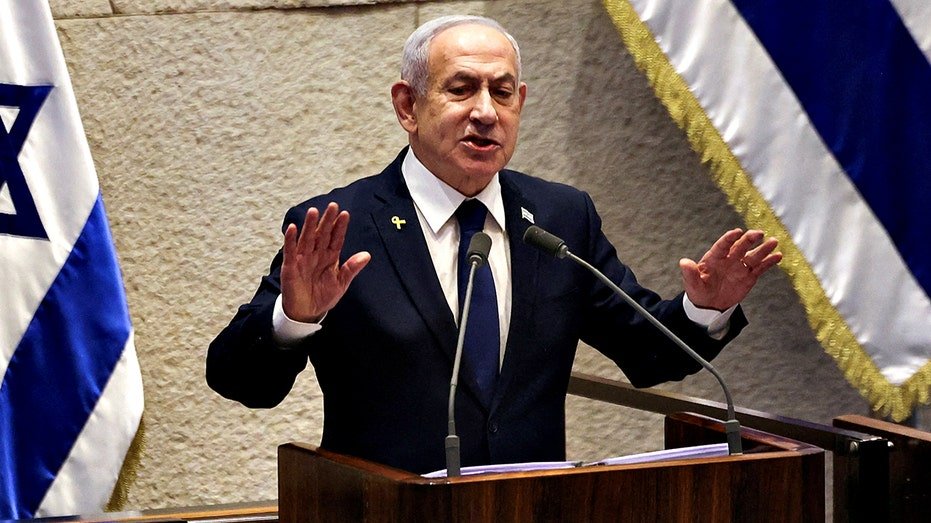
TEL AVIV, Israel: As Israel prepares to hold national elections on Oct. 27 for the first time since Hamas’s Oct. 7, 2023, massacre and the ensuing wars, Benjamin Netanyahu’s long political career and legacy are once again at the center of a vote some describe as the most fateful in the country’s history.
Israel’s longest-serving prime minister, Netanyahu, has overseen the country’s transformation into a free-market, high-tech economy and a regional military powerhouse.
Zvika Klein, editor-in-chief of The Jerusalem Post, told Fox News Digital that people under 20 “don’t even know an Israel without him being prime minister,” aside from the brief period from 2021 to 2022 when a government led by Naftali Bennett and Yair Lapid was in power for over a year. The two are running again on a joint slate in the upcoming elections.
FLYDUBAI PILOT STABS FELLOW PILOT, ATTEMPTS TO CRASH PLANE, NETANYAHU SAYS
Gadi Taub, co-host of Tablet’s “Israel Update” podcast, said Israeli voters will have one central question in mind when they cast their ballots: who is best positioned to continue the work begun under Netanyahu, foremost prosecuting the wars that have, to a large extent, dismantled the Iranian-led Shiite axis surrounding Israel.
“The job is not finished. On the one hand, you have Netanyahu, who from the first moment, two days after Oct. 7, said that we are going to change the Middle East,” he said.
Eylon Levy, a former spokesman for the State of Israel, told Fox News Digital the election represents, for many Israelis, a critical opportunity to change course following what he described as the country’s biggest disaster. Benjamin Netanyahu, who has cumulatively served some two decades in office, is fighting for both his political future and his legacy.
“He doesn’t want to go down in history books as the man on whose watch the Oct. 7 massacre happened; he wants to have a long political career ahead of him and take the really incredible military achievements of the last few years as a credit to his leadership,” he said.
NETANYAHU REVEALS HE WANTS AMERICAN FINANCIAL SUPPORT FOR ISRAEL TO ‘DRAW DOWN TO ZERO’
“This is an election with a lot of anger about responsibility for the Oct. 7 massacre and about the social and economic cost of sustaining the war since,” Levy stated.
Few polls are projecting a majority for either the current government or the opposition bloc led by former army chief Gadi Eisenkot. The most likely outcome of the upcoming elections, Levy said, would be some form of deadlock, in which case Netanyahu would continue serving as caretaker prime minister until a new government is sworn in. Israel held five elections between 2019 and 2022, amid prolonged political instability.
Unlike the United States, Israel operates under a parliamentary system, with voters casting ballots for parties to represent them in the Knesset. The legislature has 120 seats and uses a system of proportional representation, with each party receiving seats based on the percentage of the vote it garners. The electoral threshold for parties to enter the Knesset is around 3.25%.
No party has ever won more than half of the vote. As a result, after each election, leaders of the larger parties seek to persuade smaller parties to join them in forming a governing coalition.
“If one can get 61 of the members of Knesset, basically half plus one, to support them as prime minister, then they become prime minister and their teammates from the other parties join as government ministers,” said Levy, who hosts Israeli Channel 16’s flagship international magazine program, “From Here to There” and its election podcast “EYLON:Israel Electioncast.”
Klein said this is the first time in several decades that an Israeli government has completed its full term.
“There is a group called ‘Rak Lo Bibi,’ translated as ‘anyone but Bibi,’ and that’s the opposition groups, which includes Eisenkot’s party Yashar, BeYachad, headed by Naftali Bennett [and] Yair Lapid, and Avigdor Liberman’s Yisrael Beiteinu, all [of whom] have worked with Netanyahu in the past in different capacities,” Klein said.
The loose alliance also includes The Democrats, which Klein described as the most left-wing party in the so-called “change” alliance.
NETANYAHU REJECTS BOARD OF PEACE’S GAZA PLAN: NO ‘WITHDRAWAL UNTIL HAMAS IS GENUINELY DISARMED’
The conservative commentator Taub said, “When you look at the candidates on the left, one after the other, they wanted to stop the war very early already in Gaza. Gadi Eisenkot, the leading contender on the left, wanted to finish the war after the pager operation, where he said we should cut a deal with Hezbollah. Netanyahu kept saying total victory,” he added.
The vulnerability on the right, Taub said, is that victory has not been total.
“We have an existential danger. That danger is Iran, with the support of Russia and China, rehabilitating its nuclear program, which we can’t let happen. It is not all up to us; there is the U.S. dealing directly with this, but this is going to be the decisive issue,” Taub concluded.
Fox News’ Sydney Finver contributed to this report.