






Backrooms is the directorial debut from Kane Parsons, also known as Kane Pixels, extending the lore and concepts established in his Backrooms YouTube series.
The film specifically follows Clark (Chiwetel Ejiofor), an aspiring architect who currently runs a furniture store. He has begun working with a therapist, Mary Kline (Renate Reinsve), on his challenges with human connection. Many of their sessions focus on the impact of his wife’s decision to leave him. As Clark continues to spend all of his time in the furniture store, he becomes attuned to some weird occurrences. He eventually discovers a section of wall that can be passed through, bringing you into a series of unsettling liminal spaces.
Backrooms Ending: One Last Therapy Session
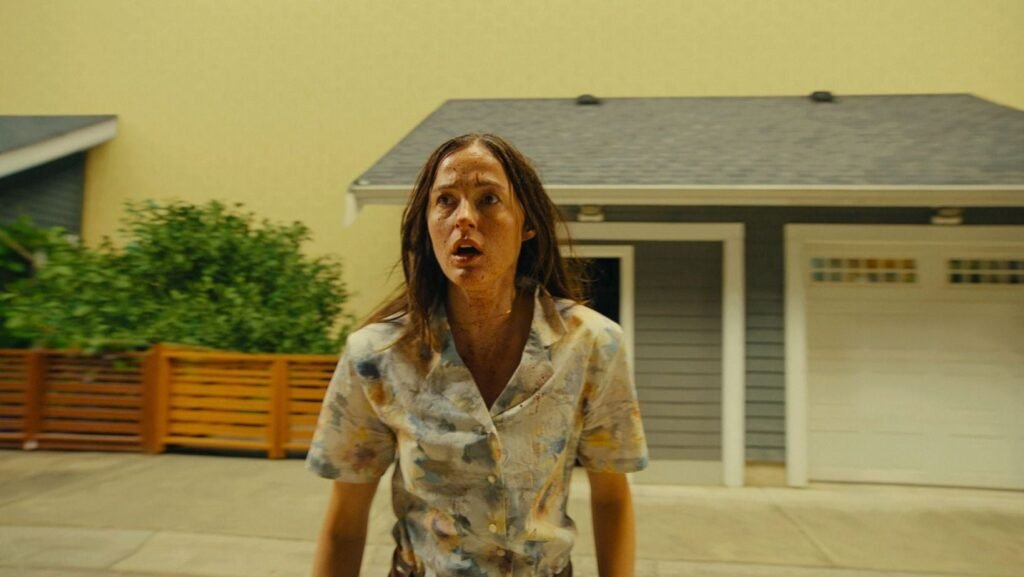
The final sequence of the film really kicks off when Mary Kline decides to look for her missing patient. Her search brings her to the Backrooms through the null zone Clark had marked off in his furniture store. Mary encounters some familiar and some entirely new liminal spaces, until she eventually finds Clark himself. He promptly knocks her out, and when she awakens, she’s tied to a chair at a disturbing dinner table.
Overdue notices under the furniture store’s door indicate some time has passed since Clark and his employees were first trapped in the Backrooms, but some lore outside of the film itself also indicates that time passes differently in these spaces. Either way, Clark has been here for some time, establishing a somewhat new life for himself that he ultimately confesses to enjoying.
In the dinner table room, we finally get our first clear look at some of the “creatures” that have been glimpsed over the course of the movie. Clark has established the theory that, much like the rooms are remembrances of real places, these are real people being “remembered” in the Backrooms. One distorted woman is suggested to be a version of his ex-wife.
These “Still Lifes” are somewhat distinct from the creatures already shown in Parsons’ Found Footage videos, like the Bacteria Man many were expecting to appear in the movie. In my opinion, it’s possible for both “forms” to exist under the same world logic. Perhaps the Bacteria Man is just a particularly distorted iteration of what was once a remembered man.
Regardless, Clark is disturbingly content showing off his ability to stab and even eat them without the Still Lifes offering any apparent reactions. It seems some of his enjoyment in existing in the Backrooms stems from not being alone, or more specifically, being surrounded by life forms that have no true will to leave him. He opens the fridge to grab a surprisingly accurate beer, while also revealing the decapitated head of his employee, Kat.
When Mary questions why she’s been brought here, Clark compels her to once again “re-enact” the night his wife left him. Mary eventually states her true analysis: Clark refuses to take any responsibility for himself. However, Mary also tells him what he wants to hear: that he doesn’t have to change, and might not ever be able to.
Just when Clark has softened to the idea of freeing Mary, a new Still Life approaches, terrifying the remembered version of Clark’s ex-wife. This is revealed to be Captain Clark, the remembered version of Clark as informed by his persona in the furniture store. “Real” Clark tells the Still Life that Mary has said they don’t have to change, and begins to offer one of the first apologies we’ve seen from him over the course of the film. Captain Clark responds by eating the original version of himself alive. I’ll leave the metaphors of this self-destruction up to you.
This is the last we see of the real Clark. Unlike other characters, such as his employees Kat and Bobby, we never see a missing poster for Clark – a final statement of the extent to which he had isolated himself from the world.
An Encounter With Async
Mary manages to escape from the dining room table space, but is being chased by Captain Clark. She makes it all the way to a version of the furniture store’s interior, briefly thinking she found her way back to the real world. She then realizes, however, that this is yet another “remembered” space in the Backrooms, and Captain Clark has found her once again. She manages to incapacitate him by breaking his peg leg and smashing his face with the concrete block she’s carried with her since childhood. Then they are gassed, but not before Mary manages to catch a glimpse of the men in hazmat suits we saw briefly in the film’s opening scene.
When Mary awakens, she has been cleaned of blood and is being guided through the Async Research Institute. We witness the researchers taking scans of Captain Clark. Mary is brought to what appears to be almost like an interrogation room, where she is eventually joined by a researcher who introduces himself as Phil. He poses a relatively simple question: “How did you get here?” There’s some room for interpretation on whether “here” is referencing the Backrooms or the lab – or if they’re one and the same. The focus on the blue sky behind windows seems to indicate we are back in the real world, but there’s not exactly proof of it.
After some pushing from Mary, Phil acknowledges that his job as part of Async is exploring the Backrooms. We’ve seen Phil briefly over the course of the movie in his own environments, like watching Clark’s furniture store commercial with his family, indicating that, if he has truly spent time in the Backrooms, he’s also capable of leaving them.
The dynamic here, on some level, mirrors the therapy session that the film opens with.
When Mary asks what will happen to her, Phil says that that is a decision outside of his control. In the meantime, he just wants them to talk, casually, to try to learn “even a little bit more” about the Backrooms. In his words, this research has become the most important thing in the world.
What he does offer a hint into is that Async was, at one point, an MRI company. While he suggests they may have just “come across” the Backrooms in a way similar to Clark, it would be correct to think twice about that suggestion. Kane Parsons’ own Backrooms series establishes Async as a company that does not stumble across the Backrooms, but in an experiment pursuing an “infinite space,” created them. The specific element of MRIs is yet another connection to the idea of “mapping memory.”
I would take that understanding of Async’s direct role in the Backrooms with a slight grain of salt, as much of what this movie seems to be doing is reinventing the original Backrooms lore as much as adding on to it. Kane Parsons has said that he’s long had an “ending” in mind for the lore, and with Backrooms 2 already confirmed, there’s a strong chance we see more clarification about this version of Async in the future.
What Happens to Mary?
We don’t know for certain what happens to Mary in the real world. Existing Backrooms lore establishes that Async is rather brutal when it comes to protecting their space and its secrets, suggesting it’s less than likely that she’s allowed to leave.
What we have learned is that Mary has her own challenged relationship with memory and space. Her mentally ill mother had kept her trapped inside a small house as a child, refusing to even let her open the window, up until the moment a company began a demolition on their home. While there’s certainly room to interpret the Backrooms as a physical manifestation of her trauma and/or Clark’s troubled mind, I personally saw the spaces as a looser interpretation of memory overall. The Backrooms remember everything, but in distorted ways, folding into loops while also expanding into infinite space.
There’s not entirely a firm resolution to the film then, but that doesn’t ever seem to be Parsons’ intention. None of the Found Footage videos ever truly offered a clear or concrete ‘conclusion,’ and are more than anything about evoking an emotional response. Whether that lends itself to an effective full-length movie is for you to decide.
What is for sure, as confirmed by the film’s final scene, is that regardless of what has happened to Mary in the real world, she is already being remembered by the rooms. We are left with the harrowing image of her own Still Life, distorted and, much like the real Mary and Clark, all alone.
Blythe (she/her) is an Audience Development Coordinator at IGN who spends way too much time in character customization screens and tracking down collectibles.