




Daniel McHugh is sick of killing bears.
Tall, bearded and blunt, with hair the color of ocher, McHugh — a bear management specialist with Montana Fish, Wildlife and Parks — got into bear biology to study and be close to the animals, not to put them down. But in a late August community meeting, he was standing in front of a packed room in the Red Lodge Senior Center, frustrated with how the year had been going.
The state game agency had killed six bears, two of them grizzlies, in the less-than-3-square-mile Montana city as of the late August meeting.
“There’s a problem,” McHugh said. “There’s something going on.”
McHugh and his colleagues had responded to more than 200 reports of conflict within 15 miles of Red Lodge since the bruins emerged from their dens last spring, most of them involving more serious infractions than bears getting into trash.
This year, bears have been causing more trouble than usual across the Rockies. A dry winter — followed by a late freeze in Montana — has left the animals short on natural foods like chokecherries, huckleberries and whitebark pine nuts. So now, as they load up on calories for winter, they’ve become increasingly desperate, venturing closer to people and aggressively dining on human garbage, compost and, in some cases, the contents of people’s pantries. Across much of bear country, there’s an old saying: “A fed bear is a dead bear.”
And this year, wildlife managers across the West have killed a lot of them.
In Colorado, by the end of August, nearly 300 bears had been killed for getting into trouble with humans and property. Wyoming is experiencing an “unprecedented” rate of conflict, and things aren’t much better in Utah, New Mexico or Idaho. Red Lodge, however, is having a uniquely difficult time.
The spate of ursine conflict has sparked heated public meetings and finger-pointing in this rural gateway community to Yellowstone National Park. Red Lodge residents have long had competing ideas about how best to live with and manage bears. While some locals feel the community should be more tolerant, burned-out bear managers like McHugh suspect that people are intentionally making choices that put both humans and bears at risk. These decisions, he said, force officials like him to pull the trigger.
McHugh put it frankly at the meeting. “The community loads the gun,” he said. “When you’re mad at us for killing the bears, we all have a hand in it. They’re all of our bears. We all own them, and we all own the responsibility of what happens in our communities.”
“When you’re mad at us for killing the bears, we all have a hand in it.”
ROUGHLY 140 PEOPLE attended the meeting, a remarkable turnout for a city of 2,500 less than 40 miles northeast of the Yellowstone boundary. Several Montana Fish, Wildlife and Parks employees, local law enforcement and even the mayor were in the crowd.
“Normally, when Fish, Wildlife and Parks has a meeting, we outnumber the attendees,” state wildlife biologist Shawn Stewart said.
Stewart, who has worked for the Montana wildlife management agency for more than 50 years, told the crowd about one of the last times bear conflicts were this bad in the Treasure State. It was 1986, and, like this year, whitebark pine and chokecherries weren’t producing enough for bears. There were 10 or 15 black bears in town every night, raiding the city’s alleys. State officials killed some of the hell-raising bruins in town. Other bears were hunted; more starved to death. “That year, we lost 30% of our black bear population in the Beartooths,” Stewart said, referring to the rugged mountain range that straddles the Montana-Wyoming border.

Then as now, Red Lodge faced some of the same problems plaguing towns across Western bear country. People didn’t secure their trash cans; bears got into birdseed and dog food and sometimes into cars and homes. But bear behavior has changed during Stewart’s time here, and that’s the shift that worries him most.
A few days before the meeting, a black bear followed a woman walking near the local middle school. A passing driver noticed the bear speeding up as it approached her and swerved to get between the woman and the bear. When the walker hopped inside the vehicle, the bear put its paws on the car, clacking its jaws. It was an eerily close call, but not entirely unheard of; Fish, Wildlife and Parks biologists said Red Lodge bears were walking city streets in broad daylight, showing little wariness of human beings.
“We’ve never had bears approaching people,” Stewart said. “We’ve never had bears stalking. We’ve never had bears chasing people. We’ve seen all those behaviors escalate alarmingly.”
But what is causing the change?
“People are intentionally feeding these bears,” Matt Heaton, a game warden, said.
The audience gave a loud collective gasp.
“They’re contributing to the death of those animals, and they are going to contribute to the death of people.”
MCHUGH HAS ALWAYS BEEN FOND of the outdoors. He fell in love with bears on a childhood trip to the Cabinet-Yaak in northwest Montana, when his father showed him a bear den in a massive, hollowed-out tree.
“It was this weird mixture of fear and awe and just the most beautiful feeling,” he said. “It’s something we have a hard time capturing in our lives now.”

He was hooked. In 2021, he started working as a state grizzly bear technician on the Rocky Mountain Front, a roughly 150-mile stretch of Montana east of the Continental Divide and south of Glacier National Park. There, where the Rockies rise dramatically out of the Great Plains, grizzlies were making a comeback and many locals were fearful, despite relatively few bear-human conflicts in the sparsely populated area. But then, in 2023, McHugh came to Red Lodge, where he found residents with an unusually high tolerance for bears.
“It was bears living in town with no regard for people, just generation after generation,” he said. “I was shocked.”
The job he’d signed up for involved equal parts conflict prevention and response; most years, he said, he knocked on doors, educating the community and helping people find solutions to bear conflicts. But this year, the conflicts and the overwhelming response to them had gotten in the way of his regular preventive work. “We’re pretty much just chasing our tail,” he said.
In Red Lodge, all the bear-killing — some of it happening in public view — has alarmed some residents.
“Are you euthanizing them because they are getting into people’s garbages?” one resident asked at the meeting, even before the presentation could begin. “I’ve never seen an aggressive black bear,” she said. Did officials just take people at their word, or were they investigating conflicts?
“No,” McHugh said; Fish, Wildlife and Parks staffers did not kill bears just for getting into trash. But a bear may start making trouble by simply eating trash at first, and then escalate from there — breaking into cars and homes, causing all kinds of problems. Wildlife managers call this “spinning out.” At that point, once a bear has become a public safety concern, they put it down.
McHugh and his co-workers said they tolerate some level of risk; a surprised bear bluff-charging a hiker in the woods is not a problem bear, wildlife managers said. But in town, the calculus shifts. Bears get a lot of chances: Fish, Wildlife and Parks staffers try hazing and educating property owners to put attractants away. They also measure tracks and interview witnesses and neighbors after conflicts, much like police officers. They track individual animals for months or years, observing if their behavior changes. Killing a bear is rarely the first response.

“What people see is just that snapshot,” bear technician Oliver Thomi said at the meeting: The moment when a bear manager shoots a bear that, for example, has gotten into some campers’ garbage.
“What they don’t see is that we’ve been trying for two years, more or less, to keep this bear out of trouble,” Thomi added.
Relocating bears can work in some circumstances. But bears frequently return to the areas where they caused problems. Lack of both road access and suitable habitat can make relocation challenging too. Often, a spun-out bear ends up getting killed.
And in Red Lodge, where the community accepts bears — and both deliberately and unintentionally feeds them — the animals often become habituated. Wildlife managers said peoples’ love for bears has gotten out of control.
“There’s a fine line between tolerating and accepting bears, versus saying, ‘This is just too much,’” Heaton, the game warden, said at the meeting. “And what we’re saying right now is we’re being too tolerant, too much. …”
The audience cut him off with a stream of questions, murmurs and, eventually, applause.
BEAR FEEDING is just one of Red Lodge’s problems, McHugh said. It happens all over town, often incidentally: People overfill bird feeders and marvel when bears find the seed. They feed deer and take photos when a passing bruin takes advantage of the easy food. The problem isn’t unique to Red Lodge; bear managers across the West always tell people not to feed bears, but with mixed success. Five years ago, the U.S. Fish and Wildlife Service investigated a Jackson Hole resident for allegedly feeding grizzly bears. She was never charged; wildlife feeding is not illegal in Wyoming.

But feeding game animals and predators like bears and mountain lions is banned in Montana, even though officials said it’s a hard crime to prove, and the fine is relatively small — usually $135.
Incidental feeding is one thing, but intentional feeding is another. And, since the spring of 2025, wildlife managers and residents suspected that people were doing the latter. At a community forum that year, one resident stood up with a pile of academic papers extolling the work of Lynn Rogers, a controversial Minnesota bear biologist who hand-feeds and walks with bears. Rogers advocates for something called “diversionary feeding” — the notion that feeding bears near populated areas can keep the animals out of trouble.
At the time, McHugh and his colleagues shrugged off the idea, saying Rogers’ decades-old science had been thoroughly debunked. Feeding bears was a recipe for trouble, they said, and other scientists agreed.
As time went on, they saw more strange bear behavior. In 2024, a black bear bit a child’s head in a tent. This year, another black bear stalked and attacked people, and bluff charged a city officer three times on the same night. Officials said they were certain it had been fed. As of the late August community meeting, McHugh and his colleagues had long been searching for one particular trap-savvy grizzly who showed herself in broad daylight and approached people as if asking for food. Officials said many of the problem bears came from the same drainage, where they were sure someone was feeding them.
“I do know there is feeding in that area,” McHugh said. “That is no mystery.”
Game warden Matt Heaton said he usually fielded anywhere from one to 10 calls a year about illegal deer-feeding. “This year and last year, I had more where (callers) were saying, ‘I believe this person is also feeding bears,’” he said. He had pictures and videos of bears coming and going at bait sites on both private and public land — and bear baiting is illegal in Montana.
Heaton declined to identify either his tipsters or suspects, and it is still unclear who is actually feeding bears, or how often and how much. He said he wanted to educate suspects, rather than enforce state laws. Instead of attempting to build a case, he tried to have a conversation.
OVER A PEPSI AND BLT in downtown Red Lodge, Bo Ewald — a retired high-speed computing executive in his late 70s — said his own temperament is a lot like a black bear’s. He is an introvert, he said, and like the bears, he is smart and curious.
Ewald was the person who spoke about diversionary feeding at the community forum in 2025. He also lives in the drainage where many problem bears have originated, and some locals have suspected him of taking bear-feeding into his own hands — an accusation he denies.
He said his own curiosity about bears led him to Rogers’ work. Like Ewald, Rogers thought that black bears were not terrifying, dangerous beasts. Ewald, in fact, had never owned bear spray. “I know they’re not gonna hurt me, and I’m not gonna hurt them,” he said. “We’ve gotten along fine.”
One of Rogers’ studies in particular piqued Ewald’s interest: From 1984 to 1991, Rogers captured and radio-collared bears and deliberately fed them beef fat. Throughout the entire study, only two known bears got into conflicts, both of them new arrivals that had not yet found the feeding sites, Rogers wrote. He concluded that habituated bears got into less trouble, preferred natural food and did not exhibit increased aggression. “Our data indicate that hunger — not habituation or food-conditioning — is the driving force behind nuisance behavior,” he wrote.
Today, many bear experts say that Rogers’ work was based on flawed science. Dave Garshelis, co-chair of the bear specialist group of the International Union of Concerned Scientists, had numerous run-ins with Rogers during his 27 years at the Minnesota Department of Natural Resources. In 2017, he published an academic paper that reviewed case studies of diversionary feeding across the globe.
Garshelis said there is a dearth of hard science on the practice. In Rogers’ case, he said there were too many variables to evaluate whether the practice actually worked. Very few bears ate at the diversionary feeding site, he said. And at the same time that he was feeding them, Rogers was giving talks in local communities, telling people not to report problem bears. “Reporting of conflicts dropped off,” Garshelis said. “But it had nothing to do with baiting. It had to do with his talking to the public.”
Ewald, though, said Rogers’ studies lined up with his own experience living in bear country. He said 100 or 200 bears had passed through his property in the 30 years he’d lived there, and he hadn’t seen any notable change in their behavior. He thought wildlife managers were killing too many. “For people that have been in Red Lodge for a long time, it’s ‘live and let live,’ rather than ‘a fed bear is a dead bear,’” he said. “That’s a self-fulfilling prophecy.”
As the state of Montana — and Red Lodge in particular — have grown, Ewald said newcomers have lost sight of how to live with wildlife. “I’ll try to say this in not-a-smart-ass way,” he said. “I honestly think it’s a people problem, not a bear problem.”
“I honestly think it’s a people problem, not a bear problem.”
Ewald said he presented Rogers’ ideas at the forum to show a different way of managing bears. But he felt attacked and dismissed. It was the first and last community bear meeting he attended.
“I’ll just ask you this straight-up,” I said over lunch. “Are you feeding bears on your property?”
“No,” Ewald said. He said Heaton, the game warden, had knocked on his door a few weeks earlier and asked him the same question. Ewald told Heaton what he told me: His property has about 20 food sources for bears ranging from natural food like sedges and grass to human-provided sustenance, including apple trees, berries and seed from birdfeeders. Ewald said he even cleans up the bird seed when “it gets out of hand.”
“Do bears eat here? Yeah, bears eat here,” he added. “But I’m not feeding them.”
IF A SWITCH FLIPPED OVERNIGHT and the intentional feeding ended, “predatory” bear behavior might decrease, McHugh and other wildlife officials said. But the overall problem in Red Lodge would persist.

“Our main concern is that the feeding stops,” McHugh said. “But it is the story of the West. The broader problems are beyond someone intentionally feeding.”
He said the bulk of the town’s issues involved the trash littering the streets, the bird feeders and the attractants one would find in Missoula or Jackson, Wyoming, or Boulder, Colorado. “But intentionally teaching bears to associate people with food is a major, major issue and probably leads to a disproportionate amount of bear death,” he said.
Solutions here likely wouldn’t come from the law alone. They’d have to come from the community itself.
“When you feed a bear intentionally, I would say that’s just downright evil, and that’s stupid,” McHugh added. “And we’re probably not going to convince many people, but maybe the community can.”
“When you feed a bear intentionally, I would say that’s just downright evil.”
The dynamics in Red Lodge make life particularly challenging for bear managers. When a bear has to be killed, McHugh said, it isn’t the bear’s fault: Red Lodge is a minefield for bear attractants. Like Ewald, he said the root of the problem is people, not bears. When McHugh has to put down a bear that’s been intentionally fed, he said, it’s an emotionally fraught experience.
“I get yelled at for it. I get the nasty calls,” he said. “And then I have to live my life with it on my conscience that I killed it. It sucks. And you want some justice, but you know you’re not gonna get it. And you just have to keep doing what you’re doing. But it’s brutal.”
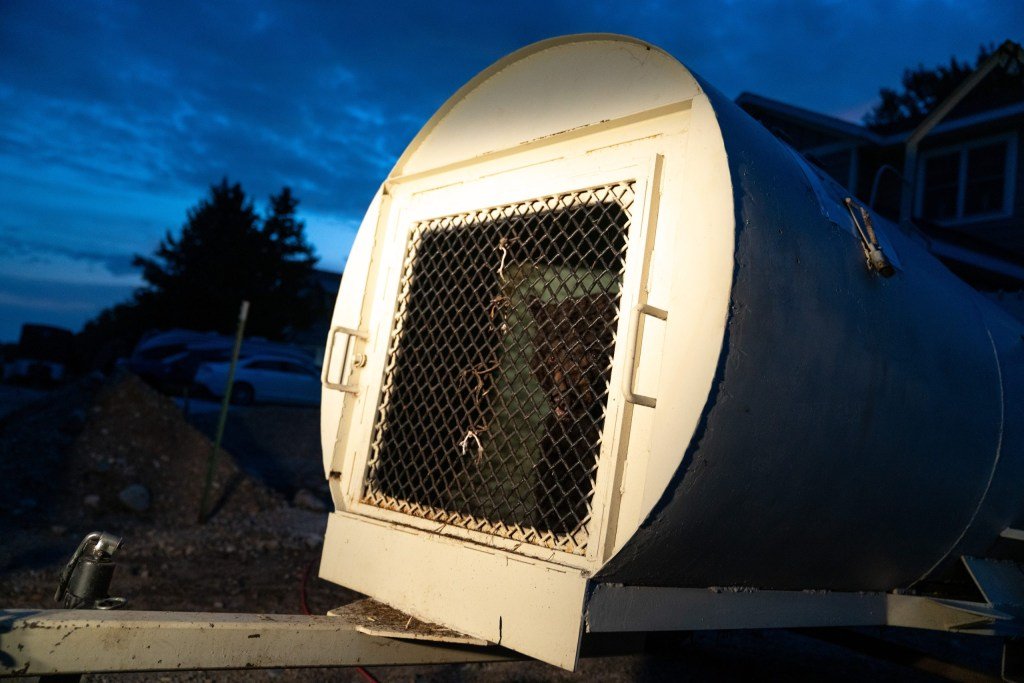
THE MORNING AFTER the heated public meeting in Red Lodge, McHugh, Thomi and Myles Steinmetz, a bear technician hired on an emergency basis, responded to a call about a trapped bear. Fish, Wildlife and Parks had set the culvert trap in a resident’s backyard, right by the creek that runs through town.
We arrived before dawn and approached with bear spray in hand. This corridor is known for bear activity, and the smell of bait — dead, decaying deer — might have lured in other bruins.
“You don’t get much sleep these years,” Thomi said. It was only Tuesday, and he had already worked about 30 hours since Saturday. “Takes a toll on the home life.”
The bear in the trap was a small male black bear with a large head and brown muzzle. It looked healthy, if a bit stressed from its hours in the cylindrical enclosure. It occasionally huffed and charged at the front of the cage as Thomi examined it.
The bear managers towed the culvert trap to a gravel parking lot just outside of town. There is no dedicated facility in the area for this kind of work.
“A lot of bears have died here,” McHugh said somberly.
Thomi pulled up images from Facebook and news stories about one black bear in particular that had been raising trouble. The bear in the trap, it appeared, was the same one that chased the woman near the middle school days earlier. It had a long rap sheet.
“Hopefully, it will be a very long time until the next time we have to do this,” McHugh said while cleaning a syringe he would attach to a long pole to sedate the bear. “But in reality, it’ll probably be two days, if we make it that long.”
He punched the needle into the bear’s shoulder. The bear ripped out the metal with its teeth. We waited to see if enough of the Telazol, a sedative, had entered its bloodstream.
In a few minutes, the bear was asleep. They moved the animal to the ground. The sky was turning pink on the horizon.
“How are you feeling?” I asked.
“Annoyed,” McHugh said.
Thomi readied his .22-caliber revolver. This, McHugh said, is the quickest and most humane way to kill a bear. They could use lethal injection, but the poison could remain in the bear’s body and impact anything that ate the carcass. Some carcasses go to the dump; others are composted.
Thomi put on noise-blocking headphones and knelt next to the bear, bracing it with one hand. With the other, he placed the barrel of the gun beneath the animal’s ear. This would be the seventh bear officials have killed in Red Lodge this year.

“Another wasted bear,” McHugh said to no one in particular. “This town sure likes to waste their bears.”
“Another wasted bear.”
Thomi squeezed the trigger. After the deafening bang, everything was quiet save for a few passing cars. Under the silent glow of the rising sun, Thomi lowered his gun and caressed the dead bear tenderly.
We welcome reader letters. Email High Country News at editor@hcn.org or submit a letter to the editor. See our letters to the editor policy.