




This article is co-published with Public Domain.
On his first day in office, President Donald Trump signed an executive order singling out the state of Alaska and its abundant stores of oil, gas and minerals. “Unleashing Alaska’s Extraordinary Resource Potential” called for expanding oil and gas development across Alaska’s North Slope, including some of the largest tracts of public land in North America.
The administration wanted to reverse regulations and new protections put in place during the previous administration — “punitive restrictions,” according to Trump — and streamline the permitting and review process for new projects, particularly in the coastal plain of the Arctic National Wildlife Refuge and the National Petroleum Reserve (NPRA).
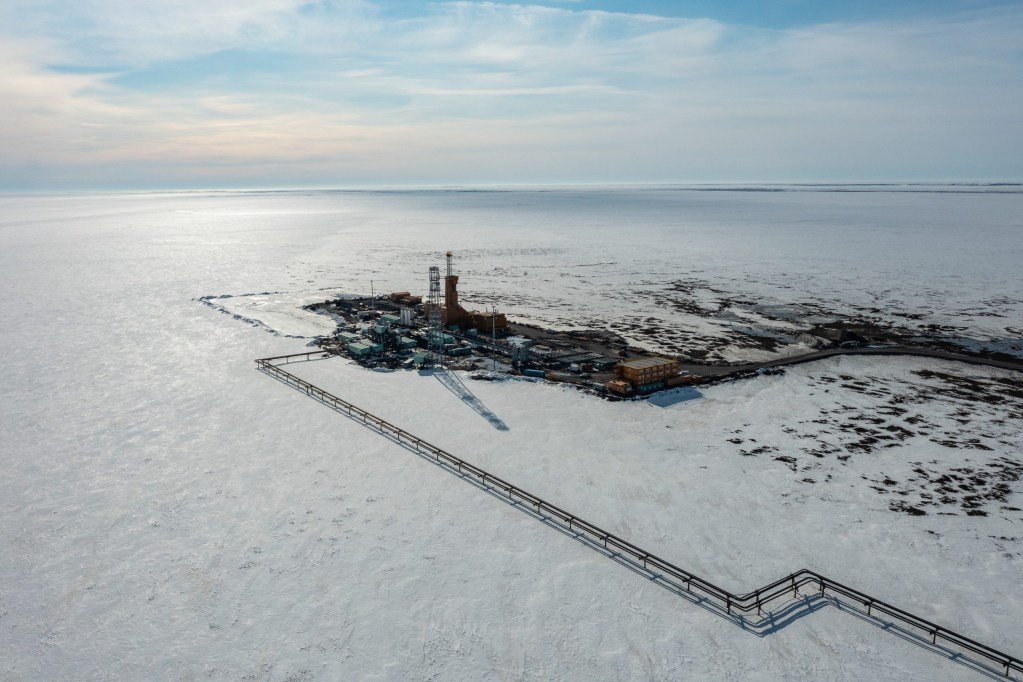
Now, according to two sources familiar with the process and documents reviewed by High Country News and Public Domain, Trump and his team are following through on their promise to fast-track drilling in the NPRA by allowing new winter exploration and drilling to move forward without any kind of environmental review. The Department of the Interior is set to publish a “categorical exclusion” to the National Environmental Policy Act that would make it easier for the oil and gas industry to conduct seismic surveys, obtain rights of way and drill new exploration wells in the NPRA, an area that has become increasingly attractive to industry.
Seismic surveys, which are done with massive vibroseis trucks that weigh over 15 tons, can scar tundra and disturb wildlife, including female polar bears that den along the coastal region of the North Slope in winter and whose numbers have declined over the last two decades. Drilling and related infrastructure are also highly intrusive and, according to recent U.S. Geological Survey studies, have altered caribou behavior and Arctic migration patterns. The impacts of oil and gas development have been further complicated by rapidly warming conditions in the region, particularly thawing permafrost, which must be taken into account when operating on the North Slope.
But the Trump administration is stripping away existing environmental protections for nearly all stages of development. According to the sources, the categorical exclusion — tentatively titled “NPR-A Wintertime Oil and Gas Exploration Operations” — could be released as early as this week in order to facilitate seismic surveys and drilling over the winter. It was drafted without any public comment period or input from those in the region directly affected.
In an emailed statement, an Interior spokesperson confirmed that the department is working on a categorical exclusion, based on findings from “dozens of environmental reviews,” to speed up permitting for winter activity, including seismic surveys and exploratory drilling. According to the department, “These efforts are about using decades of experience and analysis to create a more efficient, predictable, and effective process while upholding environmental standards.”
The legal basis for a categorical exclusion is that the proposed activities will have “no significant impact” on the environment. Such exclusions are typically applied in places where the agency has determined there is little risk to natural resources. Jeremy Lieb, a senior attorney at Earthjustice, an advocacy group that has sued to block development in the NPRA, said that exploratory drilling and seismic testing have had well-documented impacts and are precisely the kind of actions that should be scrutinized by the land-management agency. The new rules, along with other changes being made by the administration, will effectively rubber-stamp industry operations in a remote and highly sensitive ecosystem.
“Drilling and seismic exploration for oil and gas in the Arctic are large-scale, industrial activities that cause significant, lasting negative impacts to the environment and nearby communities,” Lieb said in a written statement. “The administration cannot rely on a categorical exclusion to hide these projects from the public and avoid evaluating their environmental impacts.”

The 23-million-acre National Petroleum Reserve — the largest chunk of land managed by the Interior Department — provides important habitat to dozens of migratory bird species, denning polar bears and three distinct caribou herds, two of which have dramatically declined over the last decade. Under President Biden, a significant portion of the reserve was set aside for conservation purposes; the Interior Department was in the process of creating a roughly 1 million-acre caribou conservation area requested by the Native Village of Nuiqsut, which sits just to the east of the reserve and relies on the Teshekpuk Caribou herd as a significant food source. The agreement, signed just before Biden left office, would have imposed additional restrictions on drilling activity in the herd’s prime calving area.
Former Nuiqsut Mayor Rosemary Ahtuangaruak, who now heads up an environmental nonprofit, said the area around the village has been inundated with new drilling activity. She added that there’s evidence that the Teshekpuk herd’s migration patterns have already been impacted.
“All of the contractual agreements that were supposed to guide how development is going to occur have been ripped out of the books,” she said. “We feel that it doesn’t matter that we have a unique DNA, a small community of 500 people, that are just being totally disregarded and sacrificed for the greed of development.”
“All of the contractual agreements that were supposed to guide how development is going to occur have been ripped out of the books.”
Since Trump took office, Interior has scrapped the Biden-era regulations and canceled the caribou conservation initiative, instead prioritizing oil and gas development. Nuiqsut sued the department over its cancellation of the program and received a preliminary injunction in March. In May, after receiving a petition from the Alaska Oil and Gas Association (AOGA), a trade group that promotes drilling in the state and whose former CEO and president, Kara Moriarty, is now a senior advisor at Interior, the federal agency announced that it would begin “streamlining permitting for oil and gas infrastructure” in the NPRA. (Interior’s senior advisor for Alaska during Trump’s first term, Steve Wackowski, replaced Moriarty as head of AOGA.)
This rule, effectively written by AOGA, would create a kind of blanket environmental impact statement that would apply to all oil and gas production sites in the NPRA, making it easier for industry to obtain approval for the construction of pipelines, gravel mines, access roads and related infrastructure. The new categorical exclusion appears to be focused on winter exploration activity — particularly seismic surveys — and follows recent guidance from the Council on Environmental Quality that underscored “the importance of CEs as a core feature of NEPA.”
The categorical exclusion is also being developed without any public input. Until recently, it was a legally required part of the process, but last April, the council relinquished its government-wide responsibility to oversee and implement NEPA, allowing federal agencies to forgo the 30-day public comment period.
Ted Boling, a partner at Ashurst Perkins Coie, who served as a member of the White House Council on Environmental Quality from 2000 to 2010 and during Trump’s first term, said this is largely uncharted territory for federal agencies. Given the size and complexity of the NPRA, he added, it could leave the forthcoming provision vulnerable to legal challenges.
“These (categorical exclusions) historically have been done if there’s a rulemaking procedure,” Boling said. “So, if they’re not going to get public comment on it, we’ll see how reliable it is.”
The elimination of standard environmental reviews for certain drilling-related activity comes as industry has acquired dozens of new leases in the NPRA — an area roughly the size of Indiana. During a lease sale held in March, nearly 200 parcels totaling more than 1.3 million acres were secured by oil and gas companies, including Exxon Mobil, ConocoPhillips and Shell. Much of the newly leased land is close to Conoco’s controversial Willow Project, which was approved during the Biden administration and includes infrastructure that will facilitate future development. ExxonMobil’s new leases — just south of Teshekpuk Lake, the largest body of freshwater in Arctic Alaska — fall within the caribou conservation area.
Matt Jackson, Alaska senior manager for The Wilderness Society, which is currently suing the Interior Department over its development plans in the NPRA, said that public lands in the Arctic are being “sacrificed for oil company profits.”
The NPRA was first set aside as a naval petroleum reserve in the early 1920s, but despite its name, it has seen remarkably little development over the years, with most oil and gas drilling on the North Slope occurring on state-owned land in and around Prudhoe Bay. In the last couple of decades, however, ConocoPhillips has gradually expanded its operations westward and into the reserve. A new discovery by wildcatter Bill Armstrong in 2013 renewed interest in the area, especially the formation in and around the Willow Project, spurring talk of a “North Slope renaissance.” In the recent NPRA lease sale, Armstrong’s company, North Slope Exploration LLC, acquired the highest number of tracts and will now seek to develop those leases, with minimal environmental oversight.

The proposed development poses increased risk to an already fragile and rapidly changing environment. The Arctic is warming faster than anywhere else on the planet, which has led to widespread permafrost thaw, coastal erosion and unpredictable winter weather during which most of the drilling activity takes place.
This past January, after an unusually warm week, one of the drilling rigs deployed by ConocoPhillips — known as “the beast” because it is the largest rig on the North Slope — toppled over and caught fire as it was being moved along an ice road toward the Willow project.
Several employees were injured, and thousands of gallons of oil were spilled on the surrounding tundra. It took the operator four months to remove the rig and clean up the site.
Lieb, the attorney at Earthjustice, said the incident was a good reminder of the “scale of these projects and the kind of things that can go wrong.”