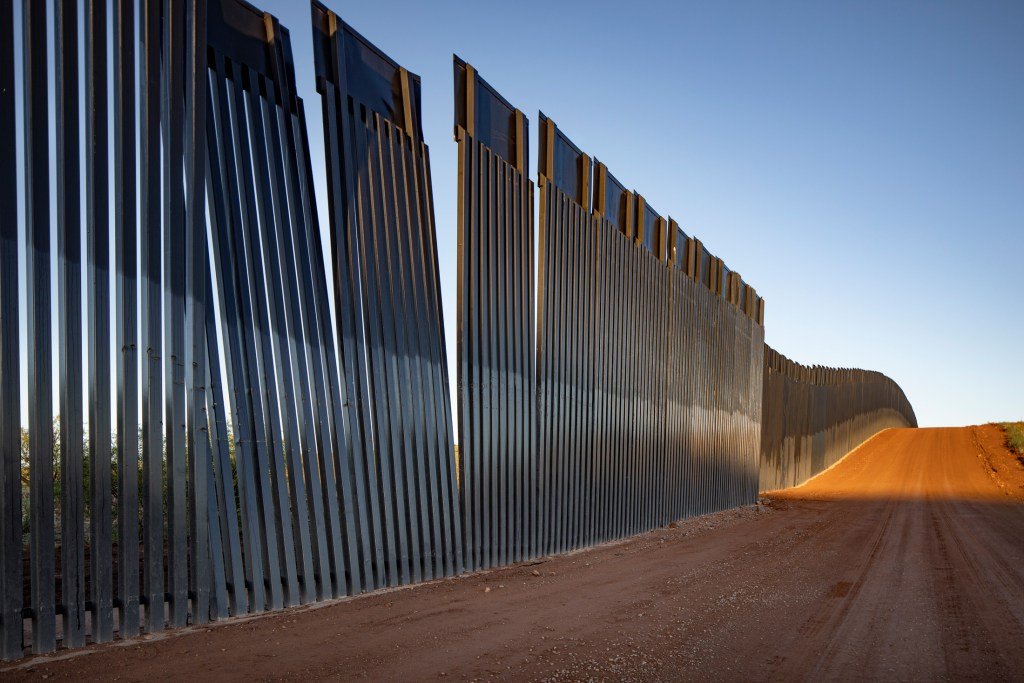
Late this spring, documentary photographer Mikal Jakubal made the trek out to southern Arizona’s San Rafael Valley to photograph a towering juniper tree, an uncommon sight in a region better known for squat mesquite. While there, he went to the border wall and snapped another picture, which showed a section of newly-built fencing so damaged that its concrete base was cracked. At least four of its metal planks were pushed forward at odd angles, leaving gaps between them.
“Oopsie on the new border wall,” Jakubal posted on Instagram May 1; he thought it might have been hit by heavy equipment. But the construction firm was already working in a different area, and he wondered how the individual panels, estimated to weigh as much as 8,000 pounds each, got so mangled.
By early July, new photos confirmed that the damage still hadn’t been repaired, though a small orange construction cone had been placed in front the area.
That apparently changed days later, after High Country News asked U.S. Customs and Border Protection (CBP) about it. According to the agency, that section had been repaired, and there were no injuries during the barrier’s original construction.
But John Mennell, a spokesperson for the agency, declined to answer specific questions about whether there had been an accident at the U.S.-Mexico border during wall construction. Instead, he referred HCN to Fisher Sand & Gravel, the North Dakota-based firm that had been awarded a $309 million contract to build 27 miles of the border wall, including the stretch of fencing in Arizona’s School Canyon.
Calls and emails to the company and its representatives went unanswered.
Critics say that the damage, and the mystery surrounding it, are another troubling symptom of the chronic lack of transparency around border wall construction. A 1996 statute, signed into law by President Bill Clinton and used by several administrations since, allows the secretary of the Department of Homeland Security (DHS) to waive dozens of laws to hasten construction of walls at the border. According to Laiken Jordahl, a national public-lands advocate with the Center for Biological Diversity, this “has created an environment where construction is shoddy by default.”
After President Donald Trump declared a national emergency at the border last year, then-DHS Secretary Kristi Noem wielded the statute to “ensure the expeditious construction of the barriers and roads.” That cleared the way for Fisher Sand & Gravel and another contractor to build sections of the wall through a no-bid process that is currently the subject of a lawsuit. Noem ensured that construction could take place even more swiftly when she waived the National Environmental Policy Act that would examine how it might impact local communities and the environment.
FOUNDED BY GENE FISHER IN 1952, Fisher Sand & Gravel has made billions in government contracts during the two Trump administrations. Yet the firm’s work building sections of the border wall in Texas and Arizona has not been without controversy. In 2020, for example, it used private funds to build a 3-mile segment of the wall in Texas, erecting it so close to the Rio Grande that it was later deemed to be in danger of toppling over.
Only months after it was constructed, a hurricane hit the region, and water carved out holes underneath that section. Just a few years after that, parts of it began to warp.
This “has created an environment where construction is shoddy by default.”
Ribbons of land along the U.S.-Mexico border bear evidence of other failures. An “entire mountainside is in danger of collapse,” according to one government report, because the contractor — Southwest Valley Constructors — cleared vegetation that had been preventing erosion on a peak in the Pajarito Mountains.
Elsewhere, strong winds have caused sections of the border wall in California and New Mexico, built by other contractors, to nearly collapse. In New Mexico, CBP said in a 2020 statement that those panels fell because they were “pending additional anchoring.”
Ultimately, Jordahl said, the wall is functioning more as “political theater” than an actual deterrent. In a video posted on X in 2023, he stood at the base of one section in Organ Pipe National Monument and pointed out exactly where smugglers had used an angle grinder to cut through the bollards on a section he said repair crews had already welded.
“This wall at Organ Pipe has destroyed desert wilderness & severed migration routes for endangered wildlife,” he wrote, “but it will never stop people from crossing.”