







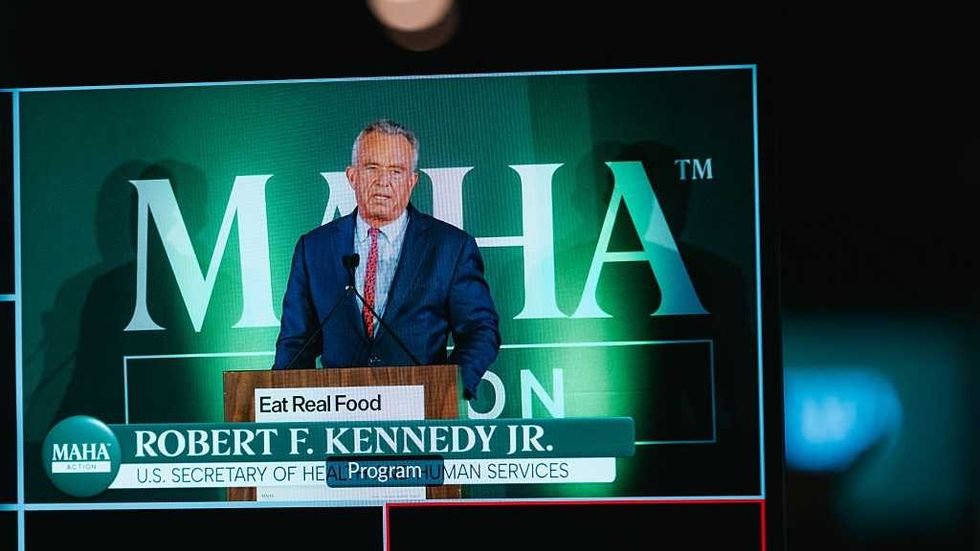
If Health and Human Services Secretary Robert F. Kennedy Jr. wants to be true to his word and “Make America Healthy Again,” he must reform the Food and Drug Administration. Dr. Vinay Prasad, whose actions thwart medical freedom, endanger the unborn, and compromise patient choice, needs to go now, not at the end of April.
Prasad is a “Bernie Sanders acolyte” who “doesn’t think patients can be trusted to make their own healthcare decisions,” as Allysia Finley put it in the Wall Street Journal. Prasad disparages the 2018 right-to-try law, which give terminal patients access to experimental treatments, calling it “terrible” and “disingenuous,” written by people who “want to weaken the FDA.”
MAHA won’t survive as a slogan alone. Behind the facade of RFK’s rhetoric is an ideological agenda at odds with key conservative values.
Prasad claims that dying patients already have access to drugs through the FDA’s expanded-use programs and blames drug companies as the “major barrier” to unapproved drugs, downplaying the government’s role in blocking patient choice.
His personal crusade against faster drug approvals has chilled medical innovation. When Prasad originally resigned in July, months into his FDA tenure, amid backlash, the market predicted a shift toward a more patient-centric “right-to-try” approach, potentially cutting the bureaucratic red tape stifling cell and gene therapies and patient access.
Prasad’s pro-abortion record is even worse. He proudly identifies as “pro-choice” and progressive, a stance fundamentally at odds with pro-life conservatism. His appointment to the FDA’s Center for Biologics Evaluation and Research overseeing drug development that affects pregnant women and unborn children is a direct threat to the culture of life.
Prasad consistently casts abortion as a medical issue rather than a moral issue. He also fiercely defended mifepristone, the abortion pill, when a Texas judge tried to suspend its FDA approval. Prasad called the court’s intervention a “dangerous precedent,” and applauded the Supreme Court for preserving access to the drug, framing the issue purely as protecting “FDA authority” and “scientific integrity.” To pro-life voters, that posture reads less like neutrality and more like a commitment to keeping the abortion drug regime insulated from challenge.
Small-government promises are colliding with Prasad’s big-government dogma. Conservatives assumed RFK Jr. and his FDA appointees would shrink regulatory excess in support of President Trump’s innovation agenda, but they have done the opposite. Prasad came in with a “stringent regulatory mindset.” Rather than trusting patients to weigh risks for themselves, he has tightened the FDA’s grip with paternalistic, ideological rules. He has sidelined MAHA’s promise and expanded oversight instead.
Prasad’s policies have often expanded the FDA’s reach in ways that could seriously harm timely access to treatments. He is imposing tougher requirements on industry, insisting on larger trials and refusing to rely on surrogate endpoints for approvals, which means more delays and more red tape before new solutions can reach the public.
RELATED: MAHA allies rage over Trump’s support for controversial weed-killing chemical
 Photo by JOSH EDELSON/AFP via Getty Images
The internal dynamics under Prasad reflect a top-down, bureaucratic rigidity and are under formal investigation, with the FDA retaining an outside investigator to examine workplace complaints alleging a toxic environment. Instead of signaling healthy reform, Prasad’s authoritarian rule of CBER is run on control and fear of pushback, where staff worry that dissent will be punished and experienced voices are pushed out or sidelined. Rather than “draining the swamp,” this approach fortified an insider bureaucracy loyal to Prasad’s agenda.
When the FDA held a meeting on a Commissioner’s National Priority Voucher drug, the voting members were top leaders like Prasad, not the scientists who reviewed the application. Career reviewers were excluded from the vote entirely, a major break from the FDA’s long-standing practice of empowering these staffers to make the final scientific call in order to shield approvals from political pressure.
The paradox for conservatives is obvious. Kennedy and Prasad earn plaudits for pulling back certain excesses, including scaling down aggressive vaccine promotion. Yet at the same time, they are building a larger, more controlling FDA bureaucracy in other domains — one that constricts medical freedom, slows innovation, and keeps pro-life concerns at arm’s length.
MAHA won’t survive as a slogan alone. Behind the facade of RFK’s rhetoric is an ideological agenda at odds with key conservative values. Conservatives who cherish medical freedom and rapid innovation find themselves at odds with Prasad’s FDA. A few welcome policy tweaks cannot obscure the reality of an expanding bureaucracy and pro-abortion policies.
With the 2026 midterms fast approaching, continuing this pattern will hurt Republicans and erode the trust of voters, handing Democrats an easy narrative about broken promises. Such an outcome would leave MAHA dead and MAGA mortally wounded. We must do better.