


THE TRUMP CARD
The president unleashed a furious attack on the Democrat leading in the polls as Republicans scramble to hold on to a crucial Senate seat.

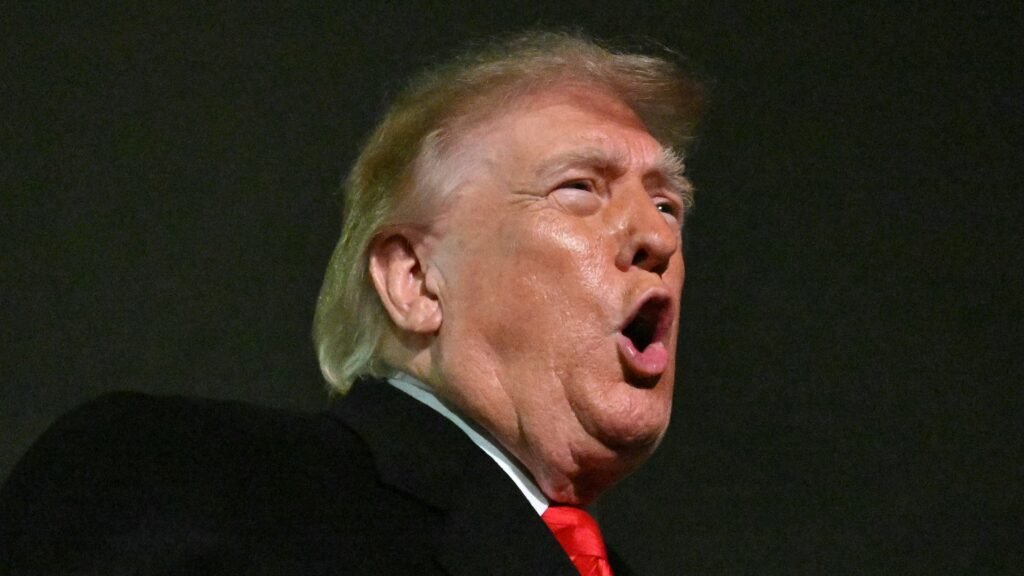
President Donald Trump marked Columbus Day with a furious Truth Social attack on North Carolina Democratic Senate candidate and former Gov. Roy Cooper.
In a lengthy post, Trump claimed Cooper had freed 83 murderers during the COVID-19 pandemic, including 51 serving life sentences. He further alleged that 25 went on to commit murder after their release.

“There has never been a Governor with such a bad record on Crime, and there never will be!” Trump wrote.
FactCheck.org reported that 51 inmates serving life sentences were included in a group eligible for parole under a prison settlement, but state officials said they were already eligible for parole and had not been made eligible by the agreement.
Cooper’s campaign has also said law enforcement officials and parole officers, rather than Cooper personally, made the release decisions.

Still, Trump compared the controversy to the 1988 presidential campaign, when Republican George H.W. Bush’s team attacked Democratic nominee Michael Dukakis over a prison furlough program involving convicted murderer Willie Horton.
Sign up for Beast Digest
By clicking “SUBSCRIBE” you agree to our Terms of Use and Privacy Policy.
“Governor Michael Dukakis lost his insurmountable lead in the 1988 Presidential Race because he released Willie Horton, who went on to immediately rape and kill three women. What Former Governor Roy Cooper did is, believe it or not, far more consequential,” the 80-year-old president wrote, before declaring: “VOTE FOR MICHAEL WHATLEY TO BE THE NEXT U.S. SENATOR FROM THE GREAT STATE OF NORTH CAROLINA.”
Trump’s account of the Horton case is false. Horton assaulted a man and raped a woman while on furlough, but he did not murder three women.
The Daily Beast has contacted Cooper’s campaign for comment.

Cooper is challenging Whatley for the Senate seat being vacated by retiring Republican Sen. Thom Tillis, a vocal critic of Trump and several aspects of his administration.
Recent polling has shown Cooper ahead in a state that Trump won in 2024 and that has not voted for a Democratic president since 2008. The RealClearPolitics average covering Sept. 6 to Oct. 10 put him at 49.9 percent, compared with 40.9 percent for Whatley—a nine-point lead for the Democrat.

If Cooper wins, he would be the first Democrat elected to the U.S. Senate from North Carolina since 2008, but Republicans are working hard to keep that from happening.
With Cooper leading in the polls, Whatley and his allies have made crime a central issue in the race, seeking to undermine the Democrat’s moderate image by portraying his record as too soft on public safety.
Trump joined that effort at a September rally in Gastonia, accusing Cooper of making North Carolina notorious for “violent crime.” Republican groups have also spent millions on attack ads, including one that falsely linked Cooper to a murder committed in South Carolina.
Cooper has countered by pointing to his record as the state’s attorney general, including his work prosecuting criminal cases, and presenting himself as willing to challenge his own party on law enforcement.
His campaign says he opposed defunding the police, worked with Republicans to strengthen bail laws, and partnered with Trump on efforts to combat fentanyl.

North Carolina is among several Republican-leaning states where the GOP faces a tough fight ahead of November’s midterms.
Multiple House congressional districts Trump carried by double digits in 2024 are now considered vulnerable, including seats in Texas, Ohio, Maine, Iowa, Nevada, and Kentucky.
Meanwhile, Ohio and Iowa are among the states Trump allies see as crucial to keeping their Senate majority. Winning Senate races in both states would make it harder for Democrats to take control of the Senate, one senior Republican official told Politico this week.
But polling suggests a difficult road ahead for the GOP.

Pollster Angus Reid found Democrats leading by 16 points on the generic congressional ballot—their biggest lead yet. Other polls have also shown Democrats ahead, raising the possibility that Republicans could lose not just the House but the Senate, too.
The tide has been turning against Trump and his party ever since he launched his deeply unpopular war on Iran in February.
The war has driven up energy prices; AAA figures show the average price of gasoline in the U.S. at $4.35 a gallon, while diesel stands at $6.26.
In the latest CNN/SSRS survey, two-thirds said Trump has made the economy worse, while a majority said the war in Iran has damaged their personal finances.
Still, in North Carolina, Whatley has allied himself with Trump.
At a rally in Gastonia last month, Whatley joined Trump onstage and praised his administration, declaring: “I am still with that guy.”

But with Trump’s approval ratings in the low 30s, the president’s backing could complicate matters for the Republican hopeful.
Cooper, meanwhile, is pitching himself as a moderate who will “make stuff cost less.”
He has told voters he would work with Trump when necessary, while opposing him when they disagree.
“People are getting tired of this ultra-partisanship that we are seeing across the country,” Cooper told reporters earlier this month. “If we can elect more people who understand that achieving consensus can be a good thing, I think that’s positive.”