






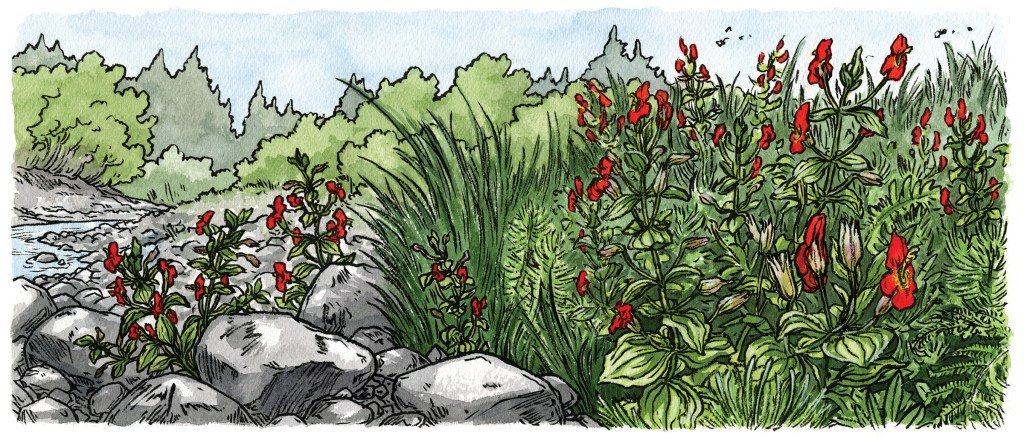
All summer, along streambanks from Washington to Northern Mexico, hummingbirds whir between red, face-shaped flowers that have evolved almost exclusively to suit them. As fall approaches, those blooms dry into long brown capsules filled with thousands of dust-like seeds — and then it is scientists who dart from pod to pod, collecting genetic material that, though not exactly meant for them, has become a key tool for studying evolutionary biology and the ways that climate change will reshape ecosystems across the West.
Earlier this year, a group of those researchers, led by University of British Columbia ecologist Amy Angert, published a groundbreaking paper using this species — the scarlet monkeyflower (Mimulus cardinalis) — to prove, for the first time, that some plants can evolve fast enough in the wild to rescue themselves from the effects of climate change. It was the latest in a string of discoveries based on this thumb-length trumpet of a flower, showing how pollinators shape speciation, that plants’ capacities to evolve can vary across their geographic range and how a floral version of intergenerational trauma can help them adjust to climatic changes even without genetic mutations.
It will probably not be the last big discovery for this species, or for Angert’s lab, which is now working on monkeyflower-based models that could eventually predict the ability of other species to adapt or evolve to outpace worsening drought, heat, fire and other climate-related stressors. Angert hopes to help conservationists understand which species or populations need their attention — and which ones, like many of her monkeyflowers, “can hold themselves up by their own bootstraps.”
From streambank to lab

Every year since 2010, Angert’s team has visited dozens to hundreds of monkeyflower sites, recording observations and collecting seeds to bring back to the lab. In several studies, her team “resurrected” multiple generations of seeds in the same greenhouse, showing that over time, the lineages that experienced drought evolved drought-tolerant traits, such as modified leaf thickness and blooming times.
Their fuzzy leaves secrete a sticky resin with a distinct smell: “It’s a little sweet, a little pungent. I’ve never been able to hit on the right word,” Angert said, “but I smell that scent and I’m immediately transported.”
“It’s a little sweet, a little pungent.”
These perennials sprout between rocks along streambanks and creeks where the water is neither fast enough to sweep them away nor so slow that meadow grasses can take over.
Scarlet monkeyflowers bloom in sprays atop stems that reach from 6 inches tall in hot, harsh areas to 3 feet tall in wetter habitats.

A supermodel for science
Monkeyflowers are “model species” in evolutionary biology, providing insights applicable to many organisms. These plants are useful for many reasons: They’ve been studied for a particularly long time (since the early 1800s); they have a short lifecycle and grow well in the lab; and they produce enough seeds — more than 2,000 per pod — to make collection efficient. Monkeyflowers also have a small genome, though that’s becoming less important as gene-sequencing costs fall and computing tools improve.

Climate toolkit
Southern scarlet monkeyflower populations have more adaptive genetic variation than Northern ones, according to research out of Angert’s lab: They can evolve more rapidly in response to the same stressors. That means researchers and conservationists can’t make species-wide generalizations from what’s known about just a few populations.
Many plants have “stress memory,” in which compounds or markers that alter gene expression but aren’t actual genetic mutations are passed from grandparent to parent to offspring — an ability that may also vary across a species’ range. Angert’s team hypothesizes that even populations that can’t evolve fast enough may still be able to use this “memory” to adapt to a changing climate.

The house special
The scarlet monkeyflower has evolved to entice hummingbirds: It is bright red, tube-shaped, filled with nectar, and has a long stamen perfectly positioned to deposit two stripes of pollen on each hummer’s forehead. A very close relative, Lewis’ monkeyflower (Mimulus lewisii), specialized to suit bumblebees instead: Its pink blossoms produce less nectar and its petals offer a nice little landing pad for pollen collection. These two species, which overlap in range, can easily hybridize but rarely do, thanks to their pollinators’ different preferences. Evolutionary biologists have shown that the flowers owe their divergent shapes to changes in just a few regions of their genomes, meaning that evolving to suit a new pollinator can happen relatively fast, on the scale of millennia.
Illustrations by Emily Poole.
We welcome reader letters. Email High Country News at editor@hcn.org or submit a letter to the editor. See our letters to the editor policy.
This article appeared in the October 2026 print edition of the magazine with the headline “Get to know the scarlet monkeyflower.”