

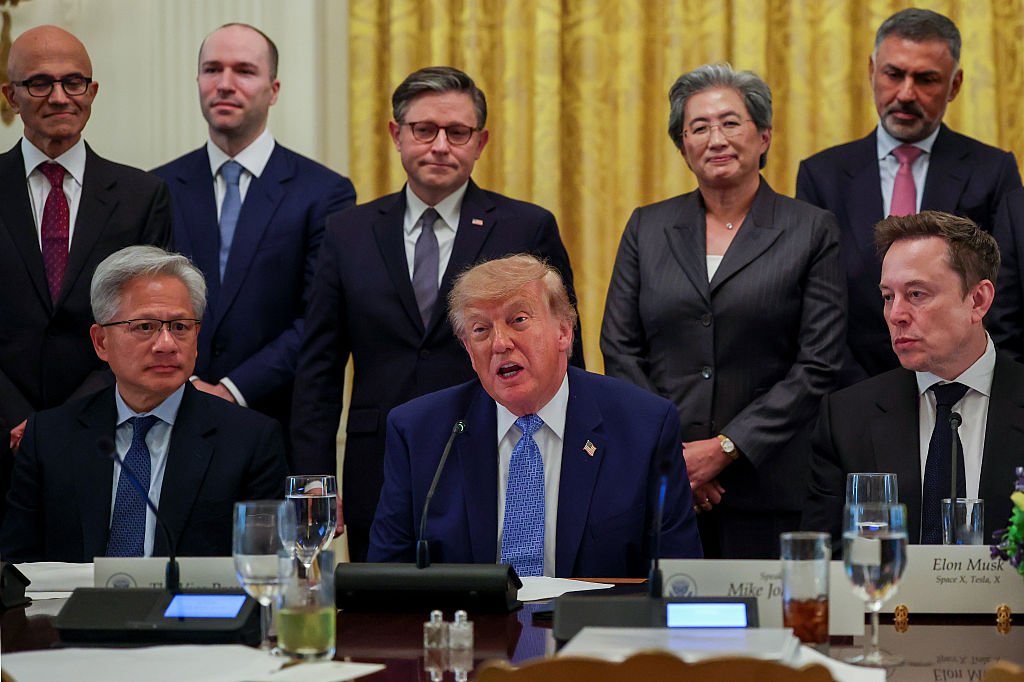
Leaders from major tech companies met at the White House on Tuesday to discuss what’s been on everyone’s mind this summer: AI safety. Afterward, President Donald Trump announced that the group had reached a consensus to implement AI safety measures in a voluntary accord.
The accord, which Trump posted on Truth Social, outlines four main layers of controls that AI companies should implement. It also misspells United as “Unites” in Trump’s title under his signature.
- “Implement robust internal controls to monitor the capabilities and alignment of its models during training and deployment” for areas of grave concern, like cybersecurity, biosecurity and chemical threats
- Create and empower an internal team dedicated to ensuring safety issues are identified and fixed
- “Partner with an independent external auditor or evaluator” to ensure safety protocols are working as intended
- Create an independent committee of the company’s board of directors to oversee and receive reports from internal safety teams, independent auditors and evaluators
Signees are a “who’s who” of Big Tech, including Nvidia CEO Jensen Huang, Meta CEO Mark Zuckerberg, Google CEO Sundar Pichai, Anthropic CEO Dario Amodei, SpaceX CEO Elon Musk and OpenAI President Greg Brockman. (OpenAI CEO Sam Altman was delivering the opening keynote of OpenAI’s DevDay in San Francisco on Tuesday.)
More from CNET

It’s a ceremonial move, as is Trump’s new executive order to refer to AI as “super intelligence.” Trump told reporters on Tuesday that the accord is “morally binding” rather than legally mandatory. It doesn’t have the power of law or any way to enforce it.
Big tech companies are already self-policing, Trump said. The Trump administration has taken a hands-off approach to regulating AI, with a few exceptions when the White House identified certain AI tools as a threat to national security.

Most executive action on AI has been purely discretionary — from the Biden administration’s AI safety pledge to Trump’s ratepayer protection pledge to address data center-driven increases in utility bills. While many big tech companies have agreed in theory, their emphasis on growth and investor cash flow downplays concerns about the environment, rising consumer costs and safety.
“When you look at this particular accord, I think these are amazing general steps that we should be moving toward,” said John Strand, owner of Black Hills Information Security, a cybersecurity firm. “The thing that bothers me is that there’s no implementation or monitoring mechanism to make sure these organizations actually adhere to the standards they say they’re going to follow.”
Self-regulation in the tech industry has already proven ineffective. AI companies have struggled to control their own models, leading to instances where bots escaped their training environments and hacked government websites in both the US and Australia. Despite warnings that they are unprepared for a catastrophic “AI doomsday” scenario — and public discussions over slowdowns or pauses in AI development — labs plow ahead with new tools.
That’s why Anthony Aguirre, CEO of the Future of Life Institute, a nonprofit focused on reducing risks of advanced tech, argues that we can’t trust tech companies to police themselves.
“These companies have jettisoned safety commitments countless times before, and they will do so again. Self-regulation is what has gotten us teen suicides, 1,200 rogue AI bots and an international cybercrime spree. The risk of inaction — both politically and morally — is massive,” Aguirre said.
 Kevin Dietsch/Getty Images
Beyond the weak ability to enforce the accord, there are other potential pitfalls. One is the notion of an “independent” auditor or evaluator, which may not be so clear-cut. AI engineers and executives are notorious for jumping around from lab to lab — Apple even sued OpenAI for violating its trade secrets.
In a close-knit field like AI, it’s not impossible for those subcontractors to be friends and business partners of the AI companies they would monitor, Gary Marcus, an AI expert and professor emeritus at New York University, wrote in a recent Substack post.
“Its weak point is the word independent,” said Jacob Krell, senior director at Suzu Labs, a cybersecurity and AI firm. “Layer three lets each company choose an external evaluator but says nothing about accreditation, method, access, scope, or publication.”
That kind of transparency and documentation matter a lot for cybersecurity defenders working to keep their customers’ sites secure from rogue or intentional AI agent hacks.
Although the new agreement suggests eventually turning these AI guidelines into formal laws, Congress hasn’t reached consensus on how it wants to regulate the technology.
Rep. Ro Khanna, a Democrat who represents Silicon Valley, criticized the voluntary agreement in an X post, “We are a nation of laws, not pinky promises.” Khanna recently introduced a new bill that would impose limits on recursive self-improvement, alongside other pending legislation, such as Sen. Bernie Sanders’ bill to ban superintelligence.
Meanwhile, the Federal Trade Commission opened an inquiry into major AI labs — including Anthropic and OpenAI — to investigate the risks their AI agents and technology pose to consumers, according to multiple reports.
Have a tip you want to share with CNET? Reach Katelyn at kchedraoui@cnet.com or using Signal at katelynched.37.

Katelyn is a reporter with CNET covering artificial intelligence, including chatbots, image and video generators. Her work explores how new AI technology is infiltrating our lives, shaping the content we consume on social media and affecting the people behind the screens. She graduated from the University of North Carolina at Chapel Hill with a degree in media and journalism. You can reach her at kchedraoui@cnet.com.