



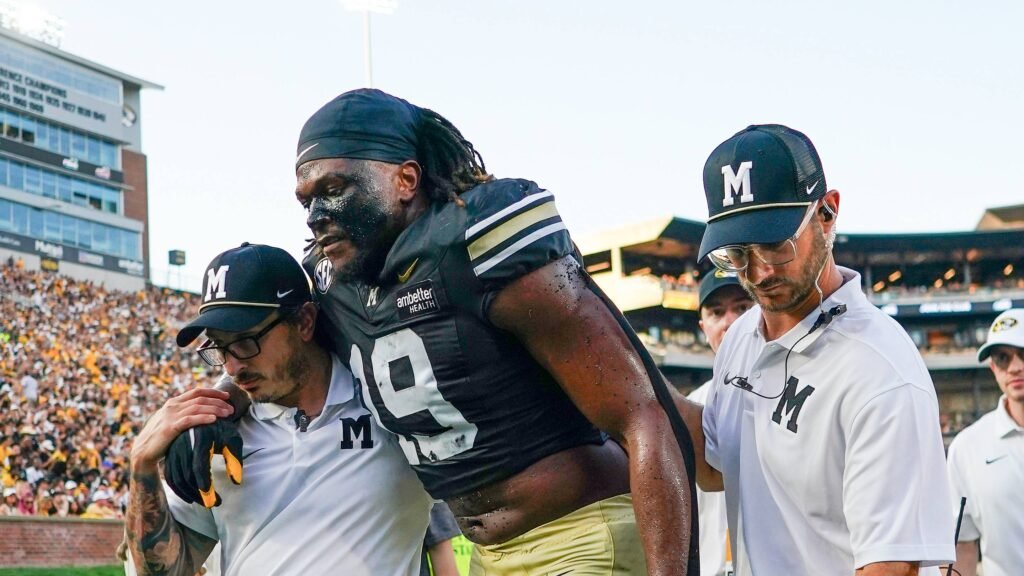

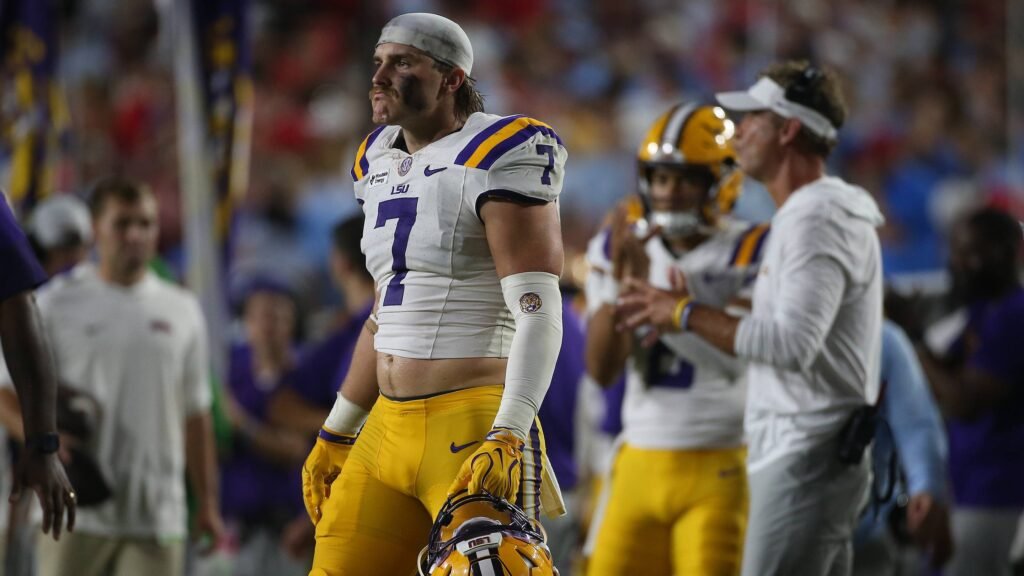
What’s clear for LSU right now is that Whit Weeks will be out of action for a significant time after suffering a fractured fibula in Saturday’s game against Texas A&M.
But what’s not so clear is just how long that significant amount of time is. Multiple reports have come out, and all of them have ranged from four weeks to this being a season-ending injury.
While Weeks finds himself back on the injury report this season after his long stint bouncing between out, doubtful, questionable and playing only limited snaps when he was available last season, it’s hard to imagine the same scenario isn’t running through his head.
Weeks was off to a flying start, looking like the best linebacker in the SEC, as everyone knew he could be. But now he looks to return to that form for the Alabama game, as his earliest hoped-for return.
How Long is Significant?
Lane Kiffin was asked about Weeks’ return timeline, and he said the star linebacker will have “a return later in the season or no return at all.”
Weeks underwent successful surgery Monday morning to repair the fibula injury. A six-week projection is what both Weeks and LSU are aiming for, which would put him returning against Alabama on November 7.
When Kiffin answered that question, he was operating under a level of understanding that Weeks was still weighing surgery. Now that Weeks has had his surgery and everything was successful, his initial timetable is a little more concrete.
But, like LSU and Weeks learned last season, not every projection is correct.
A Psycological Return
Weeks is an elite competitor, but he’s also a human.
It shouldn’t be written off that a psychological hurdle could be something he needs to clear also as he works his way back in 2026, because of how unpredictable his injury timeline became last season.
The progression of Weeks’ ankle injury last season was anything but straightforward.
Weeks entered the season having already returned from the ankle injury he suffered in the 2024 Texas Bowl, and he was able to establish himself as a major part of LSU’s defense. But then, after suffering another injury to the same ankle at Ole Miss, he initially appeared to be on track to continue playing.
He gutted through the South Carolina game despite hardly being able to move painlessly, only to discover afterward that he had a bone bruise in the same ankle. He then missed four games.
After weeks in a walking boot, he finally returned against Western Kentucky on a limited basis before being listed as probable for Oklahoma. He ultimately played in the regular-season finale as well, but also in a limited capacity. His play on the field was impactful, but it wasn’t the Weeks that started the season.
That’s something that could easily live in Weeks’ head as he returns this season.
While Weeks has already demonstrated that he can play through considerable discomfort and push to get back on the field, last year’s experience also gave him multiple reasons to question whether he can be truly ready for the demands of football after another injury.
The physical rehabilitation is one part of the comeback, the one that doctors tell coaches about and that creates a timeline for returning, but rebuilding the confidence to plant, cut, change direction and play without consciously protecting the injured leg can be another.
For Weeks, getting completely comfortable trusting his leg again could be an important psychological hurdle as he attempts to return to the player he was in the first four weeks.
Sign up for our free newsletter and follow us on Facebook and X for the latest news.
 Add us as a preferred source on Google