

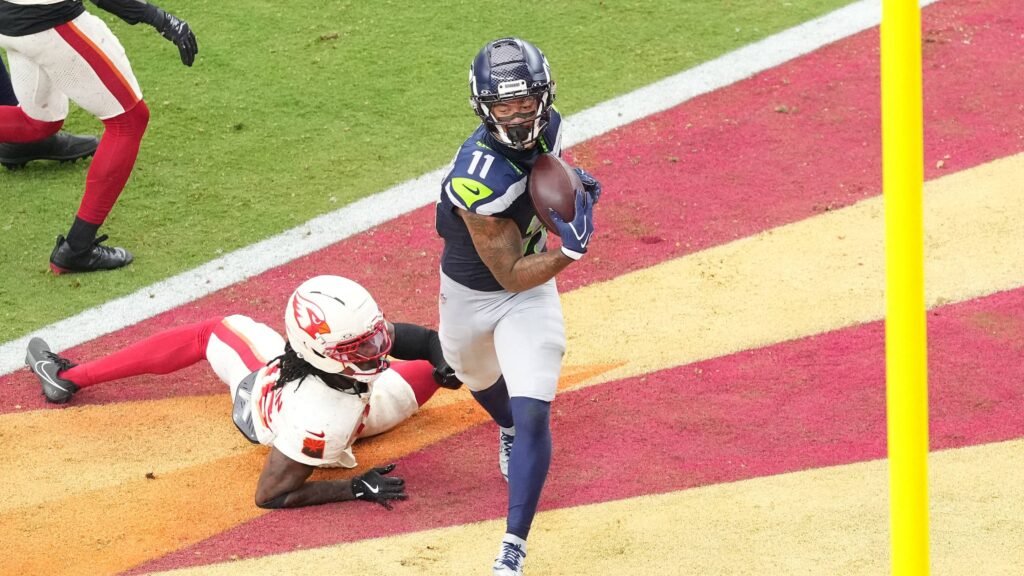

After getting exposed once again last Sunday in Dallas by CeeDee Lamb, who went for eight catches, 153 yards, and two touchdowns against Washington’s secondary, the schedule is sending an even hotter receiver to Northwest Stadium. This weekend, the Commanders will host their first home game of the season against the Seattle Seahawks, a team riding a 12-game winning streak that includes Super Bowl LX. The Seahawks have the league’s premier receiver, Jaxon Smith-Njigba, who has 17 catches, 277 yards (16.3 per catch), and four touchdowns through two games.
The Commanders hosted the Seahawks last November; JSN had eight catches on nine targets for 129 yards, while Seattle won the game 38-14 on the strength of Sam Darnold’s 21-of-24 for 330 yards and four touchdowns. Washington knew what was coming that day and, while it kept him from getting one of Darnold’s TD passes, still couldn’t stop him.
Dallas laid out the blueprint for what Seattle will face this week because the problem wasn’t only Lamb winning his matchups. Dak Prescott completed 26 of 31 passes for 279 yards and four touchdowns, and when Washington couldn’t pressure him, little slowed him down. Prescott was 17-of-18 for 178 yards when kept clean, with all four of his touchdowns coming without pressure, and that’s where this gets dangerous again. The Commanders can send extra people all they want, but if they don’t get home, they’re only leaving the guys behind them with even more work to do against a receiver like Smith-Njigba.
This isn’t a one-week issue either. Philadelphia finished with 318 yards in Week 1, but a huge chunk of that came on explosive plays, including a 64-yard catch by Dontayvion Wicks and a 31-yarder to DeVonta Smith. Washington would make stops, get itself into good situations, and then give a big piece of it back on one snap. A week later, Lamb did the same thing in Dallas. That’s what makes Smith-Njigba coming to town such a problem: two games into the season, allowing those chunk plays is starting to look less like an occasional mistake and more like something teams know they can attack.
The problem is Smith-Njigba isn’t the same receiver Washington saw last November, either. He finished last season with 119 catches for 1,793 yards and 10 touchdowns, and through two games this year he’s already added another 277 yards and four scores. He also showed against Arizona that the damage doesn’t have to come five or 10 yards at a time anymore, taking one catch 82 yards for a touchdown. Last year against Washington, his longest reception went for 26 yards, and he still finished with 129. Now the Commanders have to worry about him doing both.
Nobody expects Washington to completely take Smith-Njigba out of the game Sunday, but it can’t keep allowing the opposing team’s best receiver to dictate what happens while the quarterback has time to find him. The communication has to be better, and when the Commanders decide to send extra pressure, they have to actually get there. They knew Lamb was the guy Dallas wanted to feature last week, and he still finished with 153 yards. They also know where Seattle wants to go with the ball. If this happens for a third week in a row, it’ll be hard to keep calling it something Washington just needs time to clean up.
Get your Commanders updates delivered instantly to your phone by subscribing to our Facebook Messenger News Channel.
 Add us as a preferred source on Google