




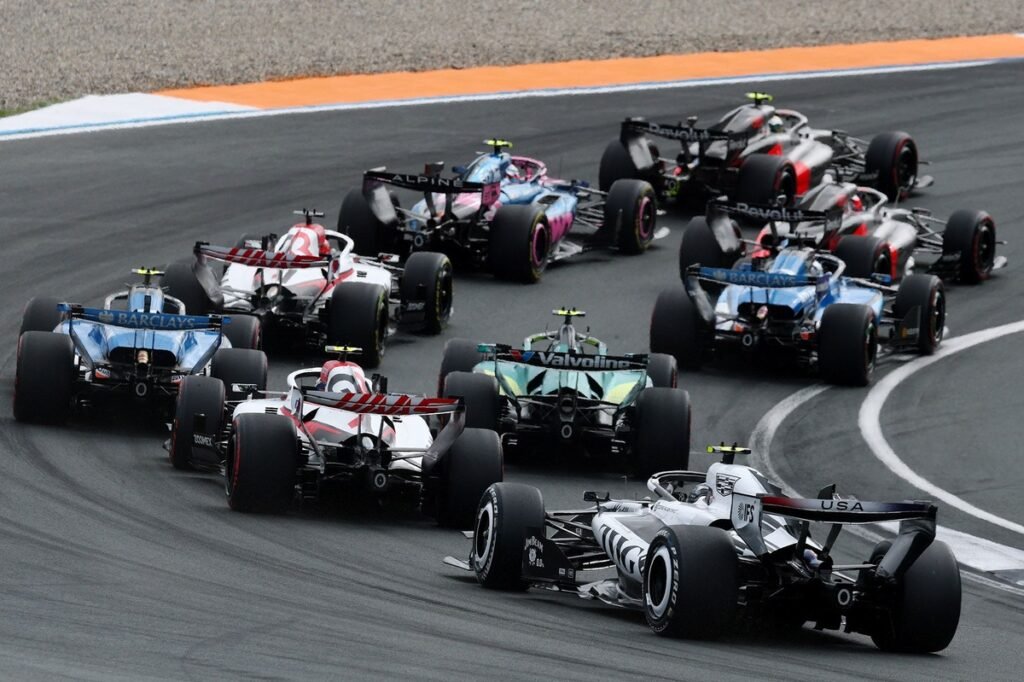
A Formula 1 Grand Prix is more than 305 kilometres long. More precisely, a race consists of the minimum number of laps required to exceed 305 kilometres. The only exception is Monaco, where the minimum distance is 260 kilometres.
There is also a two-hour limit on actual racing time. If a race is suspended, the total duration including the interruption may not exceed three hours. That is what the current Formula 1 regulations stipulate.
But it has not always been this standardised. During the first decades of the World Championship, some races were almost twice as long. And in 2027, the distance will be reduced again. How long a race lasts in practice and how many laps are completed is also explained in our article How long does a Formula 1 race last?
The 1950s: Races of up to 500 kilometres
When the Formula 1 World Championship began in 1950, there was no standard race distance. Organisers were largely free to determine the length of their own events, resulting in considerable variation.
The very first World Championship race at Silverstone ran for 70 laps and 325 kilometres. Winner Nino Farina completed it in 2 hours and 13 minutes. At the season finale in Monza, by contrast, Farina raced for 80 laps and around 504 kilometres. He was behind the wheel for almost three hours.
Longer still was the Indianapolis 500, which counted towards the World Championship from 1950 to 1960. At 200 laps and 805 kilometres, it remains the race with both the highest number of laps and the greatest distance in World Championship history.
1958: The first major reduction
In 1958, the governing body introduced much tighter restrictions. Race distances were set at between 300 and 500 kilometres, with a maximum duration of two hours.
In the years that followed, most Grands Prix covered between 300 and 400 kilometres. The upper limit was eventually 400 kilometres.
1971: A maximum of around 322 kilometres
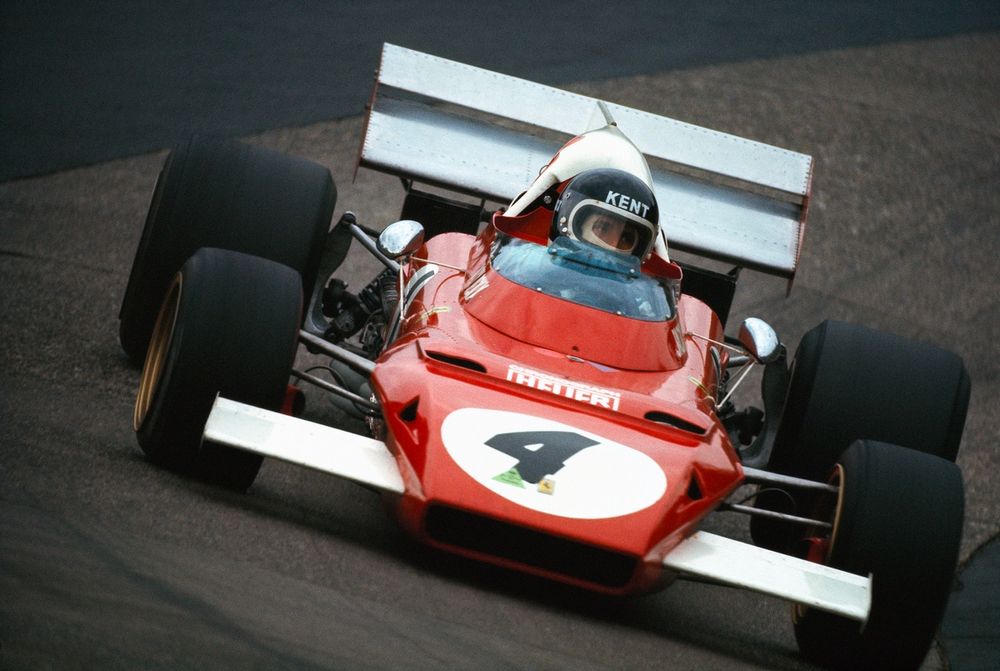
Jacky Ickx, Ferrari 312B2
Photo by: Rainer Schlegelmilch / Getty Images
For the 1971 season, the maximum race distance was reduced from 400 to around 322 kilometres. Races consequently became noticeably shorter.
One extreme example came that same season. The German Grand Prix on the Nürburgring Nordschleife lasted just 12 laps. With the circuit measuring almost 23 kilometres, it remains the lowest number of laps in a regularly completed World Championship race.
During the 1970s and 1980s, most races settled at around 300 to 320 kilometres.
1989: The 305-kilometre standard
In 1989, the race distance was standardised at a minimum of 305 kilometres. The aim was to ensure that a race could be completed within two hours.
Since then, each Grand Prix has consisted of the minimum number of laps required to take the total distance just beyond 305 kilometres. The basic principle remains in place today.
In 2026, for example, that means 44 laps at Spa-Francorchamps, where the circuit is more than seven kilometres long. Baku has 51 laps and Sepang 56. Monaco has the highest lap count at 78.
The Monaco exception: Why the race is only 260 kilometres

Photo by: Filip Cleeren
Monaco is the only circuit where the 305-kilometre rule does not apply. The race in the Principality covers 78 laps and around 260 kilometres.
The reason is speed. The street circuit is only 3.337 kilometres long, as well as being narrow and twisty. Average speeds are considerably lower than at other circuits.
Covering more than 305 kilometres in Monaco would therefore risk producing an exceptionally long race because of the low average speed. That is why Monaco has a minimum race distance of 260 kilometres.
Canada 2011: The longest Formula 1 race to date
For many years, there was only a two-hour limit on actual racing time. There was no rule governing how long a race could last once interruptions were taken into account. That changed after the 2011 Canadian Grand Prix.
Heavy rain stopped the race in Montreal for around two hours. Jenson Button eventually won after a spectacular comeback drive. The official race time was 4:04:39.537, making it the longest race in Formula 1 history.
The FIA responded quickly. From 2012, a race including interruptions could last no more than four hours. The two-hour limit on actual racing remained in place. For the 2021 season, the overall limit was reduced to three hours.
Belgium 2021: The shortest race and new points rules

Photo by: Erik Junius
Formula 1 experienced the opposite extreme at Spa-Francorchamps in 2021. Persistent rain meant the field only circulated behind the Safety Car. Just one lap was included in the official classification.
Under the rules in force at the time, half points were nevertheless awarded. That prompted widespread criticism.
Since 2022, a sliding scale has therefore applied to points awarded for shortened races, provided that at least two laps have been completed without the Safety Car or Virtual Safety Car:
Fewer than two laps: no points.
Two laps to 25 per cent of the race distance: points for the top five (6-4-3-2-1).
25 to 50 per cent: points for the top nine (13-10-8-6-5-4-3-2-1).
50 to 75 per cent: points for the top 10 (19-14-12-9-8-6-5-3-2-1).
More than 75 per cent: full points.
Since 2023, full points have also been awarded when a suspended race is resumed, even if the full scheduled distance is ultimately not completed.
The Sprint: Around 100 kilometres
Selected race weekends also feature a Sprint alongside the Grand Prix. It covers around 100 kilometres, roughly one-third of the distance of a normal race, and usually lasts around half an hour.
There is no mandatory pit stop. Points are awarded to the top eight finishers (8-7-6-5-4-3-2-1). Six Sprints feature on the 2026 calendar. Full details of the format can be found in Formula 1 Sprint: Everything you need to know.
2027: Why races are getting shorter
From 2027, the standard race distance is set to fall from 305 to 290 kilometres. According to the FIA, that equates to around two or three fewer laps.
The Formula 1 Commission has approved the reduction, although it still requires final approval from the FIA World Motor Sport Council.

Kimi Antonelli, Mercedes, Max Verstappen, Red Bull Racing, Lando Norris, McLaren
Photo by: Federico Basile
At the same time, the current three-hour overall limit for races affected by interruptions is set to be abolished. Instead, a fixed hard stop will be introduced for the end of racing activity. The two-hour limit on actual racing time will remain.
The reason for the adjustment lies in the power units. Since 2026, roughly half the power has come from the internal combustion engine and half from the electric motor. Many drivers have criticised the characteristics of the new power units. They have to constantly manage and harvest energy, producing a yo-yo effect during races.
For 2027, the balance will therefore shift to 58:42 in favour of the internal combustion engine, followed by 60:40 in 2028.
More combustion-engine power means more fuel consumption, but larger fuel tanks would have required new chassis. Many teams want to continue using their 2026 cars.
The original plan was therefore to shorten only certain races by as many as four laps. That could have resulted in some Grands Prix becoming fuel-saving exercises. Instead, all races are now set to be shortened by the same principle.
The Monaco race distance is also expected to be reduced, although by how much remains undecided. The rule initially applies only to 2027. Whether it will remain in place for 2028 depends on the impact of the higher fuel flow that season.
There are already discussions about making races even shorter in the future. Formula 1 President and CEO Stefano Domenicali has outlined some unexpected ideas in this area.

Stefano Domenicali, Formula 1 President and CEO
Photo by: Sam Bagnall / Sutton Images via Getty Images
How many kilometres is a Formula 1 race?
More than 305 kilometres. The race consists of the minimum number of complete laps required to exceed that distance. From 2027, the distance is set to fall to 290 kilometres.
Monaco is currently the only exception, at 260 kilometres.
How long can a Formula 1 race last?
Actual racing time is limited to two hours. Since 2021, a race including interruptions may last no more than three hours. From 2012 to 2020, the limit was four hours.
For 2027, the three-hour limit is set to be abolished and replaced by a fixed hard stop for racing activity. The two-hour limit on actual racing will remain.
What was the longest Formula 1 race?
By time, the 2011 Canadian Grand Prix at 4:04:39.537. By distance, the Indianapolis 500, which counted towards the World Championship from 1950 to 1960, at 805 kilometres.
What was the shortest Formula 1 race?
The 2021 Belgian Grand Prix. Only one lap behind the Safety Car counted towards the official classification.
Which Formula 1 race has the most laps?
On the current calendar, Monaco with 78 laps. In World Championship history, the Indianapolis 500 with 200 laps.
How long is a Formula 1 Sprint?
Around 100 kilometres, roughly one-third of the distance of a Grand Prix.