




The Trump Era Tests British-American Ties
Washington prioritizes its “special relationship” with Israel over its historic ties with Britain.
There was a time when Britain and America could be accurately described as two halves of a single civilization.
The strength of the fraternal bond shared by the two nations lay not only in the shared history of a people, but in the resulting understanding of the world and our responsibilities to it. America did not emerge, fully formed, from nothing; the Americans carried much of Britain’s political and cultural inheritance with them across the Atlantic.
“‘Americanism’ is expanded Anglo-Saxonism,” wrote H.P. Lovecraft in 1919.
It is the spirit of England, transplanted to a soil of vast extent and diversity, and nourished for a time under pioneer conditions calculated to increase its democratic aspects without impairing its fundamental virtues. It is the spirit of truth, honour, justice, morality, moderation, individualism, conservative liberty, magnanimity, toleration, enterprise, industriousness, and progress—which is England—plus the clement of equality and opportunity caused by pioneer settlement.
Certainly, Britain and America have their differences, but they are the differences of brothers, not of strangers. In this regard, the two share a complicated familial respect, with all the mockery, irritation, rivalry, admiration, and loyalty that has entailed. For us Brits, Americans were the wild youngsters, go-getters who made their own rules. They shirked tradition, sometimes to our disdain, but the result was often brilliant and novel. Americans, too, found qualities to be admired in the British attachment to permanence and tradition, and to its grand institutions and vast history. With these differences working in complement, the two nations were able to achieve what neither could alone.
From these two nations with a shared understanding came a relationship that was not just politically expedient, but culturally productive, too. The transatlantic partnership produced an enormous number of collaborative feats, from the Atlantic Charter and NATO to Beatlemania and James Bond. It produced generations of soldiers, diplomats, scientists, intelligence officers, musicians, and movie stars who moved almost effortlessly between the two countries.
Indeed, there was something of the spirit of this relationship in the remarks of Vice President J.D. Vance earlier this year, during which he expressed his concerns about the direction the UK was heading in, and voiced support for anti-immigration activists. “What you see all over the West, and it’s kind of crazy, is this idea that the way to generate prosperity is to bring in millions and millions of unvetted people and drop them into your neighborhoods, and we simply reject that idea,” Vance said. “To everybody in the UK who rejects that idea, I’d encourage them to just keep on going. It’s OK to want to defend your culture. It’s OK to want to live in a safe neighborhood.”
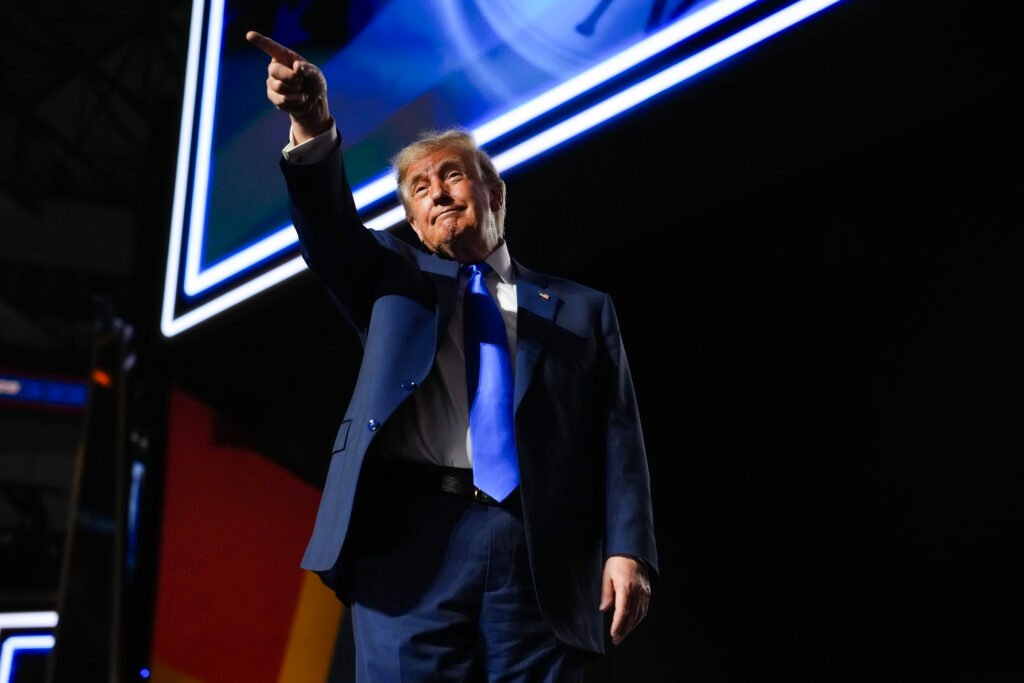
But in recent months, President Donald Trump and his administration are seemingly determined to destroy any lingering support that existed in the UK. Almost overnight, a series of antagonizing statements made by the president eroded all good will among British nationalists, and demonstrated his own misunderstanding of the character of the transatlantic alliance.
Trump began his assault by all but throwing his support behind Argentina in the country’s continued dispute with Britain over the Falkland Islands, suggesting that the U.S. would not come to Britain’s aid should Argentina again seek to invade the British territory.
For Britain, the events of the Falklands are of recent memory, events in which British men lost their lives in the defense of the sovereignty of their nation and its overseas territories. The Falklands have always been British, the inhabitants of the Falklands have repeatedly expressed their desire to remain British, and the British government has repeatedly maintained that it is a nonnegotiable matter.
Until now, this position was understood by Britain’s allies abroad. An American president directly intervening in questions of British national sovereignty is a remarkable departure from the relationship that existed mere decades ago, and there is a profound irony in the inability of the Trump administration, a supposedly nationalist administration, to understand the nationalism of its closest ally.
Trump’s remarks emboldened Argentina’s President Javier Milei, who immediately seized upon the opening, escalating Buenos Aires’s sovereignty campaign and threatening sanctions against companies operating in the islands.
Discontent with antagonizing the British right merely once in a single week, Trump made another swipe threatening Britain’s territory just days later, this time suggesting that Northern Ireland—a right-wing, Protestant nationalist stronghold—should be severed from the United Kingdom and “unified” with the independent Republic of Ireland.
“I don’t want to cause any problems, but I will tell you I’d love to see it unified. I have friends on both sides, great people, they’re Irish people, how can they be bad?” asked Trump. “I think it would be a great feather in everybody’s cap, it’s going to happen eventually, it may as well happen now.”
The British political left, for the most part, do not care about Britain’s overseas territories, as the Labour Party’s widely-panned surrender of the Chagos Islands has recently demonstrated. And given the Irish Republican Army’s historical links to communism, as well as the close ties between Northern Ireland’s Ulster Unionists and anti-immigration English nationalists, including the National Front, Trump’s comments served only to wound his last holdout of supporters across the Atlantic.
On the right, the response was swift, with every major conservative and nationalist political party quickly issuing statements condemning the remarks.
“The American President is talking about breaking up our country. This is unacceptable, this is insulting,” protested Rupert Lowe, whose new anti-immigration party Restore Britain has soared to become among the five largest, with more than 130,000 members, in less than a year. “I like Trump, I’ve backed Trump. But he should not be aiming to permanently damage our country to get back at the current malign Labour Government.”
Lowe warned, “Whether it’s a unified Ireland, or failing to support us properly on the Falkland Islands. Do not irreversibly damage our relationship because of this Labour Government.”
Conservative Party leader Kemi Badenoch also chided the president, declaring, “The Falkland Islands are British… no matter what Donald Trump says,” and describing Trump’s Ireland comments as “deeply unhelpful.”
After holding his tongue for the most part over Trump’s antagonistic comments on the Falklands, the Reform UK leader Nigel Farage—who campaigned onstage for Trump in both 2016 and 2020—also made his disagreements clear.
“Northern Ireland is a proud and integral part of the United Kingdom. The people of Northern Ireland neither want a referendum, nor unification,” he said. “I disagree with President Trump.”
Tensions between the British right and MAGA continued to rise on Saturday after it was reported that the Trump administration had smuggled an alleged pedophile out of the U.S. Embassy in London and back into the United States to prevent him from facing justice.
“The US Government is now protecting paedophiles,” protested Conservative MP Ben Obese-Jecty. “US Marines conducting a raid on British soil, on which they have no jurisdiction, to seize one of their own diplomats and then use US military resources to ferry the suspect out of the country and fly him to the US is completely unacceptable… Absolutely grotesque.”
That same day, it was also reported that the Trump administration would be selling Black Hawk helicopters to Argentina that could be used in a future conflict with Britain over the Falklands.
Trump’s rhetoric on the Falklands came suspiciously at the same time as Israel’s own antagonizing remarks over the territory amid worsening British–Israeli relations. Britain continues to move further away from the Israeli government, introducing sanctions and additional restrictions concerning Israeli settlements in the West Bank and moving toward restrictions on trade in settlement goods and services—a move to which Israel responded by announcing the closure of the British consulate in East Jerusalem.
As tensions have risen between Britain and Israel, the U.S. seemingly continues to prioritize its one-sided alliance in the Middle East over its historic blood kinship with Britain.
London and Washington have certainly disagreed before, sometimes profoundly, but disagreement once occurred within a framework of mutual respect. Whatever one’s position on Israel or the war in Gaza, the situation reveals that Washington and London increasingly appear to be pursuing different paths, and thereby demonstrating an extreme underestimation of the mutual interests they share. Like Britain, America faces its own existential threat from mass migration, and risks being swept under the wave.
For all the talk of replacing the old transatlantic order with transactional alliances, there is no obvious substitute for the Anglo-American relationship. There is no other country whose institutions, language, intelligence services, military traditions, and culture fit so naturally alongside America’s own. There is no other country that truly shares its spirit.
For the Trump administration to risk permanent damage to the relationship at a time when it looks increasingly likely that Britain will once again be governed by a nationalist party is particularly short-sighted. Britain is beginning to rediscover the importance of national interest and sovereignty, precisely the principles which many British nationalists once admired in Trump and the MAGA movement at large.
Britain has seen the worst of what globalism and multiculturalism has to offer. Today, huge swathes of the British Isles are unrecognizable, with native Brits inching ever closer towards minority status year by year. But revolutions, like swords, are forged in flame. Whatever emerges from the ruins of our ancestral land in the coming years will be nothing less than spectacular. It cannot be anything less than spectacular.
The political reality in Britain is looking increasingly optimistic. The political reality in the United States is not. As right-wing parties like Restore Britain are being pressured by the membership into abandoning the traditional fealty to Israel and its performative wall-kissing in favor of an unapologetic national self-interest unseen for generations, it is becoming increasingly apparent, even to the most slavish of supporters, that the MAGA movement across the Atlantic is at this point all but a heap of dying embers.
The Britain of today may no longer be the respectable older brother it once was, but the spirit of its people persists. There is work to be done, and that work must be done by Britons themselves. But the victory of Britain’s patriotic right is inevitable, and when it appears, I hope America will still be standing at the side of its historic ally.
The post The Trump Era Tests British-American Ties appeared first on The American Conservative.