




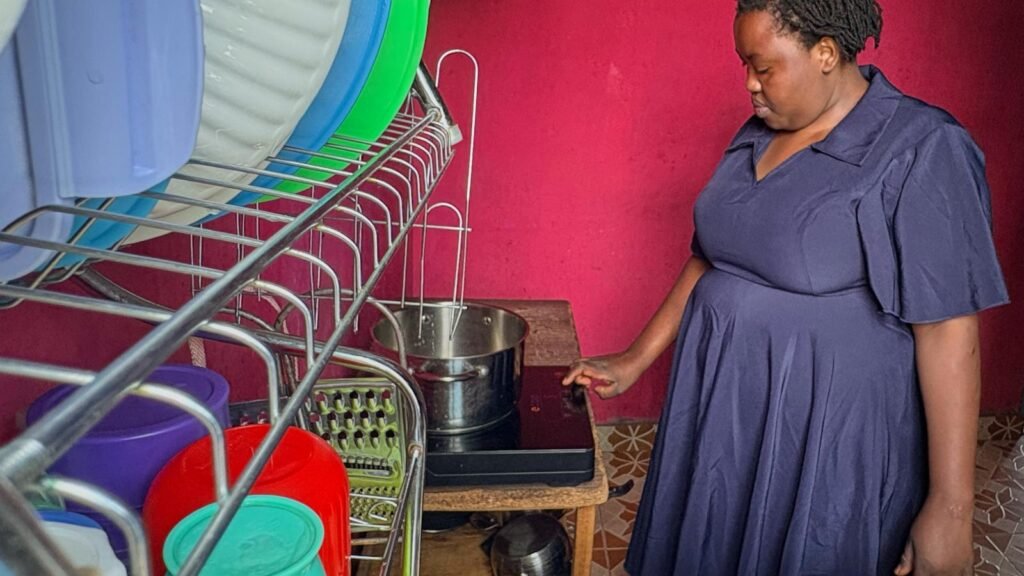
NAIROBI, Kenya — Every morning, Mary Kavutha prepares breakfast for her two young children using an induction cooker in her Nairobi home. Two years ago, the businesswoman relied on a charcoal stove that filled her kitchen with smoke and cost about $1.15 in fuel each day.
Today, she says, for 80 cents in electricity tokens she can cook several meals.
“It cooks much faster, and is much safer because I have young children,” Kavutha said. “With charcoal there was always smoke in the house. Now I can cook indoors comfortably, and I spend much less.”
Nearly 1 billion Africans still rely on charcoal or firewood for everyday cooking. The International Energy Agency (IEA) estimates that household air pollution from these fuels contributes to about 850,000 deaths annually on the continent.
Like millions of other Africans, Kavutha switched not out of climate concerns but because the stoves are affordable since they are underwritten by carbon credit financing, which allows clean cooking companies to raise capital against future revenues from emission reductions.
Clean cooking companies are betting that carbon finance, long criticized over concerns about the credibility of some projects, could become Africa’s most important tool for expanding cleaner household energy and reducing pressure on forests.
In June, the IEA announced Africa had secured $900 million in new financial commitments towards clean cooking technologies.
More than 30 governments in countries accounting for about 80% of Africans who still lack access to clean cooking have introduced 121 new clean cooking policies since the Paris climate summit in 2015, the energy agency said.
Clean cooking is not a luxury, but an everyday necessity affecting every household, Tanzanian President Samia Suluhu said after co-hosting an IEA conference on clean cooking in Dar es Salaam earlier this year. That followed the African Union’s Dar es Salaam Declaration on Clean Cooking, adopted by 30 governments last year.
Carbon finance has transformed what was once an expensive clean-energy product into one that millions of low-income households can afford, said Peter Scott, founder and CEO of BURN, which makes eco-friendly cookstoves.
“The only way clean cooking is going to scale on the continent is through carbon project finance,” Scott said. “Governments earn revenue and customers get a product they would never have been able to afford without that subsidy.”
The Nairobi-based firm said it has distributed more than 7.3 million cookstoves in 11 African countries.
“Our biggest innovation is not the stove itself, but the financing behind it,” Scott said. “Without that financing, many families cannot afford to switch.”
An efficient biomass stove that would normally retail for about $40 can cost customers as little as $5 after carbon subsidies. More expensive induction cookers are financed through carbon credits and short-term pay-as-you-go plans that spread payments over several months.
“Investors provide upfront capital that subsidizes the retail price of our stoves. In return, they receive revenue from carbon credits generated as households reduce their use of charcoal, wood and other polluting fuels,” he said.
The industry has adopted strict standards and more sophisticated measuring of emissions, including Bluetooth monitoring, digital verification and real-time usage data to address criticism of carbon credits.
Critics of the approach say relying too heavily on carbon credits to finance clean cooking is still risky.
In one setback, the Kenyan clean cooking firm Koko Networks, hailed as a poster child of Africa’s green transition, closed in February after failing to win a government letter of authorization to sell carbon credits.
Carbon money can help but should not be the foundation of the transition, said George Mwaniki, WRI Kenya representative and head of Air Quality for WRI Africa.
The problem, he said, is that carbon finance generally comes after the investment required to put cleaner cooking equipment into households.
“Carbon financing is more of a second financing source,” Mwaniki said. “That creates a problem for clean-cooking companies as they need money to manufacture and distribute equipment before they can generate the emissions reductions that ultimately produce carbon credits.”
“If we depend wholly on carbon credits to support the transition, it will be extremely slow and will not happen at the pace that we need it to,” he said.
Companies are adapting their approach to suit local conditions. BURN, for example, says its electric cooking is more viable in Kenya and Tanzania, while biomass stoves are preferred in the Democratic Republic of Congo and Madagascar.
Eco Safi, which operates in Uganda, Kenya, and Malawi, offers forced-draft pellet stoves and clean, renewable fuel made from agricultural waste. In Rwanda, BioMassters produces smokeless, locally manufactured, solar-powered pellet stoves and biomass-residue fuel, while ENEDOM manufactures agricultural-residue briquettes in Kigali.
For households like Kavutha’s, what matters is that a cleaner stove now costs less to own and operate than the charcoal she once depended on.
“My kitchen is cleaner, my children are safer, and I spend less,” Kavutha said. “That is all that matters.”
———–
The Associated Press’ climate and environmental coverage receives financial support from multiple private foundations. AP is solely responsible for all content. Find AP’s standards for working with philanthropies, a list of supporters and funded coverage areas at AP.org.