



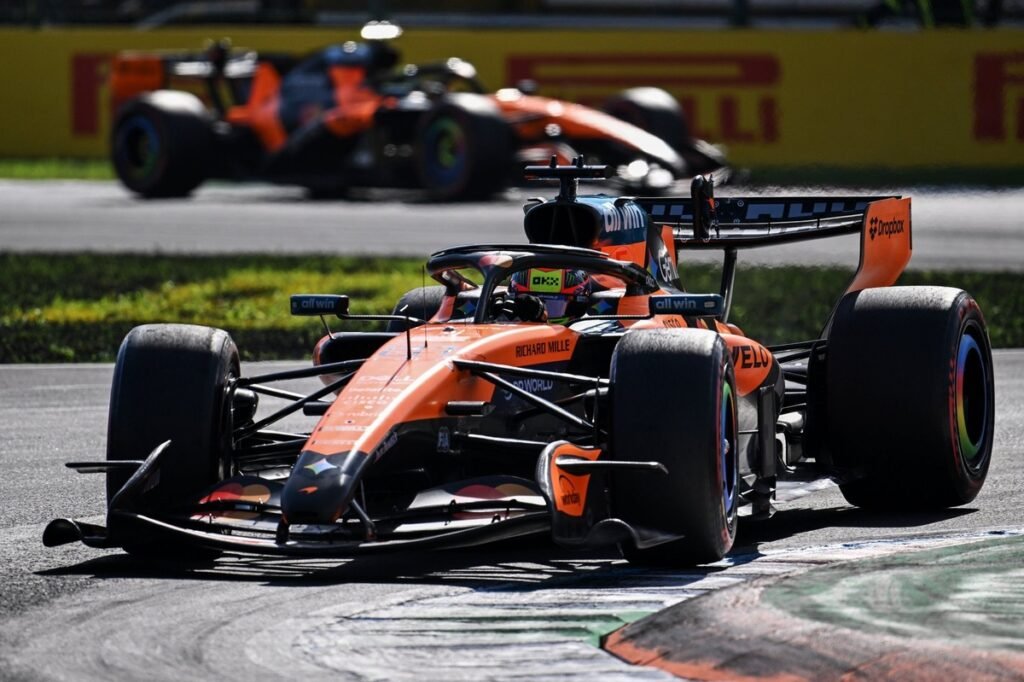
As Pierre Gasly and Alpine mastered the qualifying game to perfection at Monza, McLaren was one of several Formula 1 teams wondering what could have been after several key factors led to an underwhelming Italian Grand Prix qualifying result.
Off the back of two wins at high downforce circuits in Budapest and Zandvoort, high-speed Monza was never expected to be McLaren’s strongest track, both because of a slightly less aero efficient car and a known weakness in low-speed chicanes.
In fact, team principal Andrea Stella called the Temple of Speed a good test to see if McLaren’s progress was able to carry over on different track layouts. Looking at Q2, the MCL40 looked set to pass that test with flying colours, with Oscar Piastri and Lando Norris second and third behind Mercedes’ Kimi Antonelli.
But, like several other frontrunners, McLaren couldn’t replicate that form in Q3. Piastri only found a tenth on his first Q3 run, while Norris was exposed by Piastri’s off at Turn 1, robbing him of a crucial slipstream from his team-mate.

Photo by: Manuel Eletto / Getty Images
As Gasly’s shock pole in the Alpine showed, execution was everything, ranging from battery and tyre management to on-track positioning on the outlap to find the perfect tow. That’s where Mercedes’ George Russell lost pole as he was too close behind a cunning Max Verstappen and, according to Stella, his team’s Q3 execution also cost it a better result than third for Piastri and a lowly ninth for Norris.
“When we executed well, like in Q2, we had the two cars P1, P2, then they ended up P2, P3 at the end of Q2, because the cars were positioned in the right place in terms of slipstream, and both Oscar and Lando drove the cars very well despite the small gaps to the cars ahead,” Stella explained.
“[In Q3] on the first attempt probably Lando had too big a gap to the car ahead, he lost some time in some corners. So, in terms of execution we leave some performance behind, while Oscar did a very good lap. Then, in the final run, we had some issues managing the battery, and here in Monza every percent of battery charge costs you a significant amount of milliseconds. And then we had the issue with Oscar locking in corner 1. So overall, there are multiple areas in which we have not executed at the level that we should have.”
One mitigating factor, though Stella was keen not to call it in as an excuse, was McLaren’s garage position at the end of the pitlane. That heavily encouraged the McLarens to go out first for the final run, because if they had waited for others they were at risk of getting blocked leaving their pit box by a train of cars in the fast lane. That would relegate them to the tail end of the field, with a chance of not being able to start the final attempt before the clock runs out.

Piastri’s lock-up in Turn 1, hurting his team-mate in the process, sent the internet’s conspiracy theorists into a frenzy.
Photo by: Simon Galloway / LAT Images via Getty Images
As it was, Piastri and Norris were first in the train with no other cars to collect a slipstream from ahead of them. With the Australian then missing his braking point into Turn 1, it left Norris all exposed.
“At no point should this be an excuse, but when you are at the first garage, you need to be a little bit careful in leaving the garage too late, because if you are the last one, there’s a risk that then you’re not going to be in time opening the lap,” Stella explained. “So that’s also why we found ourselves being first, but probably we have to review the margins that we adopted, because then being first with the slipstream effect that we have this year seems definitely a position that you don’t want to be.”
Piastri’s lock-up in Turn 1, hurting his team-mate in the process, sent the internet’s conspiracy theorists into a frenzy, though both he and Norris had been struggling with front-tyre locking into the chicane all day. F1’s 2026 battery management needs on energy-starved Monza made it tough for drivers to work heat into their brakes, Stella explained, because they couldn’t afford to deviate from their optimal energy harvesting strategy.
“It’s very specific to Monza,” the Italian said. “There’s not much energy that you can spend in an outlap to properly work your brakes, because the harvest is so limited that you need to pay a lot of attention to it. It’s not like you can do lots of acceleration and braking, warm up your brakes, plus if you start to do so, you may lose contact with the car ahead, so it’s very tricky.
“That’s certainly something that we might have to look into in terms of making sure that the brakes can operate even without this input of energy that you have to give in outlaps, but I would say that the problem here is very much Monza-specific.”

McLaren was satisfied with the competitive running of its rotating wing design, a concept pioneered by Ferrari.
Photo by: Steven Tee / LAT Images via Getty Images
Overall, Stella felt the team’s underlying performance was encouraging for other low-draw circuits on the calendar and said its lack of aero efficiency was a “red herring” given the improvements the team had made to the car, including the introduction of its rotating rear wing design.
If Monza was an exam for the overall performance of the MCL40, Stella gave his team a half pass. “Our engineers have done a good job of minimising drag, and once we also optimised the power unit and the energy management, we were actually not that far off in terms of top speed. It would be a little bit of a red herring or an excuse to say we have too much drag.
“I think if we had done a better job of execution and controlling some parameters that don’t only depend on the pure performance of the car, we could have definitely qualified on the first couple of rows on the grid. So, it’s almost a half pass from a performance point of view in terms of Monza being an exam.”