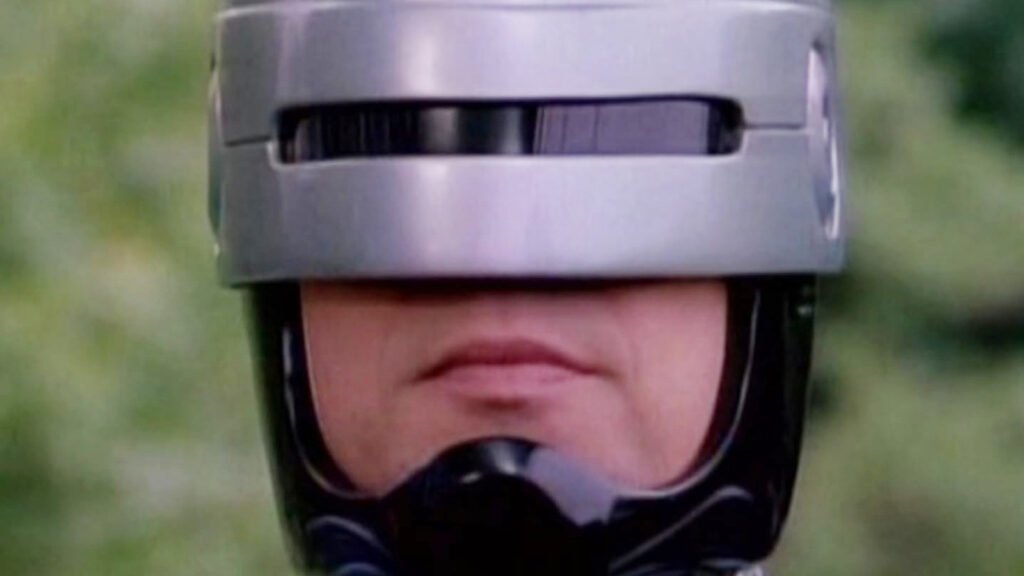
Diana Powers is the most interesting twist to the story in “RoboCop: The Series.” In the pilot episode, Diana’s boss, the wicked Chip Chaykin (John Rubinstein), along with the twisted scientist Cray Z. Mallardo (Cliff De Young), removes Diana’s brain and inserts it into NeuroBrain, a network that keeps all of Detroit’s infrastructure humming along. Chaykin and Mallardo’s original intent was to erase Diana’s consciousness, but RoboCop stops them before they can, allowing Diana to live on, essentially, in the cloud. Diana thereafter appears as a hologram, often only seen by RoboCop.
Diana and RoboCop are great counterpoints, with both having had their bodies co-opted by corporate malfeasance and been forced into privatized public works. RoboCop, however, is all brawn and might, an indestructible metal man with a giant gun. Diana, by comparison, is all disembodied consciousness and has no body. She, in turn, serves as RoboCop’s conscience, confidant, and perhaps the only person who can really understand him.
The “RoboCop” movies have never delved so deeply into RoboCop emotionally, as they’ve mostly been ultra-violent satires. In that respect, “RoboCop: The Series” unfolds more like a conventional sci-fi TV drama, and it, surprisingly, pulls off the tonal shift with aplomb. The show can still be silly, sure, but it’s also thoughtful in unexpected ways.
Obviously, the strictures of 1990s television dictated that “RoboCop: The Series” had to be less violent than Paul Verhoeven’s borderline X-rated “RoboCop” film, so RoboCop doesn’t always murder suspects. Moreover, this allowed for a recurring rogues gallery of fun villains. For instance, I was fond of James Kidnie as William Ray “Pudface” Morgan, a criminal who blamed RoboCop for the physical damage that he’d unwittingly caused himself.
You can watch “RoboCop: The Series” on Prime Video.