
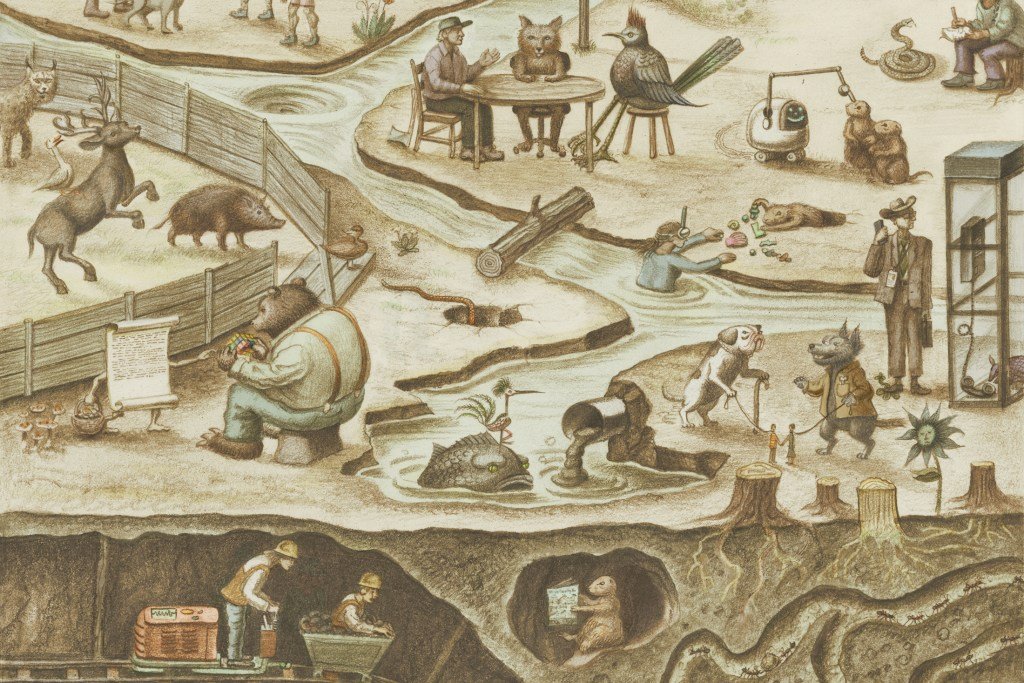
When it came to finding a cover image for August’s special issue on Conversations, we always knew that depicting the complexities of communication was going to be challenging. Fortunately, former Visuals Editor Roberto “Bear” Guerra had the perfect artist in mind: Armando Veve, a longtime contributor to High Country News. For years, Bear and I wanted to get his work on the magazine’s cover. The stars aligned for the Conversations issue, which also happened to be the last one with Bear’s name on the masthead.
Veve took on the assignment with all his typical delight and his distinctive style. By introducing a whimsical variety of unlikely conversationalists and their tense but friendly interactions while also leaving space for convivial silence, he mapped the winding nature of a good back-and-forth.

Veve is based in Philadelphia, Pennsylvania, but the Paonia, Colorado, HCN office was lucky enough to visit with him a couple years ago while he was passing through on a road trip to a Telluride art gallery. We hope you enjoy his company, too, through his thoughtful responses about the cover and his wider approach to art-making.
This conversation has been edited for length and clarity.
HCN: It’s clear that you spend a lot of time and care bringing an idea to life. Would you tell me about your process and how you’ve developed it?
AV: I work mostly in graphite on paper. I love its immediacy and its relationship to writing; I often think of drawing as a form of writing, but with pictures. My drawings build up like sedimentary layers: graphite, watercolor, colored pencil. For this piece, the color was added digitally because time was of the essence, but even the digital layers are still driven by the hand. The drawing and color merge on the printed page. In the context of magazines and newspapers, I think of the printed page as the final work.
HCN: Where do you find inspiration in your everyday life? What kinds of things drive you to make art?
AV: Drawing is how I process the world — how I center myself, how I make sense of chaos, how I give form to my inner thoughts and sift through them for something worth saving.
I’m always looking for inspiration, trying to be more aware of my surroundings and notice things that might otherwise get overlooked. I’m trying to use my phone less, pay more attention and engage with real humans more. I go on long walks, sometimes to photograph things, sometimes just to open up space in my mind and get the blood circulating. Lately, I’ve been leaning more on memory and less on reference material, and it’s been invigorating. It opens up new possibilities on the page.
Drawing is a way to remain in conversation with the past and the future, to inspire closer looking and new ways of thinking. But it’s also just like scratching an itch: peeling away a surface, digging deeper and deeper in search of some symbol or story.
“Drawing is how I process the world — how I center myself, how I make sense of chaos.”
HCN: For a number of years, you and I collaborated on the monthly illustrations for Heard Around the West. The spirit of that column is very much present in this cover, and alert readers might even recognize some familiar characters. When you work on an illustration, are those creatures forever filed away in your brain?
AV: I loved drawing for the Heard section. The stories Tiffany (Midge) curated were so strange and funny — like the man who pushed a peanut up a mountain with his nose, or the mutt named Ghost, who fled his home and lived among coyotes. If you look closely, you’ll find a few Heard easter eggs on the cover, including Bo the Bear and Ghost, two characters who first appeared in the column.
I love remixing older pieces and building connective threads between them, breathing new life into recycled motifs and characters. My cat is hidden in a lot of my pieces, too, so keep an eye out. I think of all of it as one evolving world. Each story gives me new subject matter and themes to explore, but they’re all orbiting the same source of energy.
My visual vocabulary, the objects, symbols, and motifs I use to carry ideas, are like characters in a play. They show up when they best serve the idea, or sometimes just because I’m bored and want an inside joke, probably just for myself. I especially love a character that doesn’t belong, that’s been pulled out of its original context. I keep coming back to this theme of displacement to defamiliarize the familiar. It comes out of a surrealist impulse, because fragmentation and cross-pollination feel like better metaphors for the world I understand.
HCN: What led you to your style — using humor and whimsy in this unique way?
AV: I’ve been fascinated by images that tell stories since the first time I saw Snow White and the Seven Dwarfs, and from the comics strewn around our house growing up. As a kid, I loved I Spy books and building mansions — which were really deathtraps for my virtual families — in The Sims; they inspired a sense of discovery and let you build your own narratives. There’s a kind of democracy in that: The viewer gets to find their own path through the image. I love maps for this reason, cross sections, too, because they highlight the interconnectedness of all things.
I like to revisit a work, build it in layers, edit and chisel away at it the way a writer prunes a draft. I like the strange stillness of a drawing. In our fast-paced world, there’s something almost absurd about spending so much time with a single subject, making marks with the direct, simple, ancient stroke of a pencil. There’s something elemental about it, too, literally drawing with the earth, graphite and clay encased in cedar.
It’s part of a long tradition of art made by human hands, one that feels increasingly threatened by AI and commercial appetites. It goes back to the earliest cave paintings, to illuminated manuscripts, to WPA murals, to the strange futuristic worlds of pulp science fiction.
Style is a tricky word, because it puts so much emphasis on the surface of a piece. I think of it as voice made concrete, like speech patterns, or the way I walk, the way I understand and process things. Humor is important in my work. If an image makes me laugh, I usually follow that impulse. Whimsy is a powerful force because it inspires free association and destabilizes familiar structures. The humor in my work usually isn’t intentional; it comes out of the natural interactions within a piece, or maybe it’s an association the viewer makes, something they’re reminded of. The drawing becomes a vehicle for that.
What did you draw inspiration from for the cover?
AV: As I was scratching my head over how to visualize conversation, I started thinking about maps as literal representations of webs of interaction and imagined a kind of landscape of conversation. That was it: “a landscape of conversation.” That phrase drove the whole idea.
I looked at medieval paintings and maps. I love their stacked sense of space, and the way they invite the viewer to wander through an image and find their own path.

What aspects of conversation felt like the most difficult to visually depict?
AV: In a drawing, there is a tricky balance between what to include and what to leave out. Building enough negative space and moments of rest between visual elements is always challenging. Like a good conversation, there need to be moments of silence to build meaning. My early sketch — was too crowded, and it was all loud. So I decided to reduce the scale of everything and open things up. This gives the viewer literal paths through the composition, and moments of silence, like the flower mourning the stumps.
HCN: Who are your favorite characters on the cover?
AV: My favorite moment might actually be the lone prairie-chicken. I love how confused they look.
To see more of Armando’s work and keep up with new projects, you can find him on Instagram at @armandoveve, or visit his website at armandoveve.com.