



In a college athletics culture operating without restraint or shame, where nobody is accountable and every crass act is rationalized in pursuit of wins and dollars, of course we have reached this point.
Of course there was an active NFL player in the transfer portal with plans to play college football this season. Of course a local judge set it in motion. Of course the setting is Louisiana, where the state’s flagship university is running its athletic department like a shady cryptocurrency company.
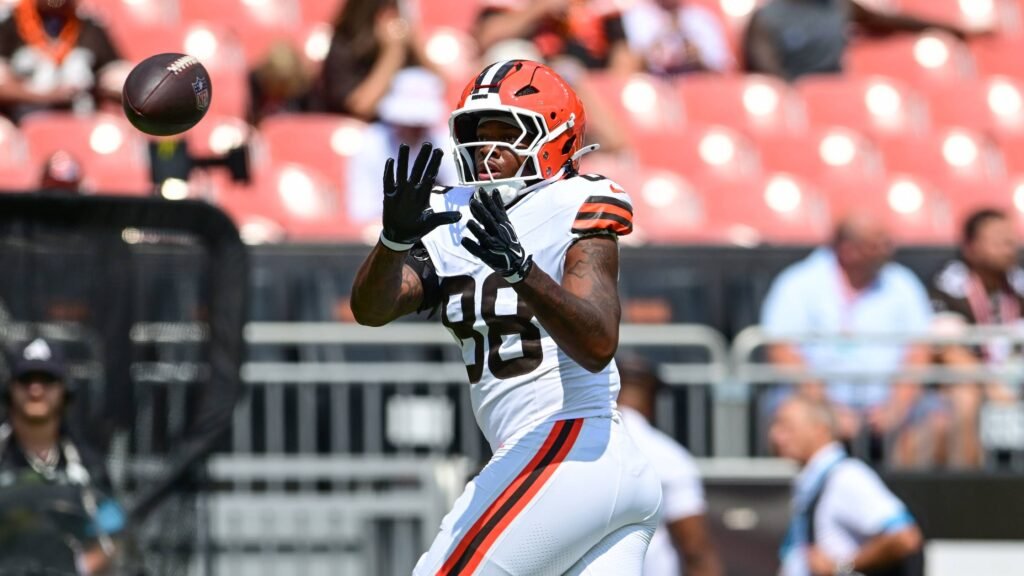
But the current state of anomie in college sports goes beyond tight end Dae’Quan Wright—a Cleveland Brown one day, an LSU Tiger the next?—and a court ruling pertaining to 16 players from the high school graduating class of 2022. This is bigger than the feckless administration at LSU and the banana republic in Baton Rouge. There have been other legal challenges to the NCAA’s eligibility rules in other jurisdictions, and a flurry of hurry-up suits is expected this week that could send more NFL training camp dropouts sprinting to play BMOC again by Labor Day weekend.
This is the perfect coda to an exhausting, bewildering, distracting offseason in college sports. Did you know football will be played Saturday? Not a damn moment too soon.
But some of those in uniform will be there after stints on NFL rosters, which is a backpedal down the career path that was never meant to happen. NCAA Council leaders—who are, in fact, campus and conference leaders—voted in the spring to immediately implement new, age-based eligibility bylaws granting athletes five years of competition. They did not grandfather in those from the Class of 2022 who had already played four seasons. That fomented the current fifth-year revolution in courts across the land.
The NCAA might be the all-time champion bureaucracy when it comes to creating unintended consequences for itself, and that ruling, at that point in the calendar, is certainly an instance of that. But the cutoff date had to happen somewhere, to some class. Life is hard that way.
The reaction by those now attempting the back-to-school lawsuit maneuver shows the inherent disdain within college sports for adhering to basic rules, guiding principles or espoused values. Few industries lie to themselves more than this one does about what they want and what they stand for. Among the things the involved stakeholders in this situation need to hear:
The players aren’t owed a do-over
The incoming Class of 2022 athletes who didn’t get a fifth year got a semi-tough break. (A much tougher break: actually being a college athlete during the COVID-19 pandemic in 2020 and ’21.) But when they enrolled in college, the rules gave them four years to play varsity sports. They got those four years. There was nothing taken away from them.
When the NCAA instituted freshman eligibility for the 1972–73 season, it did not retroactively add a year on to UCLA basketball star Bill Walton’s eligibility, or anyone else’s. When Colorado raised its drinking age from 18 for 3.2% beer to 21 for all alcohol in the 1980s, it did not keep open a window for those who were 17 at the time the new law went into effect. The rules changed, and that was that.
For those who played their four years, it’s time to move on with life. The pay is nice for some athletes in some sports at some schools, as it should be—this isn’t a condemnation of NIL in the slightest. But college athletics isn’t a “Peter Pan” arrangement. It doesn’t extend in perpetuity as a safe harbor from the adult world.
If an athlete is good enough to make a living in their sport professionally, fantastic. Even so, it comes with an expiration date. And for those who aren’t going pro, the job market awaits. Getting a degree, with the help of a brigade of academic support staff available, might actually be useful in life after sports.
Nobody is making the presidents, athletic directors and coaches take in these players
Just because athletes win an injunction doesn’t mean the schools have to jump through enrollment hoops, find scholarships for them and round up NIL cash to pay them at the last minute. But in the current no-limits climate, some schools find themselves utterly incapable of saying a simple word: No.
Coaches, do you like your team as it’s currently constructed? Then keep it that way.
Successful college coaches are often among the most powerful people in their town or state. Yet some of them prostrate themselves for the sake of talent acquisition. They live with a gnawing fear that they never have enough players. They always need more, more, more.
Sometimes chemistry experiments end in explosions
I heard a lot of relief from football coaches in recent months about the benefits of just one transfer portal period, during the winter. They had their rosters set by January or early February, which enhanced continuity and culture and player-driven leadership. All the buzzwords. All the stuff coaches say is vital to successful seasons.
Maybe those words don’t mean as much when you can add someone fresh out of an NFL camp in late August. Does the new guy take reps from the player who busted his rear end through winter conditioning and spring practice and preseason camp for his chance? How does that go over in the locker room?
For the love of Rudy, what about the walk-ons?
Few things whipped up more maudlin sentiment from coaches in the spring of 2024 than House v. NCAA settlement roster limits that would whittle SEC football teams from the size of small armies to 85. Their chorus of concern: We’re taking beloved walk-ons out of the sport. (Mostly this was about needing cheap labor as practice cannon fodder.)
Among those who lamented loudest: Mr. Lane Kiffin.
“It’s a major concern,” said Kiffin, the coach at Mississippi then and LSU now. “There’s all kinds of walk-ons that have become great players and gone on to win championships and are playing in the NFL. And just the locker room culture of having walk-ons, they become friends with the star scholarship players, and they’re in each other’s weddings down the road, and so many of those guys actually have become coaches. That’s part of the fabric of college football, is the walk-ons and their stories and their family tradition and going to the same school, and you would be removing that.”
Roster limits were increased to 105 last year, alleviating some of the tragic loss to the fabric of college football that Kiffin was so worried about. But let’s do some current LSU math.
The Tigers’ online roster, as of Saturday, listed 112 players. Some of them could be “Designated Student-Athletes,” which means they were designated at the time the House settlement was approved as players who would otherwise have been cut by the implementation of roster limits. But seven DSAs seems like a high number—and now there are more players coming in.
Let’s assume that Wright and two other former Mississippi players under Kiffin who were part of the Louisiana lawsuit all end up playing for the Tigers. Let’s assume the same of Notre Dame transfer Junior Tuihalamaka—another party to the Louisiana lawsuit. Who do you think has to go to make room for them on the 105-man roster that must be input the day before LSU’s season opener against Clemson on Sept. 5?
The walk-ons. Think of the toll that will take on LSU football weddings down the road.
But this is what a Louisiana court has countenanced, and in college sports these days an agreeable local judge can be as important as a star rush end or a tight end. When there is no restraint and no shame, of course this is where things can end up.
PODCAST: Listen to SI’s college sports podcast, Others Receiving Votes, hosted by Pat Forde, below or on Apple and Spotify. Watch the show on SI’s college YouTube channel or on SI TV.
 Add us as a preferred source on Google