




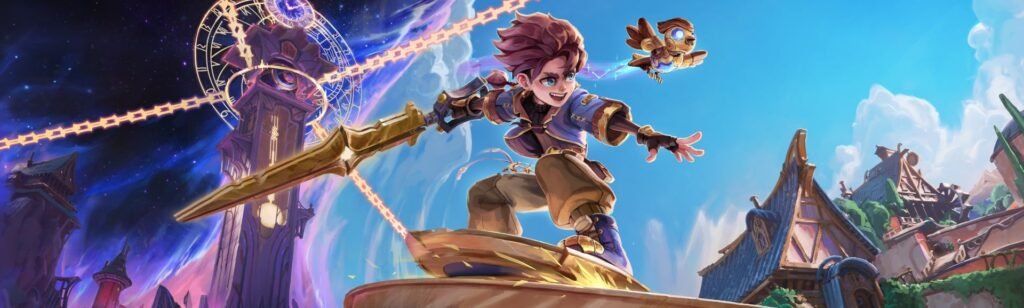

A couple of decades ago, before the average cost of game development launched into the stratosphere, it used to be common to see more experimental ‘AA’ releases on console. These lower-budget games didn’t have quite the same production value as the major, best-selling games of the time, but they often made up for this with their charm and willingness to explore novel concepts. Though this sort of game kind of dropped off as the indie scene gained ground, every now and then a modern game will come along in that vein, and Duskfade certainly fits the bill.
Indie developer Weird Beluga’s sophomore project following 2021’s Clid the Snail is a love letter to a bygone age, combining 3D platforming and light action combat elements with a heartfelt story. It’s got its issues and it certainly isn’t a home run, but this is the kind of game that you can’t help but love despite its shortcomings.

The story places you in the role of Zirian, a plucky boy who lives with his sister, Allira, in the magical world of Tick Town. The two are grieving the loss of their recently deceased grandfather, and the main conflict is set in motion when Allira messes with misunderstood technology leftover from the ancient and godlike Master Clockmakers.
The calamity brings with it monsters and an ethereal darkness over the land, overseen by a creepy clocktower she becomes locked within. Zirian then grabs his grandfather’s old sword and, accompanied by a loudmouthed and sassy clockwork bird named Cuckoo, sets out to both free his sister and learn more about the mysterious masters of time magic.
It’s a really interesting premise, and what it lacks in depth it makes up for with heart. Though the plot of Zirian’s quest is itself rather surface-level and straightforward, there are some real hard-hitting themes here of grief, love, loss, and learning to move with the flow of time and to stop living in the past. Were the story to focus solely on Zirian, Allira, and the relatively personal stakes of their struggles, I’d say the developers largely stuck the landing story-wise.

Unfortunately, the narrative often gets gummed up with attempts to spread lore about the Master Clockmakers and the catastrophe that led to their demise. Simply put, this element of the storytelling feels like the definition of ‘Tell, don’t show’. As you explore the world, you’ll come across echoes from the past in which a somewhat interesting story that happened completely offscreen is doled out to you in scattered chunks of dialogue between unseen characters.
It’s unfocused, occasionally confusing, and feels like a relatively shallow attempt to bluntly inject the world with a sense of mystique that feels a bit out of place. The good news? You can largely ignore most of these echoes and let this subplot fall by the wayside.
Gameplay is billed as that of a 3D platformer first and foremost, but there’s a light smattering of action-RPG mechanics in there to differentiate it from something more traditional. Levels aren’t quite laid out in the collectathon, open-playground style; instead, they employ a ‘wide-linear’ design in which you’re ultimately pointed in a specific direction, but with plenty of little side areas and extra hiding spots to find goodies. As you progress through worlds, you slowly expand Zirian’s kit and grant him new combat abilities and movement options, such as a hook to grapple to specific points or the ability to grind on rails.

Overall, level design can come off as a bit basic, but it usually manages to hit that sweet spot where it’s challenging enough to be interesting without being overly difficult or off-putting. Zirian feels a little floaty and loose, but it’s satisfying to learn how to chain his moves together and engage in a bit of skill expression as you navigate obstacles.
However, one rather irritating omission is the lack of any sort of map. Though the environments aren’t exactly massive, it can be a little annoying when backtracking through previously cleared areas looking for more collectibles and having no reference for the places you’ve already checked.
The RPG elements come in with how the collectibles reward you: ‘upgrade gears’ (this game’s version of jiggies or stars) and ‘time crystals’ scattered liberally around stages like coins can be traded in as currency at a shop for new upgrades and combat actions. While it’s nice that the collectibles have some meaning, the economy here wasn’t terribly well-judged, which leads to some points where you have a ton of resources and nothing to spend them on because you’ve unlocked everything you can for the moment. This limits the thrill of finding a new collectible, as you sigh and toss it on the pile and hope there’ll be more to do with it after the next boss fight.

Combat employs a hack ‘n’ slash formula that feels like it draws more than a little inspiration from Kingdom Hearts II, as Zirian snaps to targets and whacks them with his big key-like sword. As you explore and progress the story, Zirian gains access to more moves and some quick-use actions that grant the use of things like ranged attacks and damage barriers, but much of your damage will be doled out with basic combos.
It’s all pretty bog-standard stuff, and unfortunately this combat system feels like it just misses the mark. Not only are some of the mechanics a little too loose — such as an enemy lock-on system that doesn’t fully lock on all the time — but the enemy variety is relatively low and their attack patterns basic.
This leads to standard combat encounters that can feel like a chore, and the problem only compounds as the runtime wears on. Bosses break this pattern, offering up some modestly challenging and gripping multi-phase fights that often demand you utilise your whole toolset, but there are only so many of these in the game between the dozens of trash-mob encounters.

More importantly, the presence and focus on combat leads to a game that often feels like it’s unsuccessfully straddling two horses. Platforming feels great, but the level design can be a bit simplistic. There’s no map to aid in exploration, and rewards for poking around are often unsatisfying and anticlimactic. Combat is snappy and smooth, but the limited moveset, surface-level RPG mechanics, and low enemy variety put a somewhat low ceiling on its fun factor. Duskfade sometimes seems to have an identity crisis, then, as some of its game-design principles clash with each other as they vie for pole position.
The visuals are one of the highest points of the experience, as you explore many a shattered and dreamlike world on Zirian’s journey. Though the colour palettes sometimes look oversaturated, there’s rarely a shortage of graphical spectacle onscreen as you battle and platform your way through caves, coasts, and cosmic pocket dimensions. Animation is another point of praise, with many of the pre-rendered cutscenes having an almost Pixar-like quality to them as they reveal more of Zirian and his relationship with his family.
Performance is mostly solid, with the handheld mode capping the motion at 40fps and the docked mode upping that cap to 60fps. These targets are largely adhered to, but I noticed a few instances in which it obviously dipped when there was a lot of action onscreen or sightlines were particularly long. Despite these occasional hiccups, I’d say performance is satisfactory given that the drops never meaningfully affect the gameplay itself.
Duskfade is the epitome of a flawed gem. There’s an excellent game in here, but Weird Beluga hasn’t quite managed to find it yet. Duskfade thus feels like a great ‘proof of concept’ release where, despite the jank, it provides a strong foundation for a potential sequel to build upon.
Gorgeous graphical design, enjoyable platforming, and a heartfelt story all make this one a worthwhile endeavour, even if the combat can get tiresome and navigation frustrating. I’d suggest picking up Duskfade if you’re feeling particularly nostalgic for the early-2000s era of gaming, though perhaps this is one to hold out for a modest sale before grabbing it.