



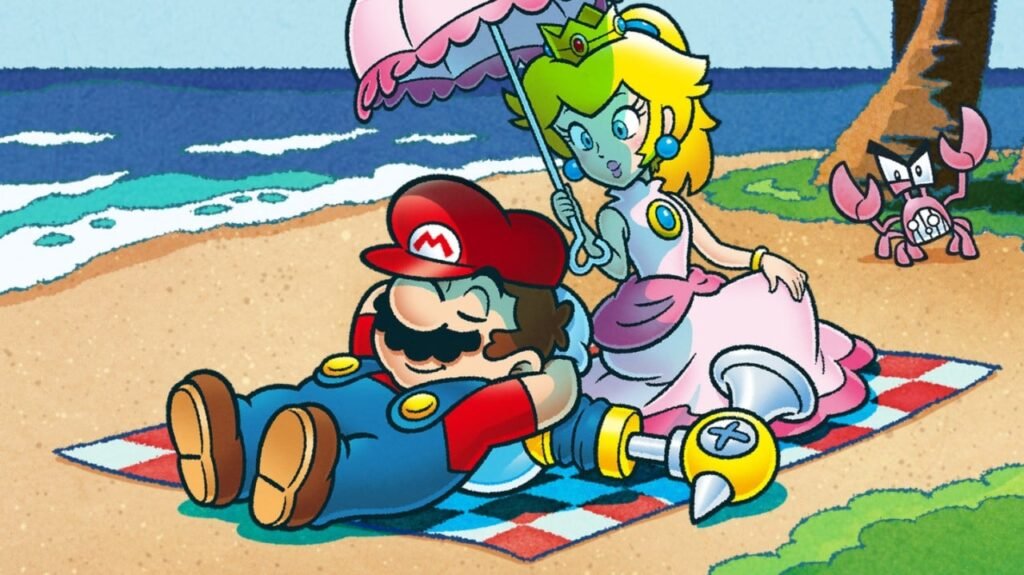
Water, water everywhere, so let’s all have a drink!
Version Reviewed: North American

This retro review was originally published in April 2010. We’re republishing it to mark the game’s arrival in the Nintendo Switch Online + Expansion Pack GameCube library.
Mario made his 3D platforming debut on the N64 way back in 1996 in one of the greatest and most influential pieces of gaming ever. Fast-forward the clock six years and you’ll find Nintendo’s attempt to beat the near-unbeatable in Mario’s next 3D adventure, but in order to top its predecessor, a hefty risk was involved. Nintendo certainly played the risky card with Super Mario Sunshine, but once again they pulled it off.
The game opens up with the first of many cutscenes; it is here that we get wind of the fact that Mario and co. are taking a plane to the sunny shores of Isle Delfino, a dolphin-shaped island (honouring the GameCube hardware’s codename during development) whose main inhabitants are the Noki and Piantas.

Once they land, however, the place isn’t so sunny, and there’s paint everywhere. After finding FLUDD — or the “Flash Liquidizer Ultra Dousing Device”, a water-shooting jetpack created by E. Gadd, creator of the Poltergust 3000 from Luigi’s Mansion — Mario is soon cleaning up the paint on the airstrip, and to reward the perfectly nice plumber for this wonderful deed, he is thrown into prison overnight, blamed for the spread of pollution and ordered to clean up the entire island.
Though the story isn’t the greatest ever told, and with Mario games they rarely are, the cutscenes in Mario Sunshine make the story seem a lot worse than it is: the voice work just isn’t loud enough to make itself heard over the background music, and even so, the voice acting itself is seriously lousy. Not even Charles Martinet seems to have gotten Mario’s classic yippees and woohoos nailed in the cutscenes. The prison cutscene in particular looks as though they worked on it for the last couple of hours before home time, and nobody went back to clean it up.
Delfino Plaza acts as the hub for Isle Delfino, with different portals, cannons and pipes taking you to your designated areas around the island. It works well and there’s plenty to do just in the plaza itself, including finding more Sprites and doing odd jobs for the local denizens. There’s always something to do, and anything worth knowing about to help you progress in the game is helpfully shown via news flashes that appear at the bottom of the screen. Anyone who’s played around in the castle on Mario 64 will be happy to know that Delfino Plaza is just as beautiful a place as the castle grounds, with plenty to see and do.
Gameplay-wise, the majority of Mario’s moves from Mario 64 make a welcome return and operate smoother than ever. The gameplay is also where Nintendo took the aforementioned big risk, and that is the introduction of the aforementioned FLUDD. Mario takes this watery jetpack with him wherever he goes, using it to float through the air over any large gaps, rocket himself high into the air, and propel himself forward at tremendous speed.
Overall, it’s a risk that paid off, and while some will grumble that it plays differently to Mario 64 because of this addition, it’s huge amounts of fun to play about with FLUDD and explore its control possibilities, especially using the GameCube’s original analogue triggers to precisely adjust the flow.

Yoshi comes on board this time around, too, and aside from floating in the air, he can also shoot juice from his mouth after eating certain fruits. Eating different coloured fruit alters the colour of Yoshi’s juice [Eww. – Ed.], turning enemies into blocks of varying properties. Yoshi doesn’t add a great deal to the gameplay, and seems to only be there because people demanded him, though he is a welcome addition nonetheless and seems to fit right at home on Isle Delfino. One annoying aspect is the fact that you’re just about always surrounded by water in most levels: having to ride something that dies every time it touches the stuff tends to get frustrating.
The trouble with a location like Isle Delfino is that everything looks pretty much the same. No matter where you go on the island, you’re still going to feel like you’re in a resort, with very little variety. You can go to a hotel on a beach, to a theme park on a beach, to a village by a lake, etc. We understand the need for water in a game like this, but it’s somewhat restrictive when it comes to biomes, save for Corona Mountain’s volcano.
Some nice diversions are thrown into the mix, however, such as the secret caves located in many of the worlds, inside which you lose FLUDD and become completely reliant on classic platforming ability. It really feels like it was a stepping stone to what eventually became a full-blown classic return in Super Mario Galaxy and beyond.

Sunshine’s audio is a bit of a mixed bag, too. Soundtrack-wise, Koji Kondo and Shinobu Tanaka astound and you’ll find yourself humming just about all of the tunes in your daily routines! It includes retro Mario, tribal sounds, samba rhythms, and more. The classic Mario theme makes a welcome acapella return, and makes the old sound brand new again.
On the other end of the audio spectrum, you end up dreading talking to the locals, as they sound like Cletus from The Simpsons. Luckily enough, you don’t really have to talk to them all that much, and it’s a lot more fun to just jump on their heads over and over again.
Though it’s not exactly the Mario game everyone was thinking of when it came out — much like the Legend of Zelda: Wind Waker wasn’t as expected — it’s still a classic Mario title that’s definitely worth having in your collection if you’re a fan of the ol’ plumber or platforming games in general. It’s a shame that there couldn’t have been more variety in the levels, but there’s a great deal of fun to be had regardless, and anything else that could set it back isn’t really a dealbreaker.
Super Mario Sunshine is a title that undeservedly gets overlooked when Mario Galaxy is described as ‘the true sequel to Super Mario 64’, but Sunshine still shines brightly.