
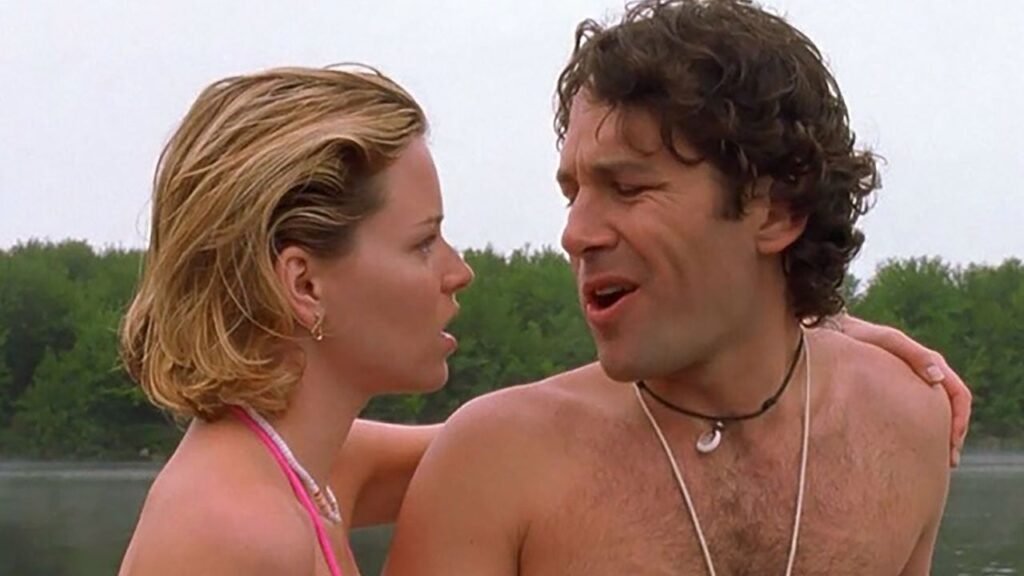
It’s not very professional to just overtly and continually gush to a director you’re interviewing about how much you love their movie, so I’ll confess to not being at my most professional when interviewing David Wain about the 25th anniversary of Wet Hot American Summer… or, as I’ve described it since seeing it on opening weekend, One of the Greatest Cinematic Comedies of All Time.
When Wet Hot opened in the summer of 2001, it was — to put it mildly — not met with a positive reaction overall. The reviews were dire, the box office was nearly non-existent, and it felt like Wain’s feature film directorial debut — he and the film’s leading man, Michael Showalter, also wrote the screenplay together — was destined to be quickly forgotten. But that’s not what happened at all, as Wet Hot’s theatrical afterlife on VHS, DVD, and cable led to it gradually finding an adoring cult following who embraced its wonderfully wacky, weird, and surreal tone, and realized just what comedic gold the cast had delivered, powered by Wain and Showalter’s script.
And what a cast it was, which included several of Wain and Showalter’s fellow alumni from the sketch comedy group/MTV series, The State, such as Ken Marino, Michael Ian Black, and Joe Lo Truglio, and proven TV-honed talent like Janeane Garofalo, David Hyde Pierce, Molly Shannon, and Christopher Meloni. And then there was Paul Rudd, a familiar face since Clueless who hadn’t quite found his footing as a movie star yet, along with a few unknowns with names like Amy Poehler, Bradley Cooper, and Elizabeth Banks. With Wet Hot American Summer returning to theaters for a 25th anniversary run this coming weekend, I recently spoke to Wain, who explained how wonderful it was to slowly but surely see the adoring fandom for the movie emerge. Wain explained that he felt, in some cases, that people might have re-evaluated the movie after not clicking with it the first time, and that ultimately, its initial failure might have helped some connect to it because “just the fact that it never was a big hit, there was a sense of discovery and ownership over it.”Wet Hot American Summer: First Day of Camp PhotosThe Wet Hot cult would eventually be strong enough for Netflix to order a follow-up in the form of two miniseries: 2015’s prequel, Wet Hot American Summer: First Day of Camp; and the 2017 sequel, Wet Hot American Summer: Ten Years Later. That’s a pretty amazing outcome for a box office bomb. Wain stresses there are no current plans for another entry in the series, and that could be it for the Wet Hot story… maybe. “I would never say never. I think that there’s always a possibility that there’s a time and place and right idea to do it again. But I will say, I very much like the ending that we did at the end of Ten Years Later.”Feeling more likely in the near-ish future is the chance of getting a new physical media version of Wet Hot, which hasn’t happened since a 2015 Blu-ray which ported over the 2002 DVD special features without adding anything new. Though nothing was promised, I sure felt like Wain’s answer implied such a thing might be in the works when I asked him about a possible 4K release, as he replied: “I believe that there might be… I think there might be. I hear…. I’ve heard things. I don’t know. I hope so. Wouldn’t that be nice!?” Wet Hot American Summer: Ten Years Later PhotosRead on for my full conversation with Wain about Wet Hot American Summer, as he delves into the origins of the film and the stories behind some of its most memorable moments, including a casual trip to town for some camp counselors that rapidly gets darker and darker, a car crash out of nowhere, and a running gag involving the sound of breaking glass… or is that breaking pottery? This interview has been edited for length and clarity.IGN: I think you guys have joked that too many people claim to have seen this movie in the theater to be mathematically possible, but I swear I did see it opening week at the Mann Plaza in Westwood, CA. I remember my friend and me saying afterward that we wished more movies were like it. David Wain: I love that! And I know it was playing there. I remember that, and I know that I have a few friends that saw it in that same theater that weekend.IGN: Reviews weren’t great at the time, nor was the box office… Wain: That’s an understatement.IGN: True! So what does it mean to you to see that initial reaction, but 25 years later, that people still very clearly care about this movie so much?Wain: It’s just so validating and encouraging and lovely and a wonderful feeling to know that you’ve created something that really does have lasting value for people and that makes people laugh or smile. The greatest compliment I always get is people say: “This is my litmus test for who I know I can hang with.” So it’s only positive and great.IGN: Did you start to perceive a cult following building around the movie pretty quickly after, or did it feel like it slowly started to grow?Wain: It was very slow and steady. It wasn’t until a couple years after it was out that I felt like there was any life beyond the failure at the box office, and then it just grew and grew very steadily, which was so cool. And some people didn’t like it at first, but then you see it the second time and you’re like, “Oh, wait a minute, it’s my favorite movie.” I’ve felt that way about certain movies. Just the fact that it never was a big hit [meant that] there was a sense of discovery and ownership over it.”Just the fact that it never was a big hit [meant that] there was a sense of discovery and ownership over it.”“IGN: What were the initial conversations between you and Michael Showalter that first led to Wet Hot?Wain: We had been working on a different script, which was a romantic comedy that took place in a high school. And it just felt like, “Wow, this is hard. It’s a lot of work!” [Laughs] And so, the impetus was [that] we wanted to write something that we could shoot the next month that would be just our friends with a camera. Just an outline too, because our friend Sam Seder had made this movie, Who’s the Caboose?, which was a 20-page outline, and then he ran around with his comedian friends and improvised scenes. We thought maybe that’s it. What’s the easiest lift? We can just only cast our friends and only our friends! We can shoot it all outside! One costume change, one location. And what’s sort of organic as something that we both have a passion about. And so… camp! “Okay, we’re gonna make a movie about camp.” The next thing was the two of us just dumping to each other every story we remember about summer camp, and the characters and the people and the funny things that happened, and the incidents, and just vomiting all of that into a giant pile. Then we started taking index cards and being like, “Oh, well maybe this goes with this? And this character could be the one who does that.” That’s how it came together.IGN: The script was first written in 1997. Did it change a lot in those three years while you were trying to get the funding to make it, or was it pretty much locked in?Wain: Oh no, it [changed] a lot. It was the first screenplay I think either of us… Well, maybe Michael had written one or two things, but it was definitely the first screenplay that I had written and we really worked hard on it. We had nothing much else to do and we didn’t have the money for it, so we just kept going back to the script and trying to make it better and have a table read. And I know one of the things we did midway through is condense it from a whole summer to one day, and other changes like that. We took characters out and kept changing things. So yeah, we did a lot of work on it over those years.IGN: Behind-the-scenes stories about this movie inevitably involve the non-stop rain you battled while filming in Pennsylvania, and I’m sure there was just the overall pressure of making your first feature. But you were part of this amazing group of people, many of whom you were already friends with. I just re-listened to the DVD audio commentary you recorded 25 years ago… Wain: Oh my goodness!IGN: [Laughs] …and you mentioned how the line between real summer camp and the movie was thin for the cast and crew. So was the mood still pretty light, even with how tough it was to get the movie made? Wain: Yeah, because everyone was so thrilled to be making a movie. With so many of us, it was our first time being on a movie set, or even any professional set, and so it was really… I think everyone was so so excited about it, and all the things that were hard were just part of the puzzle — fighting the rain and the time and the budget and all the normal things that happen in an independent film, which was all new to us.IGN: The movie has so many surreal touches, like the guys running up to the wall after the trip to town sequence or blatantly showing the stunt motorcycle rider for Joe Lo Truglio. How much of those little pieces were scripted versus finding them in the moment on set? Wain: I would say the majority were scripted, but certainly I think the running up to the wall thing was definitely a more ‘on the day’ idea. Somebody was asking about that recently, and it might have actually just been a true accident where they just sort of did that [as a joke] and didn’t even realize it was on screen. And a lot of it was solving problems that I didn’t know how to solve because I wasn’t an experienced director. Like someone asking, “[David Hyde Pierce] is carrying a trophy now. What does he do with it?” And I’m like, “Well… Just hand it off.” You know, those things came up in the moment. But it was case by case, because many others were part of the plan.IGN: I’m gonna try not to turn this interview into “it’s so funny when…” and go over every moment that makes me laugh, but I’ll ask about a couple. There’s this great running sound effect gag with the glass smashing when anyone throws something off screen. Was that always planned? Wain: No, that was an editing room thing where we were playing around on the Avid. We grabbed the stock sound effect of the Pottery Crash, which any sound designer will tell you has been in every library for all time, that exact sound. And so we stuck it in that first part where it made sense, and then just thought, “Oh, let’s just put it in there too,” and just had this little inspiration to keep adding it.IGN: See, this is a very important moment for me, because now I’ll stop saying Glass Smash sound effect and I’ll know to say Pottery Crash.Wain: I thought it was called Glass Smash too for years! It wasn’t until we did the [Netflix series] sequel that I had to re-find that sound effect, and I learned it’s called Pottery Crash.IGN: If I was to name the funniest moments in movie history, I would definitely include when Ken Marino crashes the van, thanks to the timing of it and the fact that there’s no explanation for what he saw or why it happened. Anything stand out to you about either the building of that joke or the filming of that scene?Wain: Oh, I can tell you a lot if you like.IGN: Please do!Wain: It’s the one scene in Wet Hot American Summer that is most closely mimicking something that really happened to me at summer camp, which is that I drove a bunch of kids up to Mount Katahdin in Maine, and I was anxious to go back that night to see a girl that I had just met even though it was night. It was a really dark night, and not recommended [I drive], and I had just gotten my license only months before. I was 16 years old. So I was like, “Guys, I’m going to take off instead of staying overnight to drive back during the day.” I drove back in the middle of these dark, windy, pitch black rural roads, like state park pathways. I was falling asleep, and I remember the song “Light My Fire” was playing, and I smashed into a tree and then hit what I thought was the brake, but it was the accelerator, and so I smashed further into a tree. I was a couple miles from the campsite and many miles from anything else, and basically by touching trees, I finally found my way back to the campsite. I was forbidden from driving for the rest… Well, all junior counselors were forbidden from driving from then on. I totaled the van. So we recreated an inspired-by version there [in Wet Hot]. But then I also remember that it didn’t occur to me until later, after we had finished the movie, how unmotivated it was. Because I was remembering my own experience, which made more sense because it was pitch black in the middle of the night and you couldn’t see anything. In this case, he was just like… [mimics Marino singing and then suddenly crashing]. It was really fun because on a small movie like this, this was a real stunt, and we had a stunt driver, and we’re going “Nobody move until it’s done!” to make sure he’s safe. It was very exciting. IGN: Much has been said about the amazing cast of Wet Hot American Summer. You had your friends from The State, and comedy pros like Molly Shannon, David Hyde Pierce, and Janeane Garofalo. But what do you think was the magic in the water and this Midas touch as you started to see Amy Poehler, Bradley Cooper, and Elizabeth Banks become big stars? Or Paul Rudd, who was somewhat of a star at this point, but would really explode afterward?Wain: I really do genuinely think it’s just a crazy and amazing coincidence. We picked people that we thought were great, and Elizabeth Banks walks in and auditions, and Bradley Cooper walks in and auditions, and we thought all these people were amazing and impressive. Did we think they would become the biggest stars in Hollywood? No. How could you ever predict something like that? But it is a wild thing. And certainly when we were making the movie, we definitely felt like we had this special group here, and it was really cool. IGN: I went to a cast signing for Alias in the Fall of 2002, and my friend and I told Bradley Cooper how much we loved Wet Hot American Summer. He truly lit up and was so appreciative, and it felt like one of the first times it had been mentioned to him in the wild. Wain: He’s always been so nice. He’ll call out the movie or me in award speeches and stuff, and he’s just incredibly generous. Because, I mean, I did nothing for him; he’s like a machine, a rocket ship.