



When tired Mormon settlers crested the Wasatch Mountains in July 1847 and first beheld the Great Salt Lake, they almost didn’t believe their eyes. But this was no mirage. And though the vast lake turned out to be saline, they knew that all of that water originated as freshwater, mostly from the abundant snowpack of Utah’s high mountain ranges — the Wasatch, over which they had just struggled in their wagons, and the Uintas. Despite the appearance of a desert landscape, they could see that water flowed from alpine valleys in frolicking creeks, which collected into a river — which they promptly named the Jordan — before emptying into the gigantic salty lake. Their leader, Brigham Young, took one look and famously declared: “It is enough. This is the right place.”
Right there, the settlers founded Great Salt Lake City (the name was shortened in 1868) and quickly set about damming and diverting creeks to irrigate fields and pastures, creating a thriving irrigated paradise, which they called Zion, in an otherwise arid and forbidding land.
The Great Salt Lake is the largest natural lake west of the Mississippi River and the largest saltwater lake in the Western Hemisphere. It historically covered between 1,700 and 2,000 square miles, depending on annual precipitation, before large-scale river diversions began in the 20th century. As a major source of water in the middle of the arid Western U.S., it is the single most important node on the Pacific Flyway that connects South America to the Arctic, which hosts more than 10 million annual migrating birds representing more than 230 species. Its critical importance to avian life cannot be overstated: It supports up to 60% of the world’s Wilson’s phalaropes, about a quarter of North America’s snowy plovers and pintail ducks, 10% to 20% of its white pelicans, and 50% to 90% of its eared grebes, which gather there in late summer to molt and fatten on brine shrimp in preparation for their migration southward.
The Great Salt Lake is unique and uniquely fragile, utterly dependent on freshwater inflows to maintain its brackish wetlands, which are hotspots of biodiversity. Its significant degradation, much less its loss, would be devastating, not only to bird populations throughout the Western Hemisphere but to the $1.9 billion diversified local economy that it supports, as well as to the respiratory health of the nearly 2.7 million people who live in the four-county megalopolis known as the Wasatch Front — the vast majority of Utah’s total population of 3.5 million.
The Great Salt Lake is unique and uniquely fragile, utterly dependent on freshwater inflows to maintain its brackish wetlands, which are hotspots of biodiversity.
And yet, the state of Utah is foolhardily rushing to dry it up.
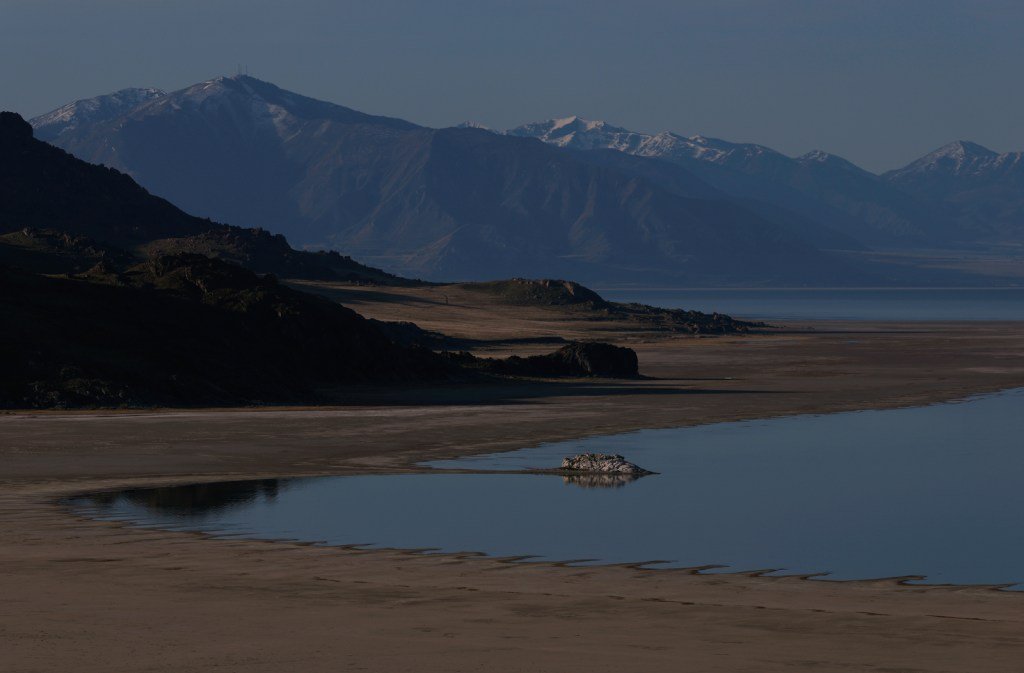
The lake is fed by three rivers: the Jordan, Weber and Bear, all of which are diverted in some part before reaching it. Overall, inflows have been reduced by about 40% since the late 1980s, and water volume is down by an alarming 64%. The lake level has dropped 11 feet since the 19th century. This shrinking footprint, nearly half of the lake’s historical average, not only raises salinity, which threatens ecosystems, it has exposed close to a thousand square miles of playa, or dry lakebed, to fierce winds. Those winds kick up dust laden with heavy metals and toxic compounds, both naturally occurring and derived from intensive mining and mineral extraction around the lake. A 2020 study published in the journal Atmospheric Environment found that air pollution, a growing portion of it linked to the region’s fierce dust storms, causes between 2,480 and 8,000 premature deaths every year, shortens average life expectancy up to 3.6 years and costs Utahns $750 million to $3.3 billion annually. The Wasatch Front is one of the fastest-growing regions in the country, yet more and more people are talking about leaving because of the worsening air pollution.
In 2022, the lake declined to its lowest level in history, an area of just 888 square miles. As the dust storms became too frequent and severe to ignore and public pressure for a solution mounted, Utah Gov. Spencer Cox simply told Utahns to pray for rain.
But the lake’s decline isn’t due to any act of God. Nor is it due to a lack of rain — though decreased river flows due to global warming are steadily making matters worse. The main culprit here is the overuse of water — which is the direct result of decades of actions by Utah politicians like Cox, and by the public institutions charged with safeguarding the state’s precious water resources — all of which have failed to heed Brigham Young’s declaration: “It is enough.”
Utah, an arid state, has the nation’s second-highest per-capita water use, behind only neighboring Idaho. Most municipal water is used to water lawns, golf courses, sidewalks, driveways and streets; 60% of household water use goes to watering the outdoor landscape, compared to the national average of 30%. And much of that landscape is lawn: around 300,000 acres of grass, mostly Kentucky bluegrass, which requires 24 to 30 inches of water over its growing season — two or more feet of water just to keep grass green. Urban Utah — or, more accurately, suburban Utah; outside of downtown Salt Lake City, this is a land of single-family homes — is a mirage-like green swath in the desert: miles of lawn, an irrigated Kentucky beyond the 100th Meridian.
All of that greensward is enabled by perverse policy incentives, beginning with obscuring water’s true cost. Utah has the cheapest municipal water rates in the U.S., so Utahns waste water because it costs them little to do so — or so it seems. But Utah also relies more on property taxes to pay for water than any other Western state. A large percentage of these taxes — on homes, businesses, cars and other property — goes to fund water diversion and delivery infrastructure, offsetting and obscuring water’s true cost. Property taxes often make up more of a water district’s revenues than water sales, with some rural districts getting 75% to 100% of their revenue from the taxes, rendering that cost, for all intents and purposes, invisible to water users.
In turn, all this high usage is cited to justify the need for more water projects. Currently, despite the obvious shrinking lake and the associated drastic consequences, the state is proceeding with plans to divert an additional 200,000 acre-feet a year from the Bear River into a 90-mile pipeline — largely in order to water more suburban lawns. This is more than the 4 million residents of the City of Los Angeles use in a year. The water is not needed, and the cost — billions over decades — will be borne by future generations of Utah taxpayers.
If the Bear River Development project goes forward, it will effectively be the death of the Great Salt Lake. How do Cox and other elected officials expect to get away with it? The answer is, the state’s dysfunctional institutions.
Even more invisible than the hidden cost of water is the web of vested interests that push and profit from water projects: legislators, often with business interests in the project zones, water district employees, lobbyists and project contractors. By law, water districts have unrestricted ability to lobby and to fund lobbying and are shielded from public scrutiny. The Water District Water Development Council — in effect the lobbying arm of the water industry — is exempt from all open government laws requiring open meetings and minutes, one of the few Utah entities so protected.
Back in 1951, the Utah Legislature passed the Water Conservancy District Act, which allowed the creation of independent water conservancy districts. The majority do not sell water directly to consumers but instead deliver wholesale water to cities or other retail water suppliers. Nevertheless, all can issue bonds and levy property taxes, even in the absence of approved project expenditures, and the taxes are never required to “sunset,” accumulating instead in slush funds that are targeted by project proponents and lobbyists.

Making matters worse, this past February, the Utah Legislature passed and Gov. Cox signed HB 392, which allows the state to kneecap lawsuits aimed at curbing its actions by blatantly judge-shopping. At its sole and absolute discretion, the state can remove a case from a particular district judge and reassign it to a hand-picked three-judge panel, while remaining immune from any challenge or judicial review. This will prohibit advocacy groups like the Utah Rivers Council, which has fought for years to block unnecessary water projects in the state, from defending the lake.
All of this mismanagement and deliberate obfuscation — what amounts to corruption — is a recipe for the destruction of not only the irreplaceable Great Salt Lake but all water resources and water-dependent ecosystems in Utah. Brigham Young must be turning over in his grave.