



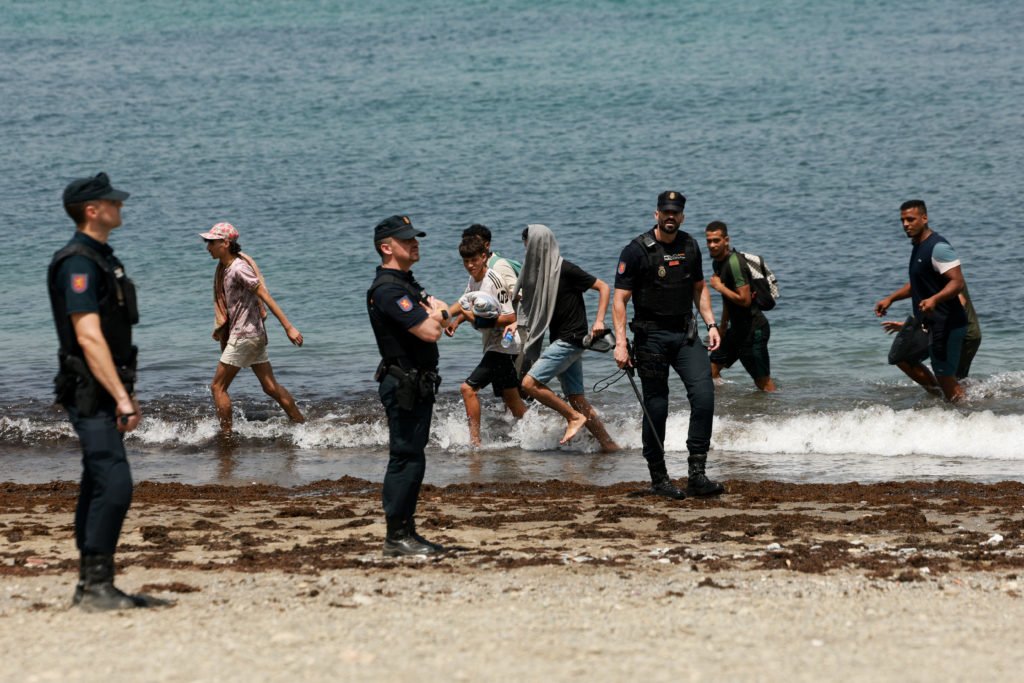
CEUTA, Spain (AP) — Spain announced it was installing a 500-meter-long (1,600-foot) containment barrier on the sea border between its North African territory of Ceuta and neighboring Morocco after between 50,000 and 60,000 migrants breached the frontier earlier this week.
WATCH: Tens of thousands of migrants enter Spanish territory, then return to Morocco
The death toll climbed to 67, including some who drowned and others who were killed in a stampede to cross a breakwater barrier, the Spanish government said Saturday.
Spanish Prime Minister Pedro Sánchez slammed the reaction of some other European Union leaders to the events in Ceuta, saying calls for Spain to be suspended from the EU’s borderless Schengen zone were “driven by prejudice, fake news, ignorance, or political interest.”
A handful of exhausted migrants who swam to Ceuta’s urban Tarajal beach Saturday morning were met by soldiers who escorted them back across the border. Spain’s interior ministry says the majority of those who entered the territory have already returned to Morocco.
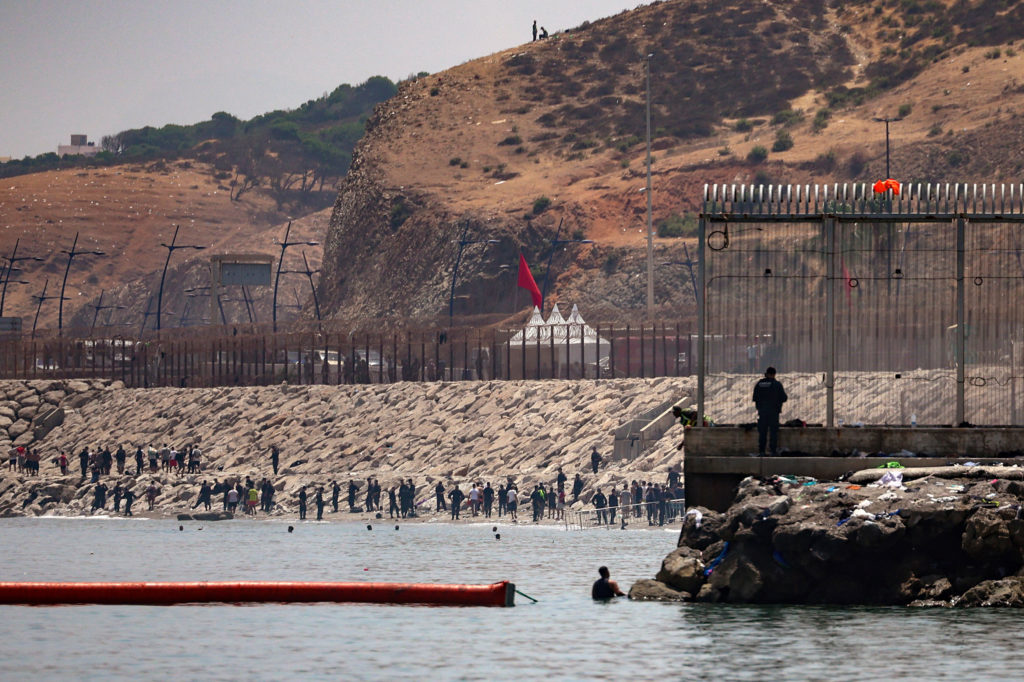
Migrants head back to Morocco after crossing into Ceuta by sea amid mass crossings of migrants on foot and by sea from Morocco into Spanish territory, in Ceuta, Spain, on Aug. 1, 2026. Photo by Pedro Nunes/Reuters
“We are relentless against those who break the law,” Spanish Interior Minister Fernando Grande-Marlaska told journalists in Ceuta on Saturday.
Questioned how this massive border breach could have happened given the heavy security on both sides of the border and whether Morocco posed a threat to Ceuta, Marlaska defended the government in Rabat.
“The events require an evaluation by Spain and Morocco,” he said. But it was the cooperation with its neighbors that allowed Spain “to revert the situation in 24 hours.”
“Morocco is not a threat to Ceuta, or to the rest of Spain. It is a reliable partner,” Marlaska emphasized.
EU leaders call for coordinated response
The leaders of 22 EU countries called for a coordinated response to the situation in Ceuta.
In a letter to top EU officials, released Saturday by the Danish prime minister’s office, the countries asked the EU’s current Irish presidency to urgently convene an extraordinary videoconference of the bloc’s interior ministers.
“We cannot allow uncontrolled mass crossings, the instrumentalization of migration or other hybrid threats to create the perception that illegal entry into the European Union is possible. That a migrant’s illegal entry can turn into legal stay,” the letter said. “Such a perception would encourage further attempts, undermine confidence in our common migration policy and have repercussions for all Member States.”
The letter was signed by the leaders of Italy, Denmark, Austria, Belgium, Bulgaria, Cyprus, Croatia, the Czech Republic, Estonia, Finland, Germany, Greece, Hungary, Latvia, Lithuania, Malta, the Netherlands, Poland, Romania, Slovenia, Slovakia and Sweden.
Sánchez, Spain’s prime minister, also asked for a videoconference of EU interior ministers to “enable us to establish a common response to situations of this kind and reaffirm that the security of our external borders is a shared responsibility of all Member States, and not only of those on the Union’s front line.”
Sánchez slammed the reaction of some EU nations who he said had “chosen to attack Spain and to call for its temporary exclusion from the Schengen Area.”
Italian Premier Giorgia Meloni has threatened to suspend Italy’s open-border Schengen agreement with Spain, and Italy was reimposing border controls for people arriving from Spain by air and sea.
“In the current international context, the European Union cannot afford this kind of selfish, polarizing and unlawful reaction,” Sánchez wrote in his letter.
Migrants head back into Morocco
Hundreds of migrants who recently crossed from Morocco into the Spanish enclave of Ceuta streamed back across the border on Saturday, telling an Associated Press reporter they were returning “of their own free will” after what they described as degrading treatment on the Spanish side.
Migrants walked along a long stretch of wave breakers before slipping into Morocco through a small breach in the border fence that had become an informal entry point. Moroccan police and soldiers stood by, watching. Most of the migrants were Moroccans, while a smaller number were from sub-Saharan Africa.
Hungry and angry, some barefoot or shirtless and others nursing visible injuries, those who returned said they had “seen hell in Ceuta.”
READ MORE: What to know about the Spanish enclave of Ceuta as migrant arrivals from Morocco spike
“I decided to come back on my own,” said Ouail Lamzeiz. “I spent eight days in Ceuta, and I was about to get a bed at the migrant center, but I hadn’t eaten for days. Even the Moroccans there didn’t help,” he added, showing a document supporting his account.
His friend, Salah Eddine El Arrage, said he decided to return to Morocco after, he said, Spanish police beat him.
Migrants interviewed by The Associated Press said they spent their nights sleeping in the forests around Ceuta because they could not find shelter, and that they often fought over food.
One, Othmane El Merzoug, stopped passersby to ask for a phone call so he could reach his family and ask them to send money for the journey back to his hometown, about 189 miles (305 kilometers) from the border.
The road linking the Moroccan town of Fnideq to the border crossing bore the scars of the previous night’s unrest. Burned-out vehicles sat along the roadside, while the acrid smell of smoke still hung in the air. Police barriers channeled traffic toward the crossing, and water cannons remained stationed nearby.
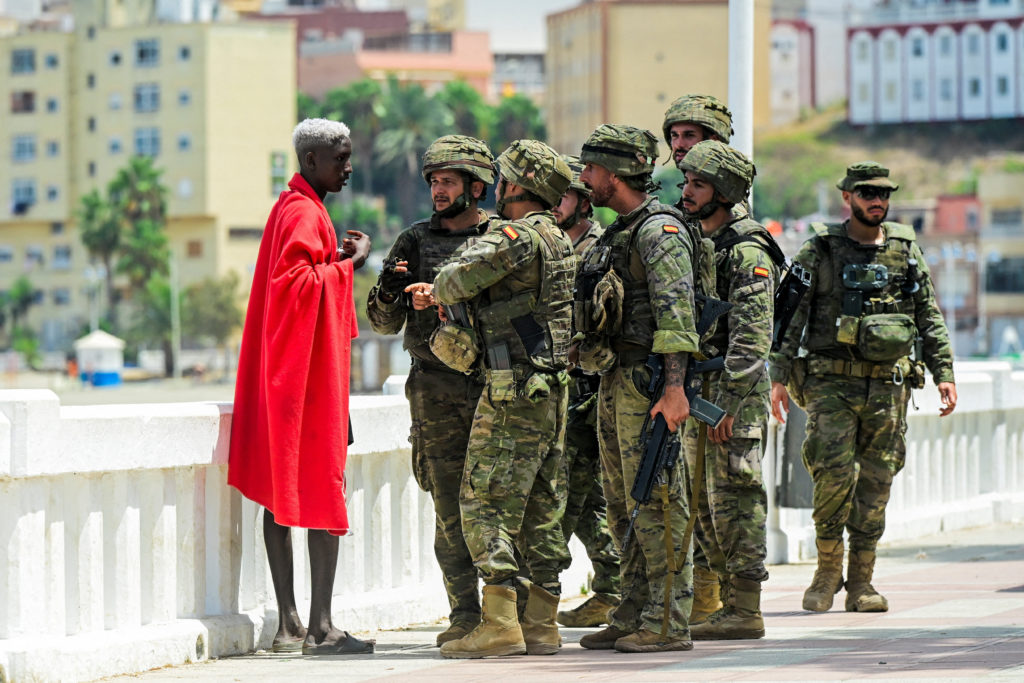
Spanish soldiers question a migrant, following mass crossings of migrants on foot and by sea from Morocco into Spanish territory, in Ceuta, Spain, on Aug. 1, 2026. Photo by Fabian Bimmer/Reuters
“Life in this city has been disrupted as a result of the border incident,” said Ceuta’s President Juan Jesús Vivas. “The return of people has begun satisfactorily but the process must be completed.”
In the Moroccan city of Tangier, about 75 kilometers (46 miles) west of Ceuta, the main railway station was busy with people returning from Ceuta or the border. Some slept on the ground, exhausted.
“I tried to cross, but I failed. I stayed near the border with Ceuta for two days, but I couldn’t find anything to eat,” said Abdalah, an aspiring migrant who asked that his last name not be published out of fear of retaliation for trying to cross illegally.
But some who made it to Ceuta were determined to stay. Among them was Mohamed Hatri, a 23-year-old Moroccan.
“They’ve closed everything down so that we can’t buy anything to eat, to force us to return to our country,” he said. “But even if they close it down … we’re round to stay here, whether we’re hungry or not.”
Oubachir reported from Fnideq, Morocco. Renata Brito in Barcelona, Spain and Elena Becatoros in Athens, Greece contributed to this report.