




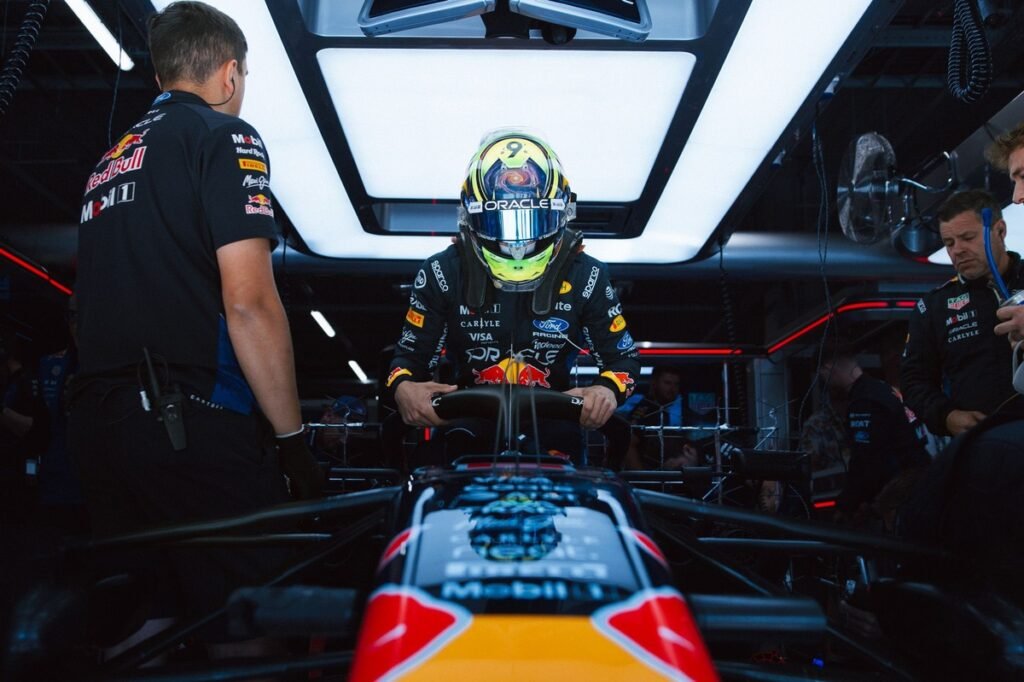
Red Bull heads into the Formula 1 summer break fourth in the constructors’ championship, but that does not tell the whole story. Since the season opener in Melbourne, the Milton Keynes-based team has made significant progress.
Figures from data partner Paceteq show that Red Bull was as much as 1.3 seconds per lap down in terms of outright race pace in both Australia and China, meaning it was fighting with the likes of Haas and Alpine. Over the final two race weekends before the summer break, that deficit was reduced to just two to three tenths per lap.
This shows that Red Bull has found around one second relative to the front of the field, but that has come at a price – both literally and figuratively.
The team introduced two major upgrade packages in Miami and Austria, significantly revising its aerodynamic concept (with the sidepods, among other things, taking on a completely different appearance) while also eliminating the RB22’s excess weight.
While Mercedes team principal Toto Wolff questioned how Ferrari was seemingly able to introduce “unlimited” upgrades, the Scuderia pointed out that Red Bull may actually have brought even more new parts over the opening 11 race weekends of the year.
Heading into the summer break, Red Bull team principal Laurent Mekies admits it will be difficult for his team to maintain that rate of development during the second half of the season. That is naturally linked to F1’s budget cap, which has been set at $215million this year.
“We have brought a huge amount of development to the car between race one and here, in order to try to as soon as possible correct the large deficit we initially had,” Mekies said.

Laurent Mekies, Red Bull Racing Team Principal
Photo by: Mark Thompson / Getty Images
“And it’s probably difficult to imagine that we will continue at that rhythm. But we nonetheless need to see what is the best way to try and close these last three tenths.”
Mekies has previously explained that those final two to three tenths are the hardest to find, particularly because the competition is not standing still either.
Alongside the cost cap, all teams have another important decision to make: how to divide resources such as wind tunnel time between this year’s car and next season’s challenger.
Mekies says Red Bull is taking a different approach in that respect compared to last year. Back then, the team threw everything at closing the gap to McLaren and giving Max Verstappen a chance to fight for a fifth world title, something Red Bull paid the price for at the start of 2026, technical director Pierre Wache later said.
This year, Red Bull intends to shift its focus to the following season earlier: “I don’t know about the other guys, but what is sure is that at some stage we’ll need to make a call on the balance between this year and next year.
“I expect that to happen earlier than what we have done last year, especially as the regulations are what they are.”