




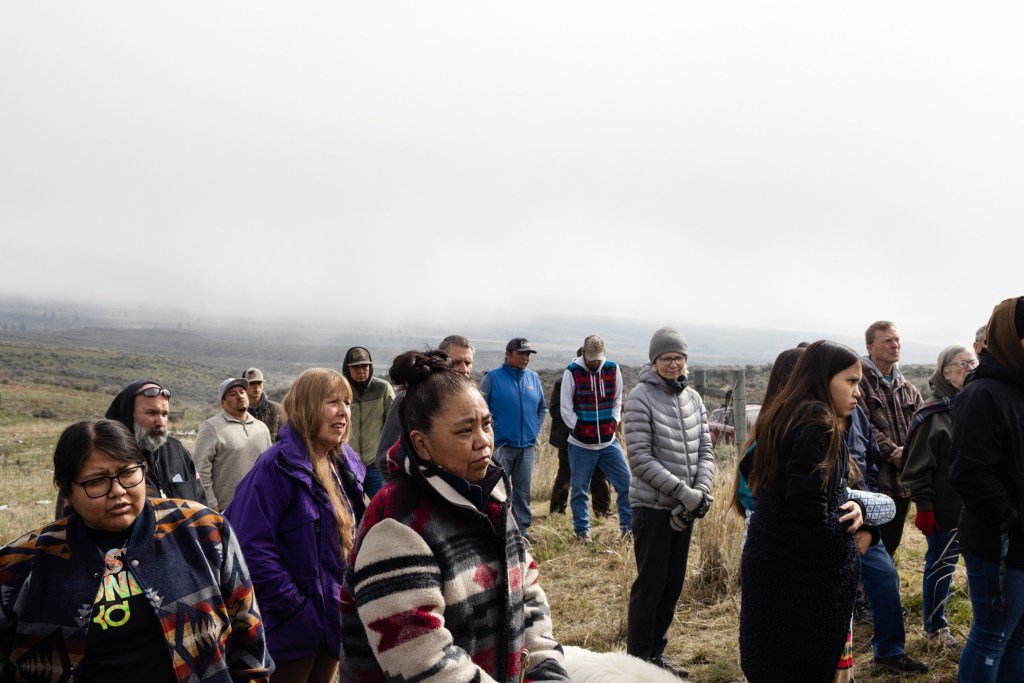
Energy developer Avangrid withdrew this month its longstanding permit application to build industrial-scale solar on a site sacred to the Confederated Tribes of the Colville Reservation and the Confederated Tribes and bands of the Yakama Nation. The proposed project site on Badger Mountain in central Washington straddles private land as well as public land owned by the Washington Department of Natural Resources. Tribal nations have the right to practice cultural traditions, such as food gathering and ceremony, on public lands, and a 2024 investigation by HCN and ProPublica revealed that Avangrid’s proposed solar development threatened those rights.
“The Colville Tribes is very happy to hear that the proposed solar project on Badger Mountain has been withdrawn,” said Chairwoman Cindy Marchand in an emailed statement Monday. “While the Colville Tribes certainly appreciates the value of renewable energy such as solar power, sacred sites must remain pristine to pass down to future generations. We appreciate Avangrid Power LLC’s decision to withdraw this project and we trust that they can find a more appropriate site.”
It’s unclear whether the company’s decision had anything to do with Indigenous rights. The formal permitting proceedings indicate that it was not tribal considerations, but rather construction delays elsewhere in the grid, that may have prompted the cancellation. Avangrid declined to clarify its reasoning to HCN, and the Department of Natural Resources declined to comment as well.
After the publication of HCN and ProPublica’s investigation, some members of the Wenatchi-P’squosa, one of the 12 Confederated Colville Tribes, held a demonstration on Badger Mountain in 2024 opposing the project, saying that while they support renewable energy, it should not be built on important cultural sites like Badger Mountain. The demonstration was organized by the Wenatchi Advisory Group, an independent body that advises the Colville Tribal Business council on issues specific to its Wenatchi-P’squosa constituents.
“While the Colville Tribes certainly appreciates the value of renewable energy such as solar power, sacred sites must remain pristine to pass down to future generations.”
Following the demonstration, Avangrid announced that it would pause development to reconsider tribal input and public response. The public comment process is one of the only avenues available for tribal nations to advocate for their rights regarding land development.
At a state energy permitting meeting earlier this month, Avangrid requested another yearlong extension to pause the permitting work — while still keeping the project active in the state’s permitting system — citing construction delays involving the Bonneville Power Administration (BPA). The BPA is building a transmission line called Cross-Cascades North to reinforce power delivery from eastern Washington to the Seattle area.
At the meeting, Avangrid’s senior director of business development, Mark Eilers, said that BPA’s anticipated construction timeline would be delayed by four years, until 2032, implying but not stating directly that this could be a reason for Avangrid’s request to extend its work pause.
The state permitting authority — the Energy Facility Site Evaluation Council (EFSEC) — hosted the July meeting. Regarding the solar project’s potential environmental and cultural impacts, EFSEC chair Kurt Beckett said, “We try to minimize as much of that noise” as possible in the public forum, but he also acknowledged the objections of the Yakama Nation and the Colville Tribes. “I don’t wish to overemphasize those, but ultimately they exist,” he said, adding that tribal objections should be considered in the state’s permitting decisions.
Five days later, Avangrid filed a request to completely withdraw its proposal — which has been in the works since at least 2019 — and on Monday, EFSEC formally announced the withdrawal. “EFSEC will move forward to process this request by closing out existing financial arrangements and notifying interested and agency partners,” the council said in a statement. It did not provide further comment, referring any questions to the developer.
Despite the lack of clarity around Avangrid’s motivation, the Wenatchi Advisory Group is pleased with the decision. “We are very, very happy that they chose to go this route with us, ’cause it is a very sacred site to us,” said Steven Wynecoop, vice chair of the Wenatchi Advisory Group and grandson of its founder, Matthew Dick. “Generations, we’ve been going to that mountain for plenty of reasons: medicines, foods like roots and berries,” he added, noting that families continue to go there for ceremony.
Family stories of Badger Mountain trace back through Wenatchi lineages, too. Wynecoop said when his grandfather was young, the family was gathering medicines on Badger Mountain when they were approached by landowners. “A white couple showed up in their car and pulled over and started talking to my grandma, because they adored her son, Uncle Terry, so much.” Terry, Matthew’s brother, was wearing overalls and fishing in a puddle with a stick and a string. “They thought he was just adorable,” Wynecoop recounted, just as his grandfather often did at ceremonies. “They wanted to adopt him. They offered their part of Badger Mountain to her for her kid – which, of course, she turned them down.”
Wynecoop chuckled as he told the story. “We would always laugh, ’cause Grandpa would always say ‘Yeah, now here we are — no Badger Mountain, but we got Terry!’”
We welcome reader letters. Email High Country News at editor@hcn.org or submit a letter to the editor. See our letters to the editor policy.