



BEIJING — Did the foreign ministers of China and Japan talk at last week’s ASEAN regional meeting, or didn’t they?
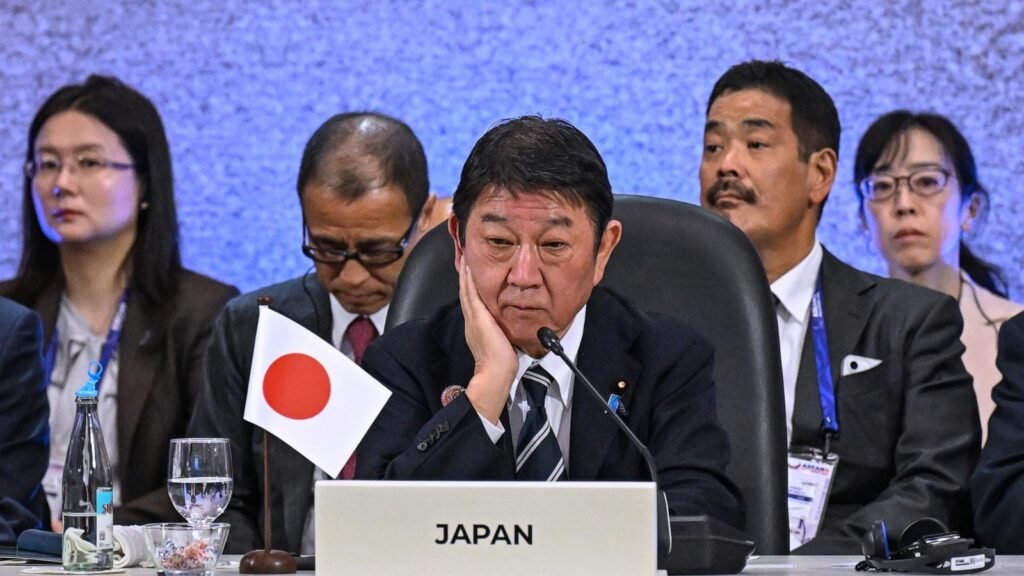
Japan’s Toshimitsu Motegi told reporters last week that he had briefly discussed bilateral relations with Chinese counterpart Wang Yi when they ran into each other during the meeting in the Philippines.
But on Monday, a Chinese Foreign Ministry spokesperson contradicted that.
“Let me make it clear once again that during his visit to Manila, Foreign Minister Wang Yi did not have a meeting with the Japanese side on his schedule, nor did any brief exchanges take place on the site,” Lin Jian said when asked at the daily briefing.
The differing accounts reflect the positions of the governments over a sharp deterioration in their ties since November, when a comment about Taiwan by Japan’s Prime Minister Sanae Takaichi angered China.
Japan is looking for opportunities to rebuild relations, but China has given its neighbor the cold shoulder.
The tensions have spilled over into the economy — including a decrease in Chinese tourists visiting Japan — and heightened unease in both countries about the expansion of each other’s militaries.
“As we have repeatedly noted, Japan is open to dialogue at all levels, and that I believe it is extremely important that we continue our dialogue as both Japan and China hold a major responsibility for regional peace,” Motegi said last week.
Although Motegi said he and Wang discussed ties, Japanese media reported that the exchange was mostly greetings and pleasantries.
Takaichi told a news conference on Monday that the two sides are holding dialogue at various levels including Motegi’s exchange with Wang.
Shortly after becoming prime minister, she was asked in parliament in November if a Chinese blockade of Taiwan or other military action would be a scenario in which Japan could get involved under a policy known as collective self-defense.
The policy allows Japan’s military to help an ally — most likely the United States — if certain conditions such as ensuring Japan’s survival are met.
Takaichi responded that the Taiwan example could meet the criteria: “If it involves the use of warships and military actions, it could by all means become a survival-threatening situation,” she said.
The remark crossed what China considers a red line in its relations with other countries. In its push to gain control of Taiwan, the government opposes any words or actions — including U.S. arms sales to Taiwan — that encourage what it labels Taiwan independence forces. Taiwan is a self-governing island, but China claims it as its territory.
Takaichi has refused to retract her answer but later told the same parliamentary committee that she would avoid talking about specific self-defense scenarios in the future.
___
Associated Press writer Mari Yamaguchi in Tokyo contributed to this report.