



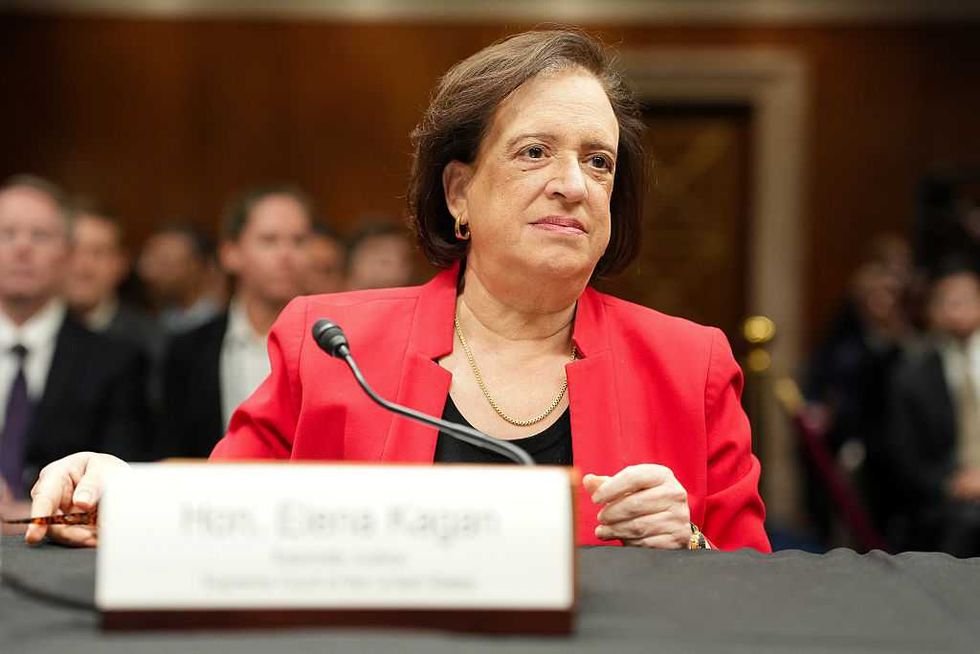
Supreme Court Justice Elena Kagan’s testimony at a July Senate hearing raised troubling questions about accountability in judicial education.
Kagan acknowledged that she wrote the foreword to the Federal Judicial Center’s “Reference Manual on Scientific Evidence” without reading its climate-change chapter — a chapter later removed after critics identified serious bias concerns. She also admitted that she still had not read it.
Kagan’s admission offers a cautionary example. Rank does not excuse a failure of diligence.
Her foreword presents the manual as an objective resource for judges handling cases involving complex scientific evidence, from epidemiology to emerging technologies. Yet Kagan placed her authority behind a volume whose most contentious material she had not taken the time to examine.
That failure weakens the manual’s credibility and raises a broader question: How carefully are judges scrutinizing the scientific authorities placed before them?
The fourth edition of the influential manual, used by thousands of federal judges, drew immediate objections. The Federal Judicial Center withdrew the climate chapter in February after state attorneys general cited imbalances and potential conflicts of interest.
The problems did not end there.
A separate chapter on the nature of science remains in the manual despite presenting a distorted account of scientific inquiry. Kagan’s foreword also remains, still attesting to the volume’s reliability and impartiality.
Earlier editions offered a clearer standard. Physicist David Goodstein emphasized empirical testing, falsifiable predictions, reliable data, and other central principles of scientific reasoning.
The new chapter moves in a different direction. It elevates social considerations and consensus among experts while giving less attention to the rigorous testing that separates science from assertion.
Scientific collaboration matters. Consensus can also provide useful evidence. But “widespread agreement” cannot substitute for disciplined scrutiny, especially in court.
The Supreme Court’s Daubert standard requires judges to assess whether expert testimony rests on testable methods, peer review, known error rates, and general acceptance — all tethered to observable reality.
Nobel Prize-winning physicist Richard Feynman stated the principle plainly: “If it disagrees with experiment, it is wrong.”
History offers repeated warnings about confusing consensus with truth.
RELATED: Out of order: Courts shouldn’t rule based on ‘trust us’ science

Dominant scientific views have often yielded to better evidence. In darker cases, governments have enforced consensus through political power. Under Joseph Stalin, Soviet biologist Trofim Lysenko rejected genetic science in favor of politically favored theories of inheritance. The state elevated his ideas into doctrine, silenced dissenting scientists, and inflicted lasting damage on Soviet agriculture.
The lesson is not that expert agreement has no value. It is that agreement must remain answerable to evidence.
That principle matters especially in courtrooms, where scientific claims can determine enormous legal and economic consequences.
The revised chapter also raises questions about authorship. Several contributors have ties to climate-policy negotiations, including work involving international financial mechanisms. Those backgrounds do not automatically disqualify them. But in an era of sprawling climate litigation, involving more than 1,000 active cases and potential liabilities reaching into the trillions of dollars, such ties create at least the appearance of imbalance.
Prominent scientists, including widely published physicists, have urged Chief Justice John Roberts and the Federal Judicial Center to revisit the chapter. They argue that the manual should restore clear explanations of hypothesis testing and empirical verification rather than rely on sociological descriptions of how scientific communities operate.
Courts increasingly adjudicate scientific disputes with consequences affecting millions, and sometimes billions, of people. The reference materials judges rely on must therefore withstand the strictest tests of objectivity.
Kagan’s admission offers a cautionary example. Rank does not excuse a failure of diligence. Judicial integrity depends on personal responsibility, especially when a justice lends her name and authority to a supposedly impartial guide.
RELATED: Justice Amy Coney Barrett describes SWATTING attack against her family

The Federal Judicial Center can still repair the damage. It should restore the manual’s emphasis on empirical verification, seek broader input from experts without policy entanglements, and reaffirm the manual’s limited role as a procedural guide rather than an arbiter of scientific truth.
Judges should also treat such manuals as starting points, not substitutes for primary research, adversarial testing, and careful examination of the evidence before them.
Kagan endorsed a manual without reviewing one of its most disputed sections. That lapse compromised the diligence her foreword implicitly promised.
The Federal Judicial Center should now restore the manual’s credibility by recommitting it to empirical evidence, falsifiability, and genuine viewpoint diversity. The integrity of judicial decision-making demands nothing less.