



Sporadic outbreaks of Salmonella enterica serovar Reading have been linked to commercial turkey production (1) and fresh produce (2). In Australia, Salmonella Reading is uncommon; an average of 117 notifications occurred per year during 2017–2022 (range 102–137 notifications) (3). In August 2023, an above-average number of Salmonella Reading laboratory cases were identified in New South Wales (NSW); 23 were reported in July 2023, compared with a monthly average of 2 (range 0–7). Early interviews identified that most case-patients shared the same cultural background and reported dining at restaurant A or consuming a dried meat product purchased from South Asian grocery stores. A concurrent food safety complaint by a patron against restaurant A prompted an urgent inspection by the NSW Department of Primary Industries and Regional Development (DPIRD) and a formal investigation by the Sydney Local Health District Public Health Unit. This article describes investigations undertaken to control this outbreak with the goal of raising awareness of Salmonella transmission risks from dried meats. Human research ethics approval was not required for this study because it was conducted as a public health investigation under the NSW Public Health Act 2010.
The Study
Figure 1
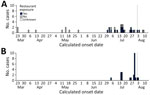
Figure 1. Number of Salmonella enterica serovar Reading cases by calculated onset date, case category, and restaurant exposure in study of outbreak of SalmonellaReading linked to dried bovine…
We identified 63 outbreak cases in NSW (39 confirmed, 24 possible) (Table 1; Appendix). Cases were sporadically reported during March–June (range 0–2 cases per month), followed by a substantial increase in July (Figure 1). Confirmed case-patients were 1–57 (median 27.5) years of age, and all with known ethnicity were from the same South Asia country (37/37; 100%).
Twenty case-patients sought care at an emergency department, and 8 were hospitalized (Table 1). Salmonella hypothesis-generating questionnaires were used to collect information from confirmed case-patients. Restaurant-exposed case-patients completed a menu-based questionnaire for restaurant A. Telephone interviews were completed for 51 cases (51/63; 81%). We identified 9 laboratory-confirmed cases retrospectively through whole-genome sequencing (WGS) several months after illness onset, when interviewing was not feasible because reliable food recall was unlikely; 3 patients were lost to follow-up.
Most outbreak cases were linked to recent consumption of food from restaurant A (44 cases [20 laboratory-confirmed, 24 possible]). The median time from food consumption to symptom onset was 1 day (range 0–3 days). Seven persons with laboratory-confirmed infection did not eat at restaurant A; 6 of those persons reported consuming fresh or dried meat purchased from South Asian grocery stores before illness onset.
We conducted a case–control analysis of menu items from restaurant A. No customer reservation data were available, so we recruited controls through snowball sampling from laboratory-confirmed cases. We defined a dining party as patrons seated together under 1 booking. We calculated attack rates as the number of cases divided by the number of diners. We estimated crude odds ratios with 95% CIs using logistic regression models fitted with Firth’s penalized maximum-likelihood (https://doi.org/10.32614/CRAN.package.logistf), which reduces small-sample and separation bias by adding a penalization term to the likelihood. The analysis included 62 persons (41 case-patients and 21 controls) across 15 dining groups; attack rates by group ranged from 20% (1/5) to 100% (4/4). Four items (mattar paneer, chicken choila, achar, and goat Bhutan) were significantly associated with illness (crude odds ratio >1; p<0.05) (Table 2).
Inspection of restaurant A found inadequate dishwasher temperature, evidence of rodents, improper food storage temperatures, and unsafe thawing practices (Appendix). Of 58 samples collected, 25 (43%) were positive for Salmonella Reading, including samples from kitchen surfaces, cleaning implements, hot and cold menu items (chicken and duck choila, chilli chicken, and chicken chow mein), and 2 sealed air-dried bovine meat samples. Environmental samples were highly genomically related to human isolates (0–5 single-nucleotide polymorphisms).
Detection of Salmonella Reading in sealed dried meat packages from restaurant A supported the hypothesis that this was a source of Salmonella. Multiple positive food and environmental samples indicated poor hygiene and food-handling practices, likely causing cross-contamination and amplifying the outbreak. Cross-contamination is further supported by detections in dishes without bovine products, including 1 of the 4 suspected menu items identified in the case–control analysis. Previous salmonellosis outbreaks indicate that contamination of numerous dishes from a single source can be encouraged by lapses in restaurant hygiene and food safety (4,5). Improper temperature control and storage might have contributed to the cross-contamination of dishes.
DPIRD traced ingredients from restaurant A and the implicated grocery stores. After Salmonella Reading was detected in sealed, dried meat from restaurant A, DPIRD investigated the manufacturer (manufacturer B) and found unsuitable facilities, no verification of ingredients, no pH or water activity checks, no controls for the preparation and dehydration processes, and no food safety program. Links to 2 butcher shops (butchers C and D) were identified. Salmonella Reading was detected in raw bovine meat from butcher D (the supplier of bovine meat for manufacturer B); however, that isolate was not linked to the outbreak by WGS. Two additional unlicensed food businesses were identified. Enforcement actions were taken against restaurant A and manufacturer B, and manufacturer B issued a product recall (6).
Multiple issues with the manufacturing process by the unlicensed manufacturer meant that a safe and suitable product could not be produced (7). The long shelf life of the dried bovine meat product might have prolonged the outbreak. Contamination of commercially manufactured and locally produced dried bovine meat products with Salmonella spp. has been associated with several international outbreaks (8,9) because serovars can survive in low-moisture, low–water-activity foods (10). A shelf-stable, culturally preferred food product has been implicated in at least 1 other protracted Salmonella Reading outbreak among a specific cultural group (11). In Australia, dried meat is an atypical source of Salmonella, so identifying its consumption among laboratory-confirmed outbreak cases with no exposure to restaurant A was critical to guiding the investigation.
Figure 2
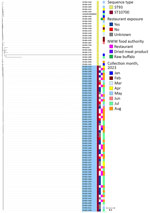
Figure 2. Phylogenetic tree of Salmonella Reading genomic surveillance cluster, SalRea-23-0001, including human, food and environmental isolates, in study of outbreak of Salmonella entericaserovar Reading linked to dried bovine meat,…
The investigation provided robust microbiological and traceback evidence linking human cases to restaurant contamination, sealed dried bovine product, and fresh/dried meats from grocery stores. Sixty Salmonella Reading isolates (41 human isolates from 39 persons and 19 food and environmental isolates) were highly genomically related (0–5 single-nucleotide polymorphism differences) within the genomic surveillance cluster SalRea-23-0001. The genomic cluster was defined as a novel sequence type, 10700 (EnteroBase; https://enterobase.warwick.ac.uk) (Figure 2). We extracted genomic DNA from pure cultures using the QIAGEN DNeasy UltraClean Microbial Kit (https://www.qiagen.com) (Appendix) and submitted the DNA sequence to the National Center for Biotechnology Information Sequence Read Archive (https://www.ncbi.nlm.nih.gov/sra; BioProject accession no. PRJNA489746, SRA sample no. SAMN36942405).
Limitations of this investigation included incomplete case interviews, possible recall bias in reported food exposures, limited controls, and a small sample size, which might reduce generalizability to other settings. However, timely WGS analysis was critical for linking isolates and confirming traceback findings. Integrating WGS data with demographic and risk factor data validated early hypotheses on sources and at-risk groups. This integrative approach has proven effective for guiding resource allocation in surveillance and outbreak investigations across disease groups (12).
Conclusions
In conclusion, an outbreak of Salmonella Reading in NSW, Australia (63 notifications during March–August 2023), was linked to contaminated dried bovine meat products and cross-contamination at restaurant A, amplified by poor hygiene and food-handling practices. Traceback identified an unlicensed manufacturer with inadequate safety controls, prompting enforcement and a product recall. Timely WGS analysis confirmed genomic relatedness among human, food, and environmental isolates and guided subsequent control measures, underscoring the need for strict food safety procedures and integrated genomic surveillance.