




The leaders of Western Europe’s three biggest economies — France, the United Kingdom, and Germany — all hold the records for the most unpopular leaders in modern history.
German Chancellor Friedrich Merz holds the unambiguous record for the most unpopular chancellor in Germany’s history, with his approval rating hitting 16% in May, according to a Deutschlandtrend/ARD poll. French President Emmanuel Macron is either tied with former President François Hollande as the most unpopular French president of the past half century, or surpasses him in unpopularity, depending on the poll used. Outgoing United Kingdom Prime Minister Keir Starmer made history as the island nation’s most unpopular premier before his resignation, with an Ipsos poll finding just 13% of voters were satisfied with him, compared to 79% who were unsatisfied.
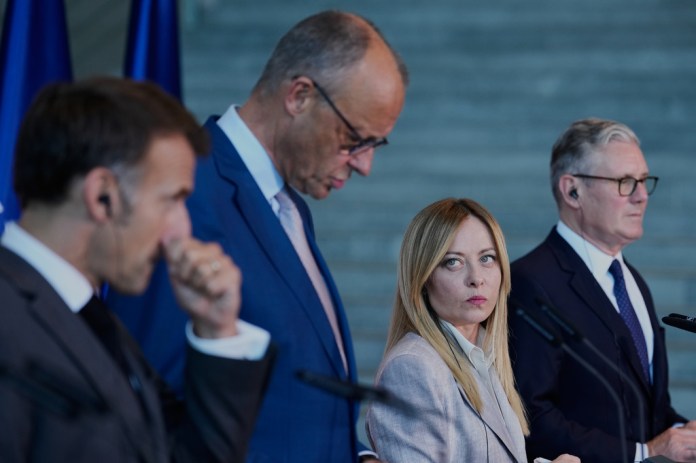
But the trio don’t hold special qualities that make them despised — over the past decade, the leaders of each country have grappled with almost equal unpopularity figures. The U.K.’s six prime ministers since Brexit have all left office despised. All German chancellors after Angela Merkel have faced rock-bottom approval ratings, capped by Merz’s historic unpopularity, and Merkel herself has faced a damning reappraisal of her tenure after leaving. Macron, the longest serving of the bunch at nearly a decade, has been underwater in approval since mid 2017.
The rest of Western, Northern, and Central Europe are mostly in the same boat, with the notable exceptions being smaller countries — Slovakia, the Czech Republic, Luxembourg, Switzerland, Ireland, and Denmark.
Spain’s official polling body, CIS Barómetro, found in June that just 31% said they have any sort of trust in Spanish Prime Minister Pedro Sanchez, compared to 68% who don’t trust him. The most recent poll from ICS/Iscte gauging the public’s trust in Portuguese Prime Minister Luis Montenegro’s government, in March, found 34% gave it a positive rating and 56% a negative. Only 24% of voters said they were satisfied with Dutch Prime Minister Rob Jetten’s cabinet, compared to 64% dissatisfied.
The Morning Consult’s global leader approval ratings tracker in April had Belgian Prime Minister Bart De Wever at 35%, Italian Prime Minister Giorgia Meloni at 39%, Swedish Prime Minister Ulf Kristersson at 38%, Norwegian Prime Minister Jonas Gahr Støre at 31%, and Austrian Chancellor Christian Stocker at 29%.
While each country faces its own unique challenges, what’s notable are the constants across each. Several key economic issues have held across all European countries as they grapple with the same demographic challenges, challenges which are increasingly crippling anyone who takes power regardless of party.
Demographic-driven stagnation
In September 2024, former European Central Bank head and Italian prime minister Mario Draghi released his long-awaited 400-page report, The Future of European Competitiveness, which sent shockwaves through European capitals. The report concluded that Europe was rapidly losing its competitiveness and had lost much of its economic leverage over the past 30 years. In Draghi’s words, for the first time since the Cold War, Europe must “genuinely fear for our self-preservation.”
In 1990, the European Union’s 12 member states accounted for 26.5% of global GDP; by 2024, this share had plummeted to just 16.1%, despite exploding in size to 27 members. The U.S., in contrast, has roughly maintained its share of global GDP over the same period.
Perhaps the biggest factor in this decline has been the sharp decline in productivity; European productivity is now measured at 80% of the U.S., compared with 95% in 1995.
This slouch in productivity, in turn, can largely be credited to Europe’s aging population. The E.U.’s median age went from 39.3 years in 2004 to 44.9 years in 2025, with some countries experiencing rapid aging; Romania aged the fastest at +8.4 years from 2004 to 2024, followed by Portugal at +8.3 years. Italy has the oldest median age at 49.1 years. Due to these demographics, Draghi concluded that unless productivity significantly improves, the E.U.’s economy will be the same size in 2050 as it is today.
A 2023 study by Harvard economist Nicole Maestas and colleagues examining the effects of aging on GDP per capita from 1980-2010, published in the American Economic Journal: Macroeconomics, found that each 10% increase in the fraction of the population aged 60+ decreased GDP per capita by 5.5%. One-third of this reduction came from slower employment growth, while two-thirds came from slower productivity growth. From this decrease, labor compensation and wages also declined.
As Maestas explained to the Washington Examiner, her study found deepening structural issues in the economy emanating from an aging population.
“One plausible mechanism is that many of the workers who retire are highly experienced and possess firm-specific knowledge, management expertise, and professional networks that are difficult to replace quickly. When they leave, the loss can reduce the productivity of the remaining workforce through spillover effects — for example, by reducing mentoring, coordination, or the diffusion of knowledge within firms,” she said.
“Our paper finds evidence consistent with these kinds of spillovers, including declines in wages across the age distribution rather than only among older workers, suggesting that the productivity effects are broad-based,” Maestas added.
Aging also shrinks the economy’s ability to adapt and innovate, a crippling issue at a time when the U.S. and China’s lead is driven by this exact innovation.
“More broadly, an aging workforce may also influence innovation, entrepreneurship, technology adoption, and organizational change,” Maestas explained. “Our empirical design captures the combined effect of all of these channels, so while we cannot isolate each one individually, the results suggest that population aging affects the economy through more than simply changing the age composition of workers.”
This decline in productivity and the other problems associated with an aging population have put European leaders in a fiscal vice, leaving them little room to maneuver. The shocks of recent years, such as the energy shock from the Russia-Ukraine War and the war with Iran, have smashed Europe much harder than it would have in a healthier fiscal environment. European countries are increasingly left without any cushion to manage shocks, further exacerbating their negative effects.
The losing politics of pension reform
One of the biggest and most direct problems with an aging population is the change in the ratio of workers to dependents. In 2001, the E.U. had an average of four working-age people for every retiree. By 2024, this had decreased to three working-age people for every retiree. The proportions vary throughout the continent; the Belgian coastal region of Veurne has nearly 3 elderly people for every 4 working-age people.
Worse yet, the problem is only going to get worse. Europe’s total fertility rate has declined from 2.7 births per woman in 1950 to just 1.41 in 2025, meaning the ratio of working-age people to retirees will only decrease in the future.
This means that a growing proportion of workers’ salaries goes towards supporting retirees to keep the current pension system going. Governments must choose between two highly unpopular measures to maintain the pension system: raising taxes on working-age people or reforming the pension system with measures such as raising the retirement age. Deciding to do neither is equally damaging and unpopular.
Older citizens are also often more politically active than their younger counterparts. In the U.K.’s 2024 general election, a majority of voters in a majority of constituencies were over 55 years of age for the first time. In France’s 2022 elections, 76% of voters in their 50s turned out to vote, compared to just 60% of voters aged 18-24.
Macron has been one of the few European leaders to try and openly tackle the pension issue through reforms to the system, campaigning on a promise to implement reforms in 2017. His first attempt sought to combine France’s dozens of pension systems into a single points-based system, eliminating the special privileges of groups like railway workers. The result was a nationwide strike of transportation workers and ballooning protests, a saga only halted when the COVID-19 pandemic hit. Macron shelved the measure to deal with the pandemic, but it never came back in that form.
Once the pandemic settled down, Macron tried another effort beginning in 2023, this time raising the retirement age from 62 to 64 by 2030, and increasing the contribution years from 42 to 43 years for a full pension. Even greater outrage arose than from the first attempt, with French police struggling to contain protests that rose to well over one million participants at their peak. Macron’s government just barely survived two no-confidence votes and, from 2024 to 2025, went through four prime ministers in barely a year, largely due to the pension issue. The current Prime Minister Sébastien Lecornu finally pledged to freeze the reform until after the 2027 elections, finally defeating one of the most comprehensive pension reform efforts in a major European economy.
Macron hasn’t been the only European leader stung by pension politics either. De Wever’s government in Belgium, grappling with a budget deficit that had ballooned to a size that violated E.U. rules, targeted the pension system with its austerity measures, including raising the retirement age from 66 to 67. As in France, trade unions exploded with rage, and sustained protests and strikes have taken place periodically for months. In one large October protest in Brussels, demonstrators carried signs showing De Wever’s picture, reading, “wanted for pension theft.” The pension reform is a central reason for his government’s collapse in popularity.
Starmer, who became the punching bag of the anglophone world before resigning under intense pressure, can also credit much of his fall to the pension issue. Weeks after taking office in 2024, his Chancellor Rachel Reeves announced that the U.K.’s Winter Fuel Payment, a subsidy paid to pensioners since 1997, was being narrowed from all 11.6 million pensioners to around 1.5 million who met special criteria. It was acknowledged as a “tough choice” that Reeves “didn’t want to make, or expected to make,” but the rising deficit made it a needed fix.
MARINE LE PEN SAYS SHE WILL RUN FOR PRESIDENT IN 2027 AFTER COURT RULES HER ELIGIBLE
The urgency of the situation didn’t satiate the rage of pensioners and the public, who savaged Starmer’s government in the press. Critics didn’t shy away from directly accusing Starmer’s government of essentially killing pensioners. Just weeks after winning the elections in a landslide, the new Labour government had the popular enthusiasm sucked out of it. Despite rolling the reform back in the Spring, the damage had already been done, and Starmer’s popularity never recovered. The Telegraph credited the saga as sealing Starmer’s fate.
“If headlines of freezing grannies dominate the first year of your premiership, it may not be destined for greatness,” Telegraph senior money writer Maya Wilson Autzen quipped.