



Formula 1 drivers are already bracing for a headache over deployment at Spa-Francorchamps, with Fernando Alonso warning they could have no battery for large parts of the lap and drop to “less power than F2”.
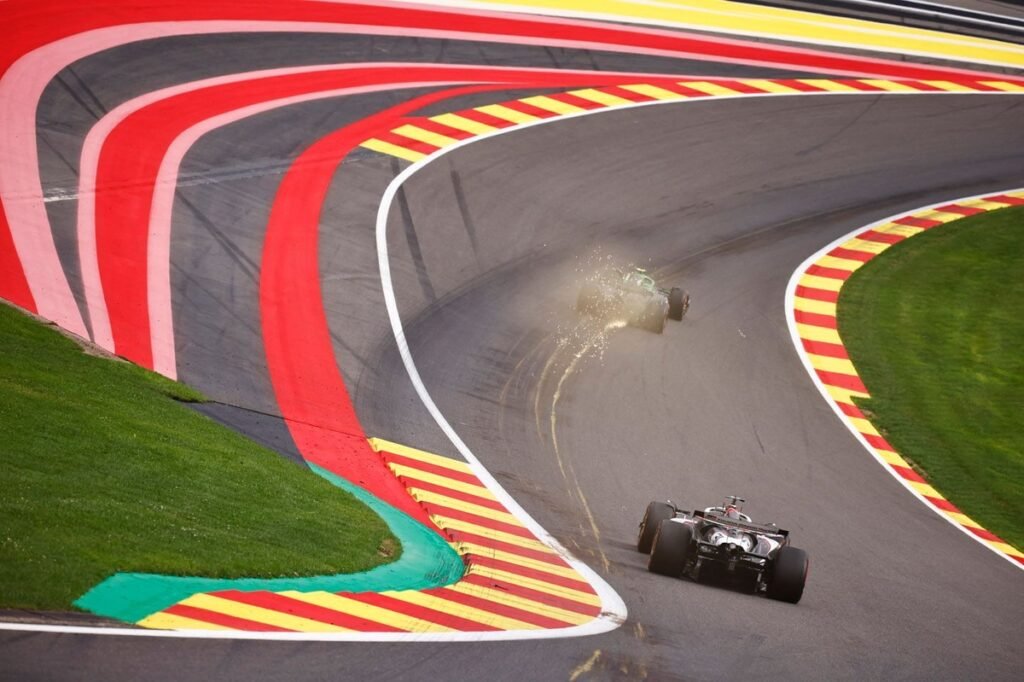
The Belgian Grand Prix venue is famed for its long straights and demanding climbs, particularly through the iconic first sector which takes drivers from La Source, up Eau Rouge and Raidillon, along the Kemmel straight and braking for Les Combes.
But much like Silverstone’s long straights and minimal heavy braking zones, Spa will pose the new F1 cars with a deployment problem given the few places to sufficiently recharge the battery pack across a lap.
Alonso expects drivers to be able to use their entire battery in the first sector having charged it at the Bus Stop chicane and La Source, but then have not enough braking zones to regain the energy for the high-speed second sector.
“Silverstone and Spa, they are very thirsty on energy,” Alonso said during the build-up to the British GP. “You cannot deploy in all the straights. Next week, it is going to be the same thing. If you deploy in Spa from Turn 1 [La Source] to 5 [Les Combes], it is finito for the rest of the lap.
“So, you need to save a little bit there to have deployment from Turn 14 [Stavelot] to the Bus Stop [chicane, Turns 18 and 19]. But if you deploy in those two straights, which is the optimal deployment, then there is one minute, sector two, with no deployment at all.
“And with no deployment at all, we cannot forget that this year we have significantly less power than last year and less power than F2. That is the case when you cut the deployment. So, yes, it is a challenge.”

Fernando Alonso, Aston Martin Racing
Photo by: Colin McMaster / LAT Images via Getty Images
F1’s V6 engines without the aid of the hybrid elements can produce around 540bhp, while F2’s official figures put the current Mecachrome engines at around 610bhp. But when F1 cars deploy full power from the engine and the battery, they can reach around 1000bhp.
It should also be stressed that F1 cars with deployment will still be comfortably quicker than F2 cars. For example, Kimi Antonelli‘s pole time at Silverstone was a 1m28.111s, while in F2 Rafael Camera’s pole lap time was a 1m39.690s.
Alonso’s sentiment was shared by other drivers on the grid, with Spa rated as the worst for F1’s power unit rules alongside Silverstone, Monza and Suzuka. At the British GP, Alonso referred to the Maggotts-Becketts-Chapel complex as a “charging station” with the corners reduced to battery management zones.
“Let’s not speak too soon because we have Spa next week… maybe Silverstone will feel mega compared to that,” Bearman added last weekend.
“I love Spa, but Spa is going to be another painful one, just because of the energy, like here,” Verstappen also said at Silvestone.
F1 has already moved to address the problem both for this year and into 2027 and 2028 by reducing the reliance on deployment energy, eventually shifting the ratio of internal combustion to electrical motor output from around 50/50 to around 60/40.
Additional reporting by Filip Cleeren and Stuart Codling