

Lewis Hamilton’s first win for Fred Vasseur’s team didn’t come in Barcelona on 14 June 2026. It came more than 20 years ago in Formula 3 Euro Series.
Back then, the 20-year-old Hamilton won the opening round at Hockenheim driving for the Frenchman’s ASM team, before going on to dominate the season with 15 victories from 20 races. The following year he moved up to GP2, now with the newly formed ART Grand Prix project led by Vasseur, and won another title that helped secure his McLaren Formula 1 drive for 2007.
When Lewis Hamilton once again became a driver of a team led by Vasseur, he was already a seven-time Formula 1 world champion, the most successful driver in the history of the sport and one of the most recognisable sporting figures in the world.
He was already Sir Lewis Hamilton, after all.
“We had amazing success in F3, and also in GP2,” recalled Hamilton back in the winter of 2024 after signing his Ferrari contract, while still preparing to complete his final season with Mercedes. “That’s really where the foundation of our relationship started. We always remained in touch. I thought that was going to be an amazing team manager at some stage and progress to F1, but at the time, he wasn’t interested in that.
“It was really cool to see him step into the Alfa [Romeo] team. Then when he got the job at Ferrari, I was just so happy for him. I think just the stars aligned. I think it really wouldn’t have happened without him. So, I’m really grateful and really excited about the work that he’s doing there.”
Yet the Hamilton that Vasseur got at Ferrari was not the one many still regarded as “prime” Hamilton.
Ahead of his first year with the Scuderia, Lewis turned 40, and it’s fair to say the final couple of seasons with Mercedes weren’t his best. Yes, he won at Silverstone and inherited another victory at Spa after George Russell‘s disqualification, but over those two years it was the younger Brit who came out on top more often.

Lewis Hamilton won a lot of races for Frederic Vasseur’s teams two decades ago
Photo by: Lorenzo Bellanca / Motorsport Images
Perhaps it wasn’t too much of a crime to assume Hamilton had passed his peak. He probably had, anyway. It’s just that now a lot of observers may need to reconsider the rate at which he’s declining.
Would Hamilton, 10 years younger – or perhaps even five – have grabbed pole position in Barcelona instead of missing out by 0.064s? Possibly. You’ll never be able to answer that question. What last Sunday proved, however, is that he still has enough speed to deliver a victory with a three-stop strategy, chasing down two drivers in what has been the fastest car of 2026.
Last year, though, it all seemed doom and gloom. After a spark in the form of a sprint win in China, there weren’t many moments to celebrate. Hamilton struggled with the car, couldn’t match Charles Leclerc‘s pace and became involved in enough tense radio exchanges with Riccardo Adami to make Ferrari’s official line that there were no tensions difficult to believe.
Vasseur was the one accusing the media of blowing the stories out of proportion based on what was broadcast during races – yet that’s exactly what a team principal is supposed to do: defend his team.
Be that as it may, Hamilton increasingly resembled a great champion approaching the end of his career. A little like Valentino Rossi during the final years of his MotoGP journey. Or Michael Schumacher during his Mercedes comeback. The raw speed appeared to be fading, and motivation often goes hand in hand with it.

In 2025, it was difficult to imagine Hamilton would ever win a race with Ferrari
Photo by: Guido De Bortoli / LAT Images via Getty Images
The honeymoon period of joining the legendary team lasted only a few months before being replaced by the routine of searching for those missing tenths of a second.
Those tenths weren’t easy to find.
The evidence seemed to point to one conclusion: Hamilton was simply too old to really give Ferrari what it needed.
At the very same time, he was putting pressure on the team.
It was at Spa last July that he spoke about calling meetings with Ferrari chairman John Elkann, CEO Benedetto Vigna and Vasseur. He revealed he had sent documents outlining structural adjustments the team needed to make. He spoke about sitting down with chassis technical director Loic Serra and the heads of other departments, “talking about the engine for next year, talking about the front suspension, the rear suspension”. About the “things that I want, issues that I have with this car”.
For Vasseur, accommodating all the changes Hamilton was asking for probably required more than simply believing Lewis still had it. He needed the team to believe it too.
Because, yes, these changes were being requested by a seven-time world champion and the most successful driver in Formula 1 history. But they were also being requested by a 40-year-old driver who may well have been past his peak. And his first season with Ferrari did little to disprove that theory.

Carlo Santi was on the podium for Kimi Raikkonen’s final Ferrari victory in Austin in 2018
Photo by: Glenn Dunbar / Motorsport Images
The most visible change this year has perhaps been the appointment of Carlo Santi as Hamilton’s race engineer.
Vasseur himself played down the significance in his post-race media session on Sunday.
“I don’t want to put Carlo in front or whatever, I think it’s a huge effort from everybody,” he shrugged. “Carlo is part of the process and the fit between Carlo and Lewis is a good one. But, you know, we have to react as a group in the good and the bad moments.
“When it’s a bad moment, I’m trying to protect the team and to take the blame for myself. Today, I don’t want to put a department or someone in front. If we are getting results, it’s because collectively we are doing a good job.”
And that’s understandable.
Highlighting Santi’s role in Hamilton’s revival would probably put pressure on the engineer himself while downplaying the contribution of others. As a manager, Vasseur doesn’t need that.
But the fact it was the 52-year-old from Verona standing alongside Lewis on the podium after his first Ferrari victory speaks volumes.
Santi’s previous podium in Formula 1 came on 21 October 2018, when he joined Kimi Raikkonen on the rostrum after the Finn’s final victory for Ferrari. From 2019 onwards, he moved into a factory role, supporting the race team from Maranello, before returning trackside this season initially to assist Hamilton while Ferrari searched for a permanent replacement for Adami.
With the way things are going, and with Lewis already calling Santi his “Italian Bono” even before Barcelona, he is unlikely to be returning to the factory any time soon.

Lewis Hamilton and his “Italian Bono” Carlo Santi celebrate victory in Barcelona
Photo by: Steven Tee / LAT Images via Getty Images
Switching away from Brembo, given Ferrari’s long-standing relationship with the company, probably wasn’t easy either. But Hamilton clearly likes something about the Carbon Industrie package, and that was likely on his list of requests too.
There were potentially dozens of other, less visible things – as he recently put it – that he had “begged” Vasseur to accommodate.
Now, Lewis is thanking his old friend for doing exactly that.
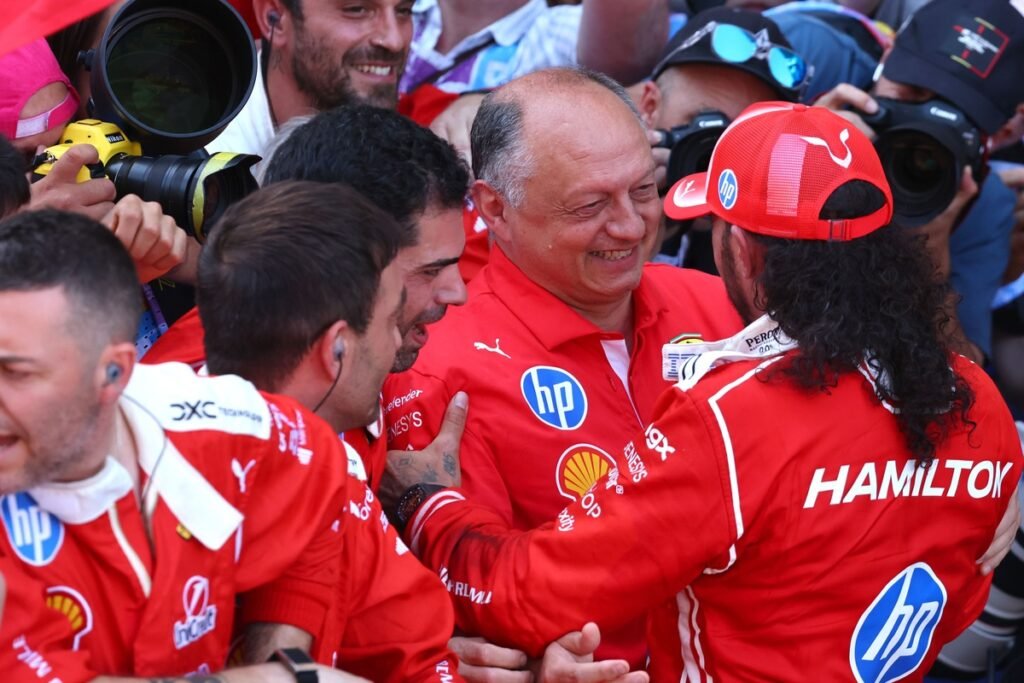
“Well, firstly, I wouldn’t be in this team without Fred,” he said on Sunday in Barcelona during his first press conference as a Ferrari winner. “Fred is the one that made it happen, of which I’m incredibly grateful to him for. I think last year was really, really tough for him to deal with.
“Me coming was a big shock to the system because I am very, very vocal. If I see something that I don’t think is right, or I push very, very hard. That’s at the core of who I am and I’m relentless with it. And I think it’s not easy to be on the receiving end of that when you’re also juggling a whole organisation, you know, and a culture that in its own is set in a certain way.
“And also, you know, he’s French in an Italian culture. It was a lot for him to juggle and I think very, very tough because obviously he would do media as well. But he continued to believe, continued to be a good friend, continued to be a great team-mate and an ally and really supportive.
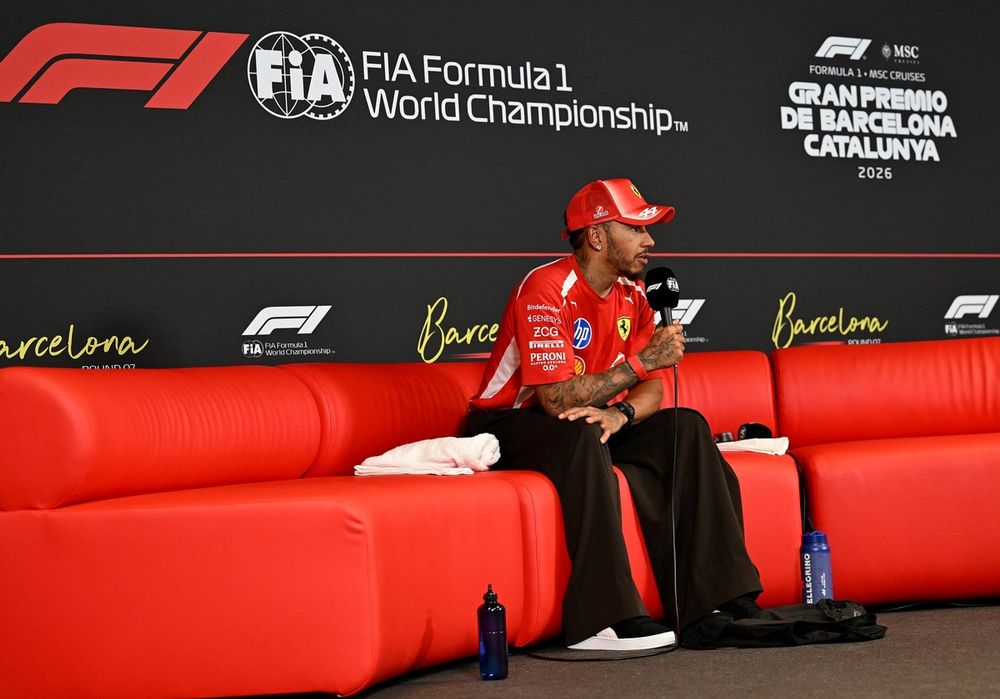
Lewis Hamilton – now a Ferrari race winner
Photo by: Sam Bagnall / Sutton Images via Getty Images
“And, you know, ultimately, he really listened at the end and I had to really ask, really ask for some of the changes. And he enabled them to happen, which I’m forever grateful for, because this [victory] wouldn’t have happened without those changes. So big, big thank you to him.”
When those words were put to Vasseur himself just minutes later, he once again downplayed his role.
“I have zero merit on this,” he insisted. “It’s more Lewis himself, I think. He was able to come back after a tough moment, a tough journey, tough weekends. He was able to come back, to do a full reset and to continue to push, to continue to come to the factory on Tuesday morning. This commitment is a huge support. Coming from a world champion, it’s even more, I would say. It was also a huge motivation for everybody at the factory.”
And that’s understandable too. Because highlighting his own role in Hamilton’s revival isn’t really what a good manager does.
Yet Barcelona’s victory must have been a huge relief for him as well.
Because bringing seven-time world champion Lewis Hamilton to Ferrari was an easy decision.
Continuing to believe in a 40-year-old driver who may already have been past his peak probably wasn’t.