


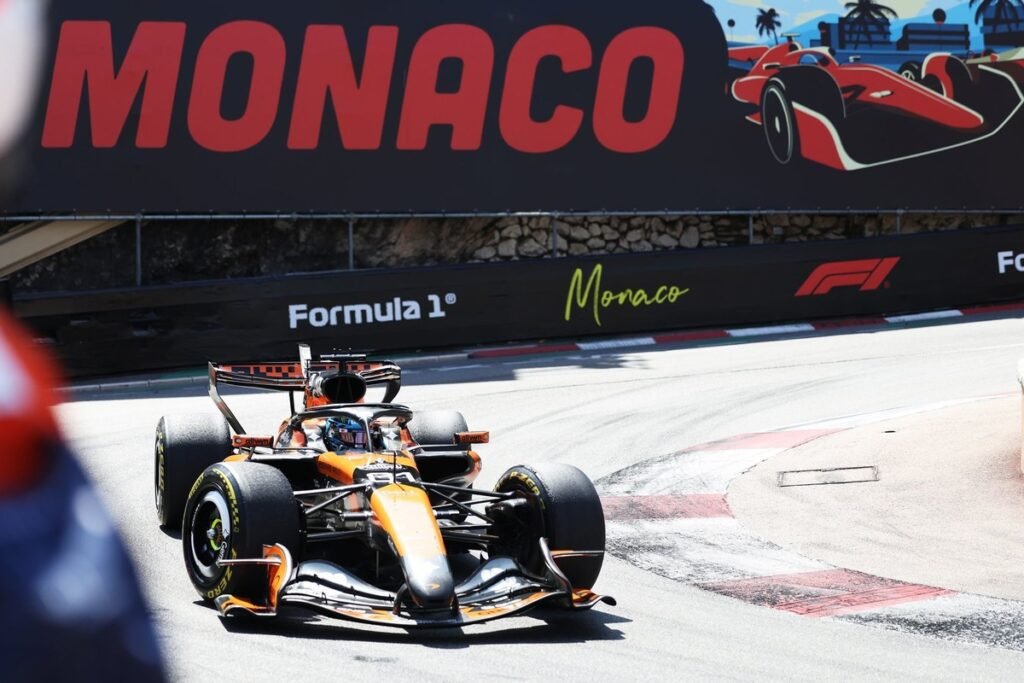
The first stage of Alpine’s Right of Review hearing on Thursday revealed that the unusually high number of pitlane speeding penalties during the Monaco Grand Prix was in fact caused by an issue with the official timing system provided by Formula One Management.
Five drivers were penalised for pitlane speeding during the race, with Pierre Gasly receiving two separate five-second penalties that ultimately cost him a podium finish. Having crossed the line third, the Frenchman was demoted to seventh in the final classification, prompting Alpine to request a Right of Review relating to his penalties.
Only on Thursday, when the stewards published their initial ruling on Alpine’s Right of Review request, did it become apparent that there had indeed been an issue with the timing system.
“FOM, as Official Timekeeping Supplier to the Competition, provided evidence that the distance used in calculating the F1 Official Timing (and hence the pit lane speed) was inaccurate,” the ruling stated.
That ultimately allowed the stewards to admit Alpine’s case, as the information was deemed both significant and unavailable at the time the original penalties were issued.
The stewards must now determine whether Gasly’s two penalties should be revoked. Yet it is unlikely that the outcome of the race will change for the other affected drivers.
While for some, including winner Kimi Antonelli and second-place finisher Lewis Hamilton, the penalties had little impact on the final result, others paid a much heavier price. Among them was George Russell, whose difficult Monaco weekend went from bad to worse after he was penalised for speeding in the pitlane and then received a second, more severe penalty after failing to serve the first one correctly.

Pierre Gasly, Alpine
Photo by: Guido De Bortoli / LAT Images via Getty Images
Oscar Piastri, who was also penalised during the race but still finished fourth after Gasly’s penalties were applied, said it had become apparent to him during the grand prix itself that something was not right.
He also acknowledged that even if Gasly may yet have a chance of recovering his podium should Alpine’s review request succeed, it would be impossible for most of the affected drivers to fully undo the consequences of what happened during the race.
“I think in the race it was reasonably obvious, I thought, that there was something weird going on, because maybe you have one or maybe two cars in the same race to have pitlane speeding penalty, but not seven or eight or however many it was,” he said.
“It’s a shame, because it’s obviously impacted the result of the race for one way or another. I got a penalty, and if I didn’t have that penalty to serve, I wouldn’t have pitted again, so they can’t change the result now, because so many decisions were made in the race based off the penalties that were given.
“But that kind of thing shouldn’t be happening in Formula 1.”
Russell was arguably one of the drivers most heavily affected by the situation.
After a difficult weekend prior to the race, the Mercedes driver received a five-second penalty for speeding in the pitlane. Matters became even worse when a miscommunication within the team led to him receiving a drive-through penalty as well.

George Russell, Mercedes
Photo by: Sam Bagnall / Sutton Images via Getty Images
Russell pitted under the safety car following Lance Stroll‘s crash intending to serve the original time penalty, but Mercedes was not prepared for the stop and failed to carry out the required procedure. As a result, the stewards deemed that the penalty had not been served and issued an additional drive-through penalty.
In their decision, the stewards explained that the harsher sanction was necessary because “there was no attempt to serve the original time penalty”.
They added that the situation differed from cases where a team attempts to serve a penalty correctly but commits a procedural error during the process.
Speaking in Barcelona on Thursday, Russell revealed that after the race was red-flagged following Charles Leclerc‘s crash, he had asked the FIA not to force him to serve the drive-through penalty after the restart and instead apply any additional sanction after the finish – to at least give him a chance to keep the result if an issue with the timing system was discovered later.
“There is nothing I can do now, unlike Pierre, for example, who can maybe get his result back,” Russell explained.
“That’s kind of why I was pleading with the FIA at the red flag to not serve that drive-through penalty and to at least penalise me after the race if they feel that it’s justifiable, because once you serve the penalty there’s no turning back.”
Under the regulations, however, the drive-through penalty had to be served once the race resumed, forcing Russell back into the pitlane and costing him several positions.
While a decision on Alpine’s Right of Review was not issued on Thursday, it is expected during the Spanish Grand Prix weekend.
Even if Gasly succeeds in recovering his podium, Russell’s situation is fundamentally different. Gasly’s penalties were converted into time added after the race, meaning they can theoretically be removed. Russell, by contrast, already served his drive-through penalty during the grand prix itself, making any attempt to restore the positions he lost considerably more complicated.