






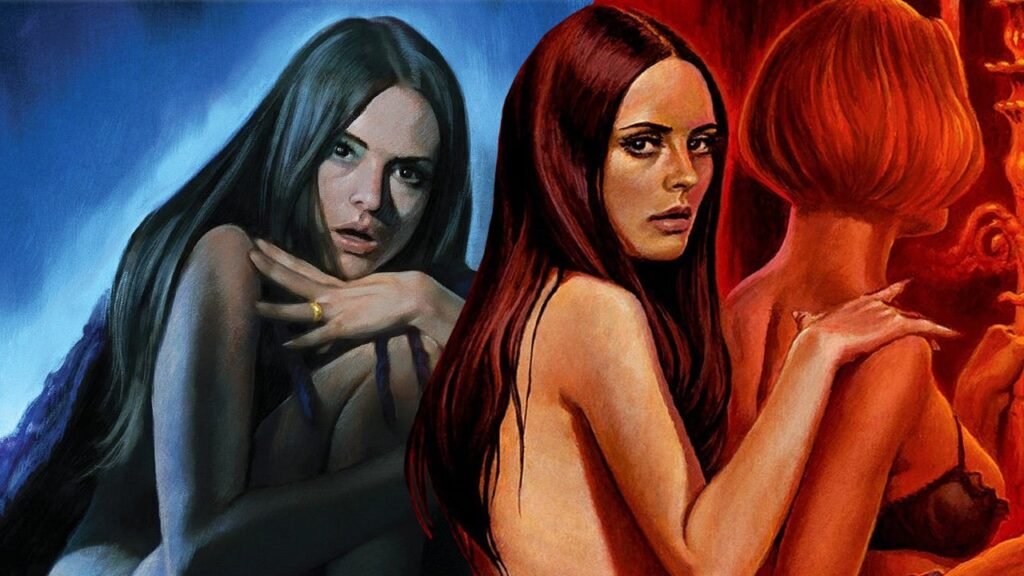

Before exploitation film legend Jesús Franco Manera – usually known as Jess Franco – met arguably his most memorable muse and eventual wife, Lina Romay, he made six films in 1970 with an actress that would surely have appeared in many more if fate hadn’t intervened. Shortly after completing Franco’s The Devil Came from Akasava, Soledad Rendón Bueno – known professionally as Soledad Miranda or Susann (Susan) Korda (Korday) – died in a car accident at the age of 27 (her husband, who was driving, was injured but survived). Franco was devastated, but then he met Romay, and the rest is history. As for Miranda, several of those 1970 productions were released from 1971-1973 and became cult classics that are also regarded as high points in Franco’s oeuvre. Now, Severin Films has released stunning 4K transfers of two of them: Vampyros Lesbos and She Killed in Ecstasy.
Before we take a look at each of these movies individually, let’s look at how both films reflect Franco’s unique voice, and how they preserve Soledad Miranda’s incredible presence for posterity.
Soledad Times Two
Franco is what you might call an acquired taste. I’ve often found him to be closely linked with fellow filmmaker Jean Rollin (they did cross paths once in a while); where Rollin tended to be more poetic, Franco was more exploitative. In these movies, however, there’s more restraint than you might expect, and if you go into a Franco film with the right mindset – expecting more performance art piece than straightforward narrative – you could be in for a good time… certainly an interesting one. While Franco could craft truly artistic moments, he also indulged some of his worst tendencies over the course of a long and controversial career, and the results are the very definition of “cult cinema.”
Franco had more than a passing fascination with the Marquis de Sade, a subject he explores in many other films. In both of these movies, Franco himself plays a character that winds up in a sexually charged torture scene with one of his female leads. But he also demonstrates a real sense of style, displaying spectacular architecture and avant-garde interiors populated by Star Trek-ian Tulip chairs and splashes of red against stark black and white furniture. There are intense close-ups, long takes, and extreme depth in shots that linger in the mind as well as on screen. Franco’s films are indeed a feast for the eyes, but they’re also somewhat…random. And through it all, incongruous jazzy music blares so continuously, you almost expect the go-go dancers to show up; are you ready, boots?
As for Miranda, she has an alluring intensity that buoys both films. While she’s strictly only a vampire in the first film, she plays distinctly vampiric characters in both and arguably exhibits even more vampire-like behavior in She Killed in Ecstasy. In that one, she seems to mesmerize victims against their will, and feeds on Franco’s blood in his obligatory de Sade-esque scene with her.
As we’ve come to expect from Severin, these restorations are immaculate. Franco could never have imagined how absolutely stunning his work would look today, with the saturated colors, lurid lighting, and even the skin texture of his cast (more of which is on display in She Killed in Ecstasy) all presented at a level of clarity and detail that has to be seen to be believed. Let’s take a closer look at each movie…
Vampyros Lesbos (1971)
A gender-swapped soft reboot of Dracula with some Nosferatu-esque shadowplay and Le Fanu’s Carmilla heavily influencing the proceedings as well, Vampyros Lesbos utilizes the impressive architecture and bleak beaches of Turkey and Spain to tell its tragic tale. There are parallels to most of the major Dracula characters, with our lead Linda Westinghouse (Ewa Strömberg) combining elements of Lucy Westenra and Mina Harker, Heidrun Kussin (in a very committed performance) as the Renfield-esque Agra, and Dennis Price’s Dr. Seward as… well, Dr. Seward. He’s also Van Helsing, yet aspires to become a vampire himself. As for his base of operations, he claims to run a private clinic, but it really just seems like a house where he collects unconscious women.
Our Queen of the Night, Countess Nadine Carody (Miranda) – the love of Dracula’s life who now claims her inheritance from the presumably vanquished Prince of Darkness – is not your traditional vampire (and yes, there are many versions of “the rules” in vampirism’s vast pop culture history). She has a reflection, sunbathes with the best of them, walks right in without an invitation, and has no problem with alcohol – as she says (perhaps surprisingly), “I love this red wine.” Her one and only demonstration of actual supernatural power occurs when she teleports into someone’s room; well, there’s other evidence, but I’ll leave that for you to discover.
The film also incorporates (twice!) an in-story cabaret act performed by the Countess and a friend that serves as an overt metaphor for what she’s doing to her enthralled victims. She even bites the other girl in the act in full view of everyone; perhaps Anne Rice saw this before she conceived of her Théâtre des Vampires. Recurring shots of a scorpion also provide some rather overt symbolism about the Countess’ lethal sting and ultimate fate.
Like many other versions of Dracula, this is a tragic love story with a slightly disappointing ending; if only more of these would end like Love at First Bite (1979). And for those who come to this film expecting some racy scenes to match the title: Yes, there is full nudity from time to time, but your appreciation for that aesthetic will depend on how alluring you find it when a naked woman lays down flat and stiff as a board, staring into the middle distance with either a blank expression or one of extreme concern.
Bonus Features: This one is loaded, with not one but two audio commentaries by film experts; a tribute to Franco by Anora’s Sean Baker, who reveals the direct links between this film and Anora; author and Franco historian Stephen Thrower analyzing the film at length and taking us on a tour of shooting locations; interviews with Soledad Miranda historian Amy Brown, who illuminates how much Miranda appreciated the chance to do something substantive here compared to many of her earlier “silly” films, and Franco himself in archival footage, where he credits Expressionism as inspiration for this film and the survival of cinema itself; an extra Franco interview segment that may shock Star Wars fans (Jess is Yoda!); and the German opening titles and trailer.
She Killed in Ecstasy (1971)
Within a month of wrapping production on Vampyros Lesbos, most of the same cast and crew were back to work with Franco on this revenge thriller. A notable addition to the ensemble is Howard Vernon, a regular Franco collaborator who had also appeared in Franco’s The Diabolical Dr. Z (1966) – one of two of the director’s previous films that served as partial inspiration for this one (the other was 1969’s Venus in Furs). If you ever wanted to see Vernon in the all-together – and I sure didn’t – this is your film!
This time around, Miranda is the wife of Dr. Johnson (no first name), who is obsessed with “helping” humanity by engaging in the kind of morally and ethically bereft research that should end anyone’s career. When a medical council sees to it that his work is ended, leading to his suicide and Mrs. Johnson (also no first name) launching a crusade of revenge that takes up the rest of the runtime, the movie seems to want us to side with the dead doc and his aggrieved wife-turned-murderer rather than the authorities that stopped his horrendous experiments. The council members are shown to be corrupt and easily seduced into sin, setting them up for a gruesome demise courtesy of a certain widow who certainly doesn’t wrestle with her husband’s questionable morality. Instead, her devotion is unwavering: She keeps (and presumably preserves?) his body, talks to him in narration throughout, and even gets in bed with his corpse in a scene that should impress you with Miranda’s fearlessness as a performer just as much as it should make your skin crawl. Maybe no one is right in the end; it is a Franco film, after all…
As a showcase for her incredible intensity, this is a better movie for Miranda than Vampyros Lesbos, where she was far more restrained. Her ferocity and facial contortions while slaughtering her prey are something to behold. And although she kills men and women, she is far more brutal with the men, attacking their manhood with animalistic abandon. When she goes after her female victim, Vampyros Lesbos’ Strömberg, it’s almost like she remembers they crossed paths in the previous film; this time she skips the vampyros and goes straight to the lesbos.
Replete in her purple crocheted cape like a stylish Reaper, Mrs. Johnson metes out punishment, observing one intended victim through the fishbowl windows of a bar like one of her husband’s experimental embryos trapped in glass. “Do I look like a killer?” she asks one doomed fellow; “You are the Devil,” he replies, but still succumbs to her charms (viewers are likely to do the same). As for the ending, I’ll leave you to discover how creepily it mirrors reality as Miranda’s character and her dead husband drive off in a car to a fate that will make your blood run cold.
Bonus Features: No audio commentaries on this one, but author Stephen Thrower returns to talk in-depth about the film and tour some locations. The same Amy Brown profile of Miranda from the other movie is included here too, as well as a very short archival interview with actor Paul Müller (who’s in both films), and another archival interview with Franco himself (who displays extraordinary humility about his work but a continued love of cinema). Oh yes, and the German trailer.