






Mary, a veteran Silicon Valley marketer who can’t find a job, considers herself a victim of an H-1B visa program run amok.
Her story, a U.S. native replaced by a foreign-born employee who is willing to work at a significantly lower wage, has become commonplace, particularly in the tech industry. Adding insult to injury, she says, her CEO, who hails from India, told her to train the man he selected to replace her before laying her off.
Despite stints at Google and Cisco and two years of job-hunting, Mary can no longer compete in a job market saturated with foreign-born H-1B visa holders. “I had experience. I should have walked right into these corporate jobs, but I didn’t. Why? Because Silicon Valley is flooded with people who work for two-thirds of the price, or even half price,” said Mary, who asked to be identified only by her first name.
Companies, on average, save nearly $100,000 per worker over six years by hiring an H-1B worker rather than an American.
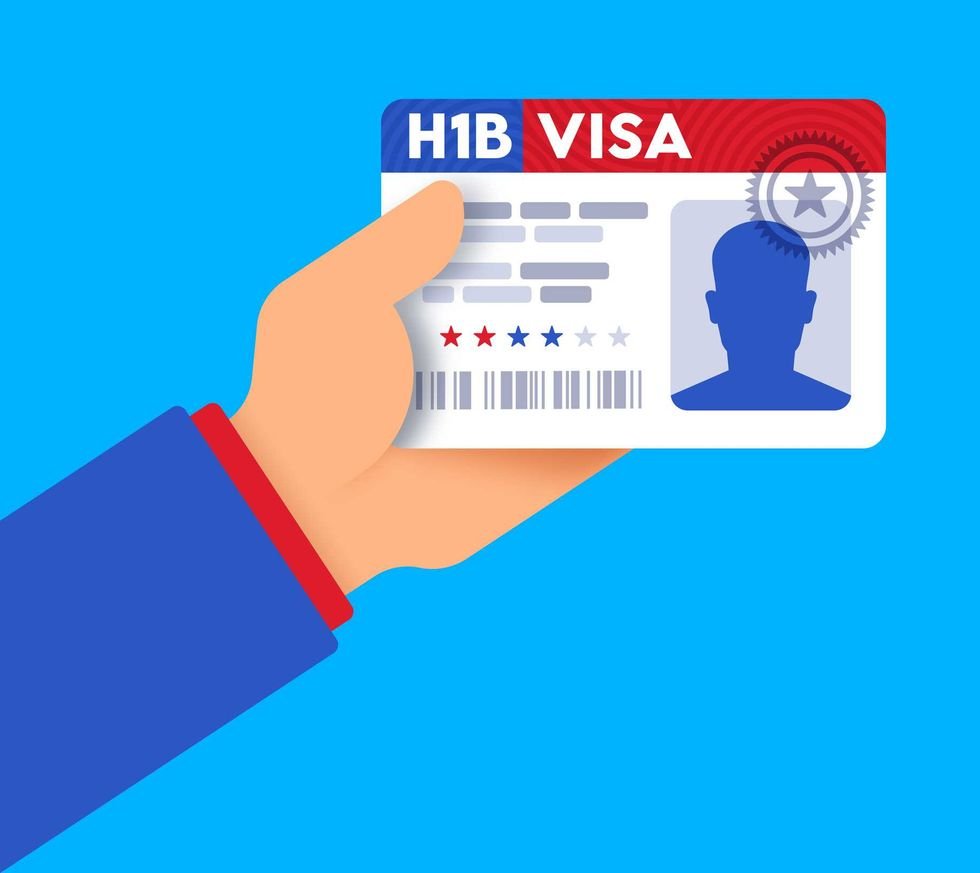
U.S. tech workers like Mary are at the center of a battle brewing in Washington, D.C., over reforming the troubled H-1B visa program, which is designed to fill highly skilled positions when qualified American workers can’t be found. The controversy pits tough-on-immigration Republicans and some Democrats against the most formidable of opponents — Big Tech, the primary beneficiary of a program considered by critics to be little more than a pipeline of cheap labor.
In the last few decades, the California dream has gone global, as U.S. tech firms have filled their ranks and C-suites with employees born abroad. Intel is no longer the company of its founders, Robert Noyce and Gordon Moore, but of Malaysian-born Lip-Bu Tan, its CEO since March 2025. Microsoft is led by Satya Nadella; Alphabet Inc. by Sundar Pichai; Adobe by Shantanu Narayen; IBM by Arvind Krishna; and T-Mobile US by Srinivas Gopalan — all of whom were born in India.
All told, a remarkable two-thirds of the Valley’s nearly 400,000 tech jobs are now held by those born abroad, according to a 2025 report from the think tank Joint Venture Silicon Valley. Today, more tech workers were born in India (23%) and China (18%) combined than in the U.S. (34%).
Low-cost talent
The influx of low-cost Asian talent has clearly helped fuel profits in one of America’s most influential sectors. But there is a downside to this tech boom — the sidelining of U.S. workers thanks to the H-1B visa program. Created in 1990, the federal program has morphed into a vehicle for employers, particularly in the nation’s tech centers, to recruit much cheaper foreign labor at the expense of U.S. tech workers, according to Harvard economist George J. Borjas.
While the H-1B program spans multiple industries, it is overwhelmingly concentrated in tech. Last year, Amazon, Meta, Microsoft, Tata Consultancy, and Google were the biggest visa users, with Amazon alone recording more than 13,000 applications. These companies find the savings from hiring foreign workers hard to resist. The job of software developer, for instance, accounts for 38% of all H-1B visa workers, according to a 2026 paper by Borjas. And these foreign software developers earn about 30% less than their U.S. counterparts, the economist estimates.
Since many of these tech jobs pay six figures, the savings quickly add up. Borjas estimates that companies, on average, save nearly $100,000 per worker over six years by hiring an H-1B worker rather than an American. The arrangement “redistributes wealth from those who compete with immigrants to those who use immigrants,” Borjas wrote in 2016. That, in turn, helps account for the soaring stock prices of Big Tech since the 2008 financial crash.
RELATED: America should eliminate the H-1B and replace it with THIS
 El Nuevo Herald/Getty Images
False rationale
The vaguely written H-1B law has been easy for companies to exploit. Hassan Abdullah, an immigration attorney and H-1B advocate, said the supposed congressional basis of the law — to fill highly skilled jobs with foreigners if Americans aren’t available — has always been a fiction. “The actual regulations don’t necessarily say that’s required,” said Abdullah, who helps companies get the visas. “Throughout all my years, I’ve never had to even consider that as a factor.”
One of the most glaring weaknesses of the law, critics say, is that most companies applying for these visas are not required to demonstrate that they were unable to find qualified American workers. Only companies with more than 15% of their workforce on H-1Bs must make small efforts to recruit U.S. citizens.
Companies are required to pay foreign workers at least the “prevailing wage” for the occupation and region, a provision that should theoretically reduce the incentive to hire employees from Asia. But the process relies on self-reporting and has been easy to manipulate because salaries are calculated using broad regional averages that often fail to reflect real market wages in the technology sector.
As a result, the number of H-1B visa workers has skyrocketed. 2025 was a banner year, with 406,348 approved visas, according to U.S. Citizenship and Immigration Services. Seventy percent of those visas were issued to Indians. That compares with a total of 275,317 visa approvals in 2015.
Missouri Sen. Eric Schmitt, who is part of the MAGA wing of the GOP, reacted to these numbers on X, calling the program “a national security nightmare. Enough. No more flooding the market with 400k+ H-1B visas while our people and our sovereignty gets screwed.”
After foreign-born employees take on leadership roles, including CEO, they attract and hire more foreigners by tapping their own professional and social networks.
With criticism of the visas dovetailing with broader anti-immigration sentiments, the Trump administration has made the most serious move yet to restrict the program. Six months ago, USCIS announced a new $100,000 fee that companies must pay per new H-1B worker living outside the U.S. While official figures have not yet been released, some immigration experts estimate that the fee may lead to a 30% to 50% decline in new visa applications.
“This is the first year we have not filed any H-1B visas for people outside the U.S. because tech companies don’t want to pay the $100,000 fee,” said immigration attorney Navdeep Meamber, who is based in Silicon Valley.
But companies have found a work-around. Meamber said she has seen an increase in the number of clients filing for the visas for workers already in the U.S., particularly those such as students who transferred from other visa types to H-1Bs.
“The $100,000 fee is discouraging some employers from bringing in brand-new H-1B workers, but it is not reducing the numbers, because foreign students, especially those who get on the Optional Practical Training program, can move into the H-1B pipeline without paying that fee,” said attorney Rosemary Jenks, a campaigner for immigration reform with the Immigration Accountability Project. “So there are still plenty of H-1B visas being issued every year.”
American ingenuity
Silicon Valley wasn’t always dominated by foreigners. Some claim the true birthplace of Silicon Valley can be found in a garage at 367 Addison Avenue in Palo Alto. It was there that David Packard, a native of Colorado, and Bill Hewlett of Michigan founded Hewlett-Packard in 1939. Robert Noyce, a native son of Iowa and co-inventor of the integrated circuit, critically made from silicon, gave name to the valley after the substance. With his colleague, Gordon Moore of San Francisco, they founded Intel in 1968.
Throughout the postwar years, America’s booming tech industry was largely pioneered by natives. By the 1980s, however, concerns were raised about the dwindling number of young people available to fill STEM jobs in the future. Erich Bloch, director of the National Science Foundation, told the American Council on Education in 1985: “The pool of potential students from U.S. schools will become smaller. Demographic projections, of which you are all aware, show the number of 18- to 24-year-olds declining by about 20% over the next decade.”
The 1990 Immigration Act created the H-1B visa, a temporary work visa lasting a few years aimed at filling the labor shortages Bloch had warned about. Since then, tech firms have sometimes struggled to find employees, particularly specialized engineers, during times of rapid growth. But whether the industry faces a persistent shortage of American workers is a matter of debate among economists and labor analysts.
Major technology companies reject the criticism that the H-1B system is primarily a source of cheap labor. Executives stress that the program allows American firms to recruit engineers and researchers with advanced technical expertise in areas where qualified talent can be scarce.
They also contend that many H-1B workers are paid high salaries and that access to global talent helps keep American companies competitive against rivals.
Critics of the visas point to waves of layoffs accompanied by the growth in H-1Bs as evidence that a labor shortage is nothing more than a fig leaf. Michael Capuano of the Federation for American Immigration Reform wrote in a blog post last year,
Google laid off 951 U.S. employees in 2024, but found room for 1,058 new H-1B workers. Apple laid off 735 people in 2024, but signed on 864 new H-1B employees. Microsoft laid off 3,426 workers from 2022 to 2024 and hired 3,259 new H-1Bs during that same period.
A 2023 analysis by the Economic Policy Institute similarly found that the top 30 H-1B employers hired more than 34,000 new H-1B workers in 2022 while laying off at least 85,000 employees during the same period.
In addition to cheaper talent, critics say H-1B visas also provide a captive workforce. Because employers can sponsor visa holders for permanent residency, many workers become heavily reliant on keeping their jobs in order to remain in the United States. Critics argue that this dynamic discourages employees from changing companies or demanding higher wages, with some likening the system to a form of indentured servitude.
Tribalism at play
Critics say favoritism has also contributed to foreign dominance of the tech sector. After foreign-born employees take on leadership roles, including CEO, they attract and hire more foreigners by tapping their own professional and social networks.
Kevin Lynn, executive director of the Institute for Sound Public Policy, argues that “professionalism doesn’t exist in these IT departments any more,” adding that “when you look at the hiring, it gets very tribal. It’s really India versus the rest of the world.”
Microsoft saw the number of decisions on H-1B applications rise from 2,983 in 2014, when Nadella became CEO, to 6,258 in 2025. Google’s numbers jumped from 2,309 in 2015, when Pichai took the top job, to 7,868 in 2025. During these years, these companies also grew, making it hard to know if the percentage of foreign workers increased. At IBM, H-1B decisions have remained consistent since Arvind Krishna was named the leader.
Meamber, the immigration lawyer, disputes the idea that companies run by foreign-born leaders are more likely to rely on labor from their home countries. “The CEO doesn’t even know who is being hired. … These decisions are being taken at a lower level by the HR team and by the recruiters,” she said.
Stephen Vivien, an engineer, said he witnessed Indian employees helping each other get hired by sharing interview questions when he worked at Google. “There were a lot of H-1B workers … there’s a network.” he said.
“When one Indian guy would be coming up for his interview; the other Indian guys who had [already] gotten hired would call and share the questions.”
RELATED: America didn’t lose its tech edge — globalist CEOs gave it away
 Dhiraj Singh/Bloomberg/Getty Images
In April, a New York jury found New Jersey-based Cognizant Technology Solutions liable for $8.4 million after a former executive sued the company, which was founded in India, for discrimination against non-Indian and non-South Asian workers. The executive argued he was passed over for a promotion and was later fired for raising concerns about bias against non-Indian employees.
The decision follows a separate successful lawsuit brought by three other employees against Cognizant in 2017, all similarly claiming discrimination against non-Indian workers, though the company is appealing and denies all allegations. In both lawsuits, juries found in favor of claims that Cognizant had used the H-1B program as a tool to discriminate against American workers. Since 2009, the company has received tens of thousands of H-1B visa approvals.
Reformers vs. Big Tech
While restrictions to the program have yet to meaningfully slow its growth, some Republicans have called to abolish it. In February, Florida Rep. Greg Steube (R) introduced the EXILE Act, which would end the H-1B visa program entirely.
A proposed reform that might gain more bipartisan support targets the ineffective prevailing wage requirement that allows firms to underpay foreign workers. One idea floated by Republicans would create a minimum salary requirement for H-1B workers that is much higher than the current pay scale, thus removing the financial incentive to replace U.S.-born workers.
Ro Khanna, the Democrat congressman representing much of Silicon Valley, said on the “All-In” podcast last year that “there’s definitely abuse. … It needs to be corrected” in the H-1B program. Khanna said a new prevailing wage standard would be a reform he could support.
But legislation that would raise labor costs would be opposed by Big Tech, armed with its war chest of money and influence in Washington. Jenks, the lawyer, said H-1B reformers face a tough fight. “The donors on this issue include all of the high-tech companies, whether it’s Microsoft, Facebook, all of them,” she said. “They put millions and millions of dollars every year into lobbying.”
Editor’s note: This article was originally published by RealClearInvestigations and made available via RealClearWire. The article was reported in conjunction with a GB News documentary, which can be viewed here.