Skip to content








Trump’s Visit to China Emphasizes American Strategic Weakness
Who looks like a winner here?
When Donald Trump exploded into national politics a decade ago, he had two characteristic policies: the Wall, that is to say, immigration enforcement; and “China, China, China,” that is to say, reorienting American relations with a large, ambitious, and increasingly wealthy and powerful competitor.
Few would say that the first Trump administration was a total success, but at the level of theory there was a certain coherence to it. On the China side of things, Elbridge Colby articulated the line of thought in the 2018 National Defense Strategy and his book-length elaboration on it, The Strategy of Denial. The U.S., Colby wrote, should boost its partnerships in the Indo-Pacific to prevent China from establishing hegemony in the region. Corollaries were a deemphasis on the Middle Eastern theater, which is not enormously important for American interests, and a real defense buildup, particularly a naval buildup—getting the number of ships from under 300 to something in the ballpark of 400, with an emphasis on vessels for littoral combat so the U.S. could credibly contest an effort to take Taiwan by force.
A temporarily painful industrial decoupling from China would give the U.S. the independent industrial base it would need to build up its defense for deterring Chinese expansion, while at the same time lowering the stakes of Chinese expansion if it could not be contained. American assessments suggested China would be in a position to take Taiwan by force between 2025 and 2030, and a broad consensus settled on 2027 as the year to be ready for.
Time passed. A request for information on constructing several new frigates went out from the Pentagon in 2017, and Fincantieri won the contract in 2020. The theory was to buy a fast, off-the-shelf solution to the ships problem, particularly the littoral combat problem. The Pentagon doesn’t roll that way, though, and the project became bogged down in the interminable bloat and inefficiencies that dominate the post-Clinton military–industrial complex. The Navy today is pretty much exactly where it was in 2016: under 300 ships. While there are virtues to the second Trump administration’s new shipbuilding program, it is simply too late if you think we have to deter or fight a war in Taiwan by 2030.
Nor has retrenchment from the Middle East gone particularly smoothly. Yes, the U.S. has pulled troops out of Syria and Iraq, but we’re now tied down in an expensive war with Iran that so far has proved resistant to easy resolution. This war has directly cannibalized the existing American assets in Asia: Carrier groups and missile systems have been redomiciled from South Korea to the Persian Gulf region. The stockpiles of American armaments have been chewed through with stupendous abandon, and, irrespective of the Pentagon’s sweaty demands for immediate increases to production, it will take time for them to be restored to the already low pre-war levels.
What about industrial decoupling? This has proved somewhat more encouraging; the U.S. trade deficit with China dropped hard in 2025. Yet certain key elements in the U.S. economy, particularly rare earth minerals and their derivative products, remain stubbornly reliant on Chinese supply chains, resulting in the brokering of a “truce” in the Chinese–American trade war of Trump’s second term.
The overall picture of Chinese–American competition, then, is mixed, tending toward bad—tending toward very bad, even. The administration even seems to have tacitly accepted that our time has run out and we haven’t completed the assignment; hence the reorientation of the new National Security and National Defense Strategies toward the Western Hemisphere. The United States has proven incapable of getting out of its own way, of pursuing the tactical means required for a strategy of peer competition. We have spent the past decade twiddling our thumbs and have little to show for it.
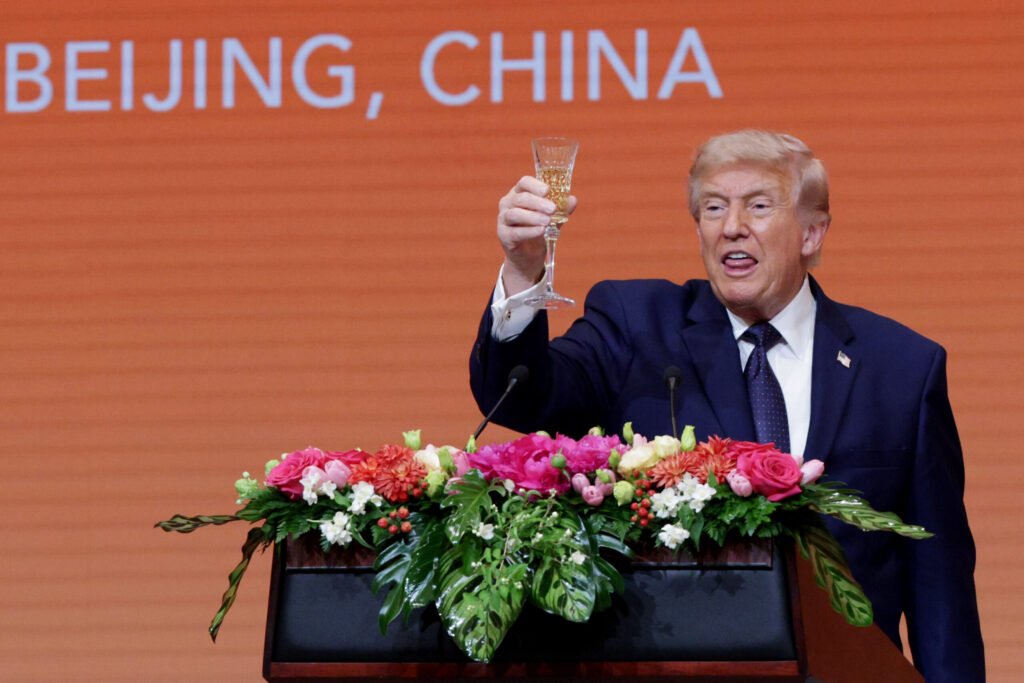
So it’s difficult not to look at President Donald Trump’s visit to Beijing this week and feel kind of bummed out. Xi Jinping said that he doesn’t want an Iranian tollbooth in the Hormuz, which is good, I guess, but it’s embarrassing that the administration is treating China getting on board with our position as manna from heaven. It’s embarrassing that Xi is decreeing what and what will not happen with Taiwan without response from the president. It’s embarrassing that Marco Rubio is cheering for the Chinese government’s interior design. When the gang gets home and sleeps off the jetlag, well, we’re still going to be at war in a peripheral theater (one that looks like it hurts us more than it hurts China, by the way, whatever the big brains on Twitter are saying), a subpar navy, and a largely compromised economy. It’s hard not to feel that China is very serious, and we are not.
The nature of the rise of American hegemony—that is to say, fundamentally, the fact that the United States was the only Western power that was exempted from the economic devastation of the Second World War—means that a decline in relative power was predetermined. The United States has never had as much relative power as it did in 1946, when it was the only nuclear power with an intact industrial economy, not to mention the lion’s share of the world’s capital. Canny management (particularly the dollarization of the world economy) and some luck meant, however, that the recovery of Europe and the Cold War did not end American primacy, despite occasional embarrassments like De Gaulle’s battleships and the Vietnam War. The nature of the modern global economy means that the quantum of American primacy will always grow harder to maintain, which has two points: American core interests should be disentangled from American primacy, and Americans must be wiser and more jealous of their quantum of primacy.
When your airplane’s engine is giving out, you have a choice—a controlled landing or crashing. Sudden hegemonic collapses are rarely pretty. Do you think American leaders can land the plane?
The post Trump’s Visit to China Emphasizes American Strategic Weakness appeared first on The American Conservative.