Skip to content










As NASA looks to explore the Moon, Mars, and beyond, researchers must develop materials capable of withstanding the extreme temperatures found in space and on other planets and their moons. In frigid conditions, rubber can shatter like glass, circuit boards may fail, and electrical connections can freeze and fracture.
Gaining a deeper understanding of how materials respond to these temperature extremes is critical — especially as NASA looks to build its Moon Base at the lunar South Pole, where surface temperatures swing dramatically from blistering heat during the day to bitter cold at night. Researchers developed a ground-breaking method for testing how materials hold up in the extreme cold of space. Engineers at NASA’s Glenn Research Center in Cleveland invented the Lunar Environment Structural Test Rig (LESTR), a machine that can test materials, electronics, and other flight hardware at temperatures as low as 40 Kelvin, or about –388 degrees Fahrenheit.
“Just as no building ever gets built without knowing exactly how the construction materials behave, no space mission is complete without a robust structural design that hinges on knowing how the materials used within it behave,” said Ariel Dimston, technical lead for LESTR at NASA Glenn.
Traditionally, NASA has used a process that involves super-cold liquids — called liquid cryogens — to test how materials respond to extreme cold. These liquids, like nitrogen, hydrogen, and helium, are some of the coldest materials on Earth and are stored in specialized tanks. Engineers use them to chill materials during testing and collect data to see how they perform.
“What makes LESTR special is that the entire rig operates in a completely dry vacuum: no liquid nitrogen, no liquid helium, no liquid anything,” Dimston said. “This is the first mechanical test rig that escapes from all of the challenges involved with cryogenic fluids.”
LESTR takes a new approach by using a high-powered refrigerator, called a cryocooler, to remove heat without using any liquid at all. This creates the first “dry” cryogenic test environment within the mechanical testing industry. This new test rig is safer and more affordable than traditional methods and allows scientists to test materials at a much wider range of temperatures, Dimston said.
“By leaving behind the liquid cryogen, you no longer need specialized handling equipment such as dewers, wet heaters, nor valves,” Dimston said. “You no longer require oxygen displacement sensors and other safety systems that add time, complexity, and cost to the process since without these cryogens they are no longer needed.”
Dimston and his team are working with NASA programs and projects to put materials through their paces using the new apparatus. The team has been testing yarns that may someday be woven into fabrics used for next-generation spacesuits and is looking to develop advanced materials for rover tires, including a new metal that can return to its original shape after being bent, stretched, heated, and cooled. This shape memory alloy technology could help future rovers travel across the uneven, rocky surfaces of the Moon and Mars without the risk of flat tires.
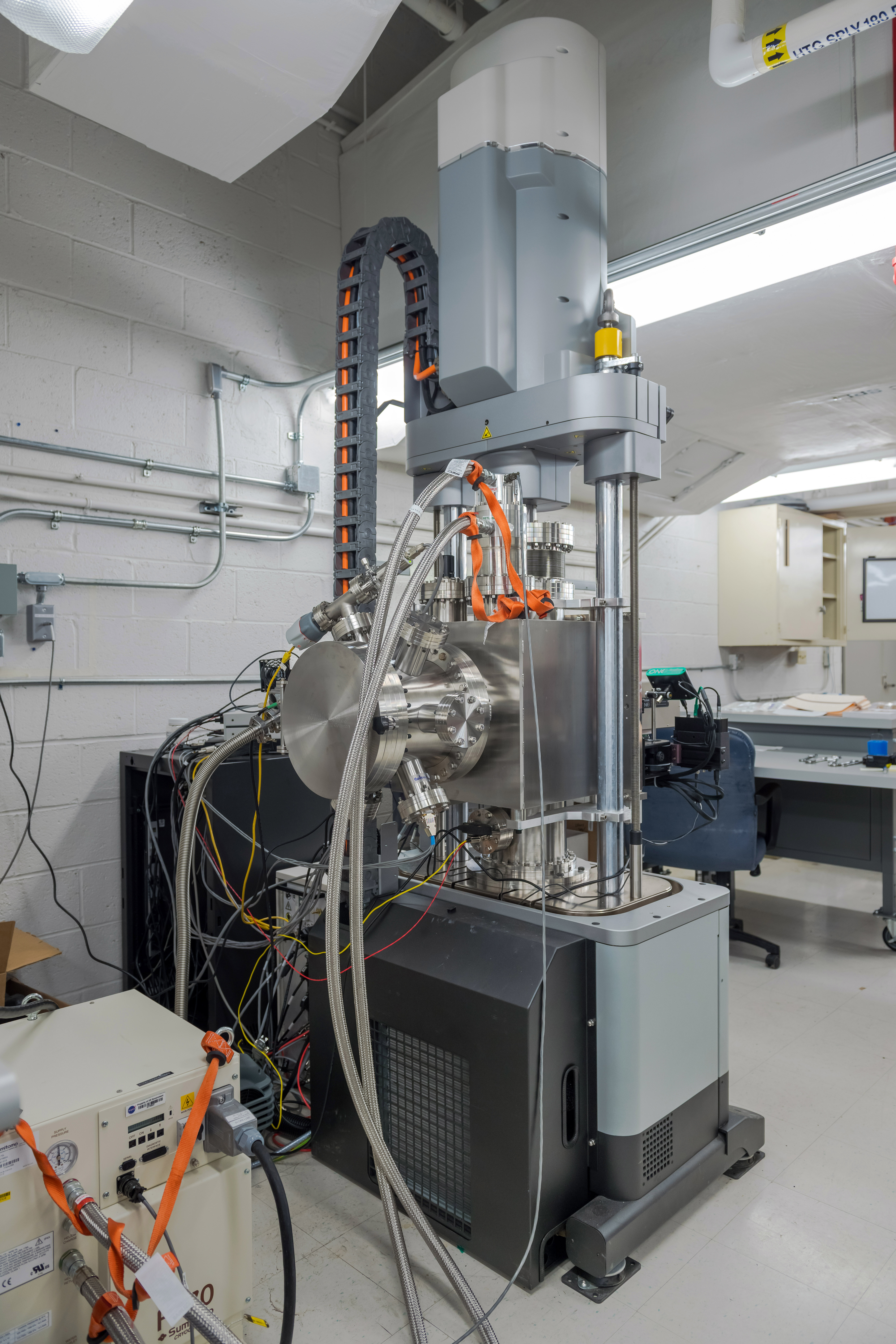
NASA researchers spent more than two years designing and building the first version of the technology — LESTR 1 — and are currently building its twin, LESTR 2. In a partnership with Fort Wayne Metals, NASA delivered LESTR 1 to the company’s facility in Fort Wayne, Indiana, where experts there will use it to test shape memory alloy material for the extreme temperatures present on the Moon.
“We are working to develop a next-generation shape memory alloy that is capable of functioning at temperatures down to 40 Kelvin, one of the coldest regions we could go to with rover capability,” said Dr. Santo Padula II, principal investigator for LESTR at NASA Glenn. “With this rig, we can test how shape memory alloys will behave in the coldest areas of the Moon and Mars. That will be a very big day for us: to be able to see what its properties look like at such low temperatures — something we’ve never seen before.”
Beyond LESTR, NASA Glenn has other world-class ground test facilities that mimic environments like the vacuum of space, the microgravity aboard the International Space Station, the sulfuric pressure cooker that is Venus, or the terrain of the Moon and Mars.
Glenn leads the agency in both advanced materials testing and in-space cryogenic fluid management, playing a vital role in developing technologies for future space exploration.
For more information on Glenn’s new test rig, visit LESTR’s web page.